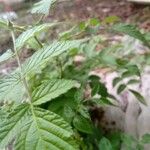
Rubus niveus
Hill raspberry · Mysore raspberry · Ceylon raspberry · Snowpeaks raspberry
Description
Source: leafsnapRubus niveus, commonly known as the Mysore raspberry or hill raspberry, is a flowering plant species in the rose family. Native to the Indian subcontinent and Southeast Asia, it has also been introduced worldwide as an ornamental plant. This plant typically grows up to 2 meters tall, featuring thorny stems and green leaves divided into three leaflets. The flowers, which bloom from late spring to early summer, are white or pinkish. These are followed by edible, though tart, red or yellowish-orange berries. Rubus niveus prefers moist soil and partial shade but can thrive in various growing conditions. It is often used for erosion control on hillsides due to its ability to spread quickly through underground runners called rhizomes. While it can be invasive in some areas, the plant is also valued for its medicinal properties, as it contains antioxidants and anti-inflammatory compounds that may offer health benefits when consumed in moderation.
Care Guide
💧 Water Every 7 days
The Mysore raspberry flourishes in moist, tropical understory environments and benefits from regular watering, though it can tolerate brief dry spells. Watering once a week is ideal for promoting lush growth. As an evergreen plant, maintaining a consistent watering schedule is essential for sustaining its foliage throughout the year, especially when grown outdoors where it can also receive natural rainfall.
☀️ Light Full sun
The Mysore raspberry comes from open settings like bright meadows and edges of forests, which provide plenty of sunlight. It flourishes in complete sunlight but can also withstand partial sunlight, showing good adaptation to different light conditions.
What are the sunlight requirements for Mysore raspberry (Rubus niveus)?
Mysore raspberry, also known by its botanical name Rubus niveus, flourishes under specific sunlight conditions. For robust growth, it requires a full sun exposure of above 6 hours of sunlight daily. However, it can also tolerate partial sun, which amounts to about 3-6 hours of sunlight each day. It's important to observe the movement of sunlight through your garden to find spots that offer an ideal balance of light and shade, ensuring the plants' health and happiness.
🌡️ Temperature 15–37.8°C
The Mysore raspberry thrives in areas with a moderate climate, preferring temperatures between 59 and 100.4°F (15 to 38°C). To acclimate the plant to colder or hotter conditions, gradual changes in temperature are required. Pay attention to the changing seasons and make adjustments as needed.
What is the native climate for Mysore raspberry?
Mysore raspberry, known botanically as Rubus niveus, thrives in regions with a moderate climate. It prefers temperatures ranging from 59 to 100.4°F (15 to 38°C). To adapt the plant to cooler or warmer conditions than its native environment, gradual temperature adjustments are necessary. It's important to be mindful of the changing seasons and adjust the care of your Mysore raspberry plant accordingly to ensure its health and productivity.
💨 Humidity
🪴 Soil 5-6
🌱 Fertilizer
For optimal fruit yield, the Mysore raspberry plant necessitates ample nutrients. Administer fertilizers in the beginning of spring to encourage the development of new growth and blossoms. Frequent fertilization supports the plant's health, enhances the production of tastier fruit, and avoids problems related to nutrient deficiencies such as foliage discoloration and inferior fruit yield.
🪴 Pot & Repot Every 12 months
✂️ Pruning
The Mysore raspberry is a thorny shrub known for producing sweet berries. To maintain its health and boost berry production, it is crucial to prune it annually. This entails removing dead canes and encouraging new growth from early winter to late winter. Such pruning improves air circulation, prevents disease, and contributes to better berry yield and the overall health of the plant.
🌿 Propagating
🐛 Diseases & pets
☠️ Toxicity
Characteristics
- Plant Type
- Shrub
- Life Cycle
- Perennial
- Genus
- Rubus
- Family
- Rosaceae
- Hardiness Zone
- 8-11
- Mature Height
- 0.91 m to 2.44 m
- Mature Spread
- 0.91 m to 2.13 m
- Leaf Color
- Green
- Leaf Type
- Evergreen
- Flower Color
- White, Pink
- Flower Size
- 1.02 cm
- Bloom Time
- Summer, Early fall, Mid fall
- Planting Time
- Spring, Summer, Autumn
- Harvest Time
- Late summer, Fall, Early winter
- Native Area
- Nepal, Sri Lanka, Afghanistan, India, Malaysia, Kazakhstan, Indonesia, Vietnam, Myanmar, Philippines, Bhutan, Pakistan, Laos, Thailand, China