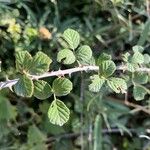
Rubus sanctus
Holy bramble
Description
Source: leafsnapRubus ulmifolius subsp. sanctus, commonly called holy bramble, is a bramble native to parts of Asia and Europe.This plant is very long-lived. An instance of it can be found at the Chapel of the Burning Bush on Mount Sinai, where it is revered as the original burning bush of the Bible. This longevity and location lead to its Latin name.
Care Guide
💧 Water
Originating from arid regions, holy bramble is highly drought-tolerant and thrives with minimal moisture. It should be watered every 2 to 3 weeks, allowing the soil to dry out between watering sessions. Typically found in rocky terrains, the root system of holy bramble is efficient at absorbing the scarce rainfall available during its active growing season.
☀️ Light Full sun
Holy bramble is native to open habitats, such as sunny meadows and forest margins, where abundant light is available. It does best in Full Sun but can also tolerate Partial Sun, adjusting well to a range of sunlight conditions.
What are the sunlight requirements for Holy Bramble (Rubus sanctus)?
Holy Bramble, or Rubus sanctus, thrives best in conditions that match its sunlight requirements. For optimal growth, Holy Bramble plants require 'Full sun,' which means they need to be exposed to more than 6 hours of sunlight daily. However, they can also tolerate 'Partial sun,' needing about 3 to 6 hours of sunlight each day. It's important to observe the movement of sunlight through your garden carefully to identify spots that offer a good balance of light and shadow. This ensures your plants remain happy and healthy.
🌡️ Temperature 5–35°C
Holy bramble is highly adaptable to a variety of climate conditions, from blazing summers to cold winters. It does, however, have a preferred temperature range for growth. If temperatures rise too far, the plant becomes vulnerable to heat and humidity stress, which can cause it to die. In areas where temperatures near the lower bound of its cold tolerance, insulating measures should be used to protect the plant.
What is the common name of Rubus sanctus?
The common name of Rubus sanctus is Holy Bramble.
What botanical name does the Holy Bramble go by?
The Holy Bramble goes by the botanical name Rubus sanctus.
💨 Humidity
🪴 Soil 6-7
🌱 Fertilizer
The Holy bramble plant needs adequate nutrients to achieve optimal fruit production. Fertilize in early spring to promote new growth and flower development. Regular fertilization keeps the plant healthy, encourages more flavorful fruit, and prevents nutrient-deficiency problems like yellowing leaves and poor fruit set.
🪴 Pot & Repot
✂️ Pruning
Holy bramble, known for its thorny stems and edible berries, thrives when pruned annually in early spring. To encourage better air circulation and increase fruit yield, remove dead canes and thin out the older growth. Regular pruning helps manage the plant's vigorous growth, preventing overcrowding and resulting in a healthier, more productive plant.
🌿 Propagating
🐛 Diseases & pets
☠️ Toxicity
Characteristics
- Plant Type
- Shrub
- Life Cycle
- Perennial
- Genus
- Rubus
- Family
- Rosaceae
- Hardiness Zone
- 5-9
- Mature Height
- 2.13 m
- Mature Spread
- 0.91 m to 6.1 m
- Leaf Color
- Green
- Leaf Type
- Deciduous
- Flower Color
- White, Pink
- Flower Size
- 2.03 cm to 3.05 cm
- Bloom Time
- Late spring, Early summer, Mid summer
- Planting Time
- Spring, Summer, Autumn
- Harvest Time
- Mid summer, Late summer, Early fall
- Native Area
- Saudi Arabia, Libya, Egypt, Turkey, Montenegro, Cyprus, Pakistan, Bulgaria, Armenia, Croatia, Slovenia, Greece, Lebanon, Russia, Serbia, Afghanistan, Iraq, Syria, Iran, Albania, Azerbaijan, Turkmenistan