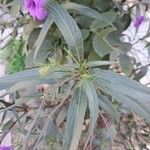
Ruellia angustifolia
Mexican Bluebell · Mexican petunia
Description
Source: wikipedia (CC BY-SA)Ruellia is a genus of flowering plants commonly known as ruellias or wild petunias. They are not closely related to petunias (Petunia) although both genera belong to the same euasterid clade. The genus was named in honor of Jean Ruelle (1474–1537), herbalist and physician to Francis I of France and translator of several works of Dioscorides.
🌳 Although the Mexican petunia is mainly appreciated for its ornamental appeal, it fulfills an important ecological function as a larval host for several butterfly species, including the Common Buckeye, creating a living tapestry of fluttering colors. Its low maintenance needs and rapid growth make it an excellent choice for ecological landscaping to support butterfly populations and help maintain a balanced ecosystem.
🎭 Bitterness, Fury, Making peace, Your presence comforts me.
Care Guide
💧 Water
☀️ Light Full sun
Mexican petunia thrives best in sun-rich zones for the most favorable growth. While it can survive in less bright areas, continual sunlight exposure promotes a healthier growth cycle. Its native habitat reflects this light level, boosting its liveliness. Inadequate light might hinder its growth, while too much sunlight could lead to the paling of the leaves.
🌡️ Temperature 15–37.8°C
Mexican petunia primarily grows in temperatures between 59 and 100 ℉ (15 to 38 ℃), yet it can withstand temperatures as low as 40 ℉ (4.4 ℃). It flourishes in hot conditions and especially appreciates temperatures about 77 ℉ (25 ℃). In the event of cold weather, it is advisable to relocate the plant indoors or shield it to safeguard it from frosty temperatures.
💨 Humidity
🪴 Soil 5-7
🌱 Fertilizer
Usually, a single dose of fertilizer applied in spring is adequate for Mexican petunia, though you can enhance growth by fertilizing it several times. It's recommended to feed it once every 30 to 45 days. The process of fertilization improves the look and functionality of the leaves, encouraging a uniform color and a healthy feel. Moreover, it spurs the growth of roots and the absorption of nutrients, which contributes to the enduring health of the plant.
🪴 Pot & Repot 2-3 years
For repotting a Mexican petunia, select a pot that is 1-2 inches (2.5-5 cm) larger and has sufficient drainage. Opt for a potting mixture with good drainage capabilities. Carry out the repotting process during spring or autumn, and make sure the root ball is positioned slightly below the rim of the flower pot. Make sure to water it properly after the repotting and keep it in a warm location that receives indirect sunlight.
✂️ Pruning
🌿 Propagating
🐛 Diseases & pets
☠️ Toxicity
Characteristics
- Plant Type
- Herb
- Life Cycle
- Perennial
- Genus
- Ruellia
- Family
- Acanthaceae
- Hardiness Zone
- 8-11
- Mature Height
- 91 cm
- Mature Spread
- 30 cm to 61 cm
- Leaf Color
- Green, Purple
- Leaf Type
- Evergreen
- Flower Color
- Purple, Lavender
- Flower Size
- 7.62 cm
- Bloom Time
- All year round
- Planting Time
- Spring
- Harvest Time
- All year round
- Native Area
- Uruguay, Cuba, Paraguay, Argentina, Haiti, Mexico, Honduras, Guatemala, Bolivia, Venezuela, Peru, Brazil, Dominican Republic, Costa Rica, Jamaica