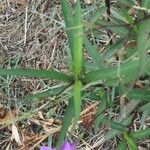
Ruellia nudiflora
Violet wild petunia · Wild petunia
Description
Source: leafsnapRuellia nudiflora, commonly known as violet ruellia or wild petunia, is a perennial herbaceous plant in the Acanthaceae family. Native to North America, it thrives in a variety of habitats, including prairies, meadows, and open woods. This plant can reach up to 3 feet in height and features lance-shaped leaves arranged oppositely along the stem. The trumpet-shaped flowers of Ruellia nudiflora, adorned with five petals, exhibit hues ranging from violet-blue to purple. These blossoms appear from June to September, attracting a variety of pollinators such as bees, butterflies, and hummingbirds. Traditionally, Native Americans have utilized Ruellia nudiflora for its anti-inflammatory properties, employing it in treating ailments like fever, coughs, colds, and headaches. Easy to cultivate, this plant thrives in well-drained soil with full sun or partial shade. It requires moderate watering during its growing season but can withstand drought conditions once established. Overall, Ruellia nudiflora is an attractive wildflower that enhances gardens and natural landscapes with its vibrant colors and also offers medicinal benefits.
🌳 Violet wild petunia is not commonly known for use in everyday products or industrial applications. Nonetheless, one of its lesser-known but important roles is supporting local ecosystems. It provides a valuable nectar source for pollinators such as bees, butterflies, and hummingbirds. This indirectly helps with crop pollination and the preservation of plant diversity. The presence of violet wild petunia can indicate a healthy, biodiverse environment, which is crucial for ecological balance and the survival of various wildlife species.
🎭 Bitterness, Ire, Your presence calms me.
Care Guide
💧 Water Every 7 days
The violet wild petunia flourishes in areas with moderate rainfall, needing weekly watering for optimal growth. While it thrives best with consistent moisture, it can tolerate short periods of dryness. Rainwater is particularly beneficial to the violet wild petunia, as it enhances hydration and supports its natural growth cycle. As an outdoor herbaceous perennial, this plant relies on these conditions for healthy development.
☀️ Light Partial sun
Violet wild petunia flourishes under moderate sunlight exposure, but also possesses the ability to withstand both strong and weak light conditions. Its origin is traced back to areas with diverse sun exposure, highlighting its flexibility. Nevertheless, an excess or deficiency of light can impact its well-being, leading to growth problems.
What are the sunlight requirements for Violet Wild Petunia (Ruellia nudiflora)?
Violet Wild Petunia thrives in moderate sun and can adapt to various light conditions, from intense sunlight to minimal light. It requires about 3-6 hours of sunlight daily for partial sun and more than 6 hours for full sun exposure. However, it's crucial to note that the plant's health might be compromised if it receives too much or too little light. To ensure its well-being, it's important to observe the movement of sunlight through your garden and select spots that offer a harmonious balance of light and shade.
How can artificial lighting benefit indoor plants like Violet Wild Petunia?
Artificial lighting can be an invaluable solution for indoor plants, especially when natural sunlight is insufficient, such as during winter or in less sunny spaces. It promotes faster and healthier growth. LED lights are a popular choice as they can be customized to offer specific wavelengths needed by your plants. For full sun plants, 30-50W per square foot is recommended; partial sun plants need 20-30W per square foot, while full shade plants should have 10-20W per square foot. The artificial light source should be placed 12-36 inches above the plant to mimic natural sunlight and turned on for 8-12 hours per day to simulate natural daylight hours.
What symptoms indicate insufficient sunlight for indoor Violet Wild Petunia?
When Violet Wild Petunia is grown indoors with insufficient light, several symptoms can appear, signaling light deficiency. These include smaller new leaves compared to older ones, leggy or sparse growth with longer spaces between leaves or stems, premature leaf drop to conserve resources, slowed or halted growth, and lighter-colored or pale new leaves. Additionally, chlorosis, sunscald, leaf curling, wilting, and leaf scorching can occur due to inappropriate light levels, ranging from excessive sunlight to severe shade.
What solutions are available to address sunlight-related issues for Violet Wild Petunia?
For indoor Violet Wild Petunias, it's beneficial to gradually shift them to sunnier spots each week until they receive 3-6 hours of direct sunlight daily, allowing for gradual adaptation. If moving the plant is not viable, consider using artificial light sources like desk or ceiling lamps for at least 8 hours daily, or invest in professional grow lights for sufficient lighting. Outdoors, gradually move your plants to sunnier locations each week to prevent sunburn, avoiding sudden changes in light intensity. If sunlight is blocked by obstacles like trees, consider pruning to increase sunlight penetration. For smaller plants, transplanting during their dormant period to a more sunlight-adequate location may be helpful. Note that parts of the plant damaged by insufficient light may not recover, but new growth should be healthy post-adjustment.
🌡️ Temperature 15–37.8°C
The native habitat of the violet wild petunia generally has a climate that is hot to warm, with temperatures fluctuating between 59 and 100℉ (15 to 38℃). This vegetation is partial to temperatures ranging from 59 to 86℉ (15 to 30℃) and might need particular adjustments during more scorching seasons. For the best growth outcome, it is recommended to offer a slight shade or water during intensely hot summertime.
What are the ideal growing conditions for Violet Wild Petunia?
Violet Wild Petunia (Ruellia nudiflora) flourishes in environments with warm to hot temperatures, ideally ranging from 59 to 86 °F (15 to 30 °C). While it can tolerate temperatures up to 100 °F (38 °C), providing light shading or irrigation during the hottest parts of summer can promote optimal growth. This plant also has some cold tolerance and usually does not need special care if temperatures stay above -5°C. However, if temperatures are expected to fall below -5°C, it's recommended to protect the plant temporarily with materials like plastic film or fabric.
How does Violet Wild Petunia react to low temperatures?
Violet Wild Petunia has a moderate tolerance to low temperatures and thrives best when the temperature remains above 15°C. If the temperature drops below -5°C, it may still survive without special care, but temperatures below -10°C can cause the leaves to droop and eventually lead to wilting and leaf drop in severe cases. To protect the plant from frost damage, you can trim off the frost-damaged parts and wrap the plant with non-woven fabric or cloth, also considering the construction of a wind barrier to shield it from cold winds.
What should be done if Violet Wild Petunia experiences high temperatures?
During the summer, it's crucial to ensure that Violet Wild Petunia is not exposed to temperatures above 38°C, as extreme heat can cause the leaves to lighten in color, dry out at the tips, curl, and increase the risk of sunburn. To mitigate these effects, remove any sunburned or dried-up parts of the plant. Relocate the plant to a shaded area during the most intense sunlight hours or use a shade cloth to protect it. Additionally, watering the plant in the morning and evening will help keep the soil adequately moist and cool.
💨 Humidity
🪴 Soil 6-7
🌱 Fertilizer
Typically, a one-time fertilization in the spring should suffice for Violet wild petunia, but additional fertilization can further boost its growth. Administer the feed every one to one and a half months. This not only improves the look and performance of the leaves by ensuring steady color and a robust texture, but it also fosters root development and the uptake of nutrients, contributing to the plant's overall well-being in the long run.
🪴 Pot & Repot
✂️ Pruning
The violet wild petunia is a low-maintenance perennial known for its striking purple blooms. To keep the plant healthy, prune it from early to late spring by removing any dead stems, which promotes new growth and improves airflow. After the initial blooming period, a light pruning can encourage a second round of flowers, further enhancing the plant's health and appearance. Always use clean, sharp tools when pruning to prevent the spread of disease.
🌿 Propagating
🐛 Diseases & pets
☠️ Toxicity
Characteristics
- Plant Type
- Herb
- Life Cycle
- Perennial
- Genus
- Ruellia
- Family
- Acanthaceae
- Hardiness Zone
- 8-11
- Mature Height
- 30 cm to 61 cm
- Mature Spread
- 5 cm
- Leaf Color
- Green, Gray
- Leaf Type
- Evergreen
- Flower Color
- Purple
- Flower Size
- 2.54 cm to 5.08 cm
- Bloom Time
- Late spring, Early summer, Mid summer
- Planting Time
- Spring
- Harvest Time
- Summer
- Native Area
- Belize, Cuba, Honduras, Mexico, Guatemala, Peru, Nicaragua, Costa Rica