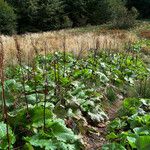
Rumex alpinus
Alpine dock · Mountain-rhubarb · Monk's-rhubarb · Butter dock · Munk's rhubarb
Description
Source: leafsnapRumex alpinus, common name monk's-rhubarb, Munk's rhubarb or Alpine dock, is a leafy perennial herb in the family Polygonaceae. It is native to upland areas of Europe and Western Asia.
Care Guide
💧 Water Every 7 days
Munk's rhubarb grows best in cool, moist alpine environments and needs regular watering, ideally once a week, to maintain consistent moisture. This plant prefers high humidity, which helps it use water efficiently during its active growing season. As an herbaceous perennial typically cultivated outdoors, Munk's rhubarb displays vigorous leaf growth.
☀️ Light Full sun
Munk's rhubarb is a sun-loving, perennial herbaceous plant native to open habitats, commonly found in meadows and grasslands. It prefers full sun but can also tolerate partial sun.
What are the sunlight requirements for Munk's rhubarb (Rumex alpinus)?
Munk's rhubarb, or Rumex alpinus, thrives in locations that receive full sun, which means the plant should be in a spot where it gets more than 6 hours of sunlight each day. It's important to observe how sunlight moves through your garden throughout the day to ensure that you choose a location that offers the right balance of light and shade. This strategy will help make sure your Munk's rhubarb plants are happy and healthy.
🌡️ Temperature 0–32.2°C
💨 Humidity normal (40-60%)
This plant will thrive in moderate humidity, which is probably the level in your home. However, misting it a few times a week can be very beneficial. Make sure the room has good ventilation.
🪴 Soil 6-7
🌱 Fertilizer
One fertilizer application in spring is generally enough for Munk's rhubarb, although multiple feedings can help maximize growth. Apply fertilizer every month to every month and a half. Fertilizing improves the leaves' appearance and performance, helping them maintain even color and a healthy texture. It also promotes root development and better nutrient uptake for the plant's long-term health.
🪴 Pot & Repot
✂️ Pruning
Munk's rhubarb thrives in cooler climates and has broad leaves that require regular care. To promote healthy growth, prune the plant from early to late spring to remove any dead leaves. Be careful not to over-prune, as this can cause stress to the plant. Using proper pruning techniques will enhance airflow and light penetration, leading to a more vigorous plant.
🌿 Propagating
🐛 Diseases & pets
☠️ Toxicity
Characteristics
- Plant Type
- Herb
- Life Cycle
- Perennial
- Genus
- Rumex
- Family
- Polygonaceae
- Hardiness Zone
- 3-7
- Mature Height
- 0.61 m to 2.13 m
- Mature Spread
- 49 cm to 91 cm
- Leaf Color
- Green, Dark Green
- Leaf Type
- Semi-evergreen
- Flower Color
- Yellow, Green
- Flower Size
- 0.51 cm to 0.51 cm
- Bloom Time
- Early summer, Mid summer
- Planting Time
- Spring, Summer, Autumn
- Harvest Time
- Late summer, Early fall
- Native Area
- Turkey, Austria, Slovakia, Montenegro, Bulgaria, Armenia, Poland, Greece, Croatia, Slovenia, Ukraine, Serbia, Germany, Italy, Spain, Switzerland, Iran, Albania, Azerbaijan, Romania, France