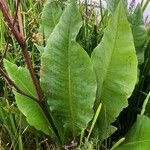
Rumex hydrolapathum
Great water dock · Water dock · Great water dock GRIN
Description
Source: leafsnapRumex hydrolapathum, commonly known as water dock or great water dock, is a perennial herbaceous plant that belongs to the family Polygonaceae. Native to Europe and Asia, it has also been introduced to North America and other regions around the world. The plant can grow up to 2 meters tall and features a stout stem, often reddish-brown in color. Its leaves are large, measuring up to 30 cm long and 20 cm wide, with a heart-shaped base and wavy margins. The flowers are small, greenish-red, and arranged on long spikes that can reach up to 1 meter in height. Water dock thrives in wet habitats such as marshes, swamps, and along riverbanks, where it can grow vigorously and form dense stands. It has been used for medicinal purposes for centuries due to its high content of tannins, which have anti-inflammatory properties. Additionally, the plant serves as an important food source for wildlife. Ducks feed on its seeds, while beavers use the plant material for building their dams. Despite its ecological significance, water dock can become invasive if not properly managed, especially in wetland areas where it can outcompete native vegetation and reduce biodiversity. Overall, Rumex hydrolapathum is an interesting species with both ecological significance and medicinal properties, making it an important part of our natural world.
Care Guide
💧 Water Every 7 days
Great water dock flourishes in wetland habitats, where it prefers consistently moist conditions. To mimic its natural environment, it's ideal to water it weekly. This herbaceous perennial grows best in containers designed to retain moisture and prevent root rot.
How should I water my Great water dock?
When watering the Great water dock, it is best to use filtered water at room temperature. Tap water can have harmful particles, so using filtered water is preferred. The Great water dock is accustomed to a warm environment, so it is important to avoid using cold water, as it can be a shock to the plant. Instead of overhead watering, it is recommended to apply filtered room temperature water directly to the soil until it is completely soaked. This is beneficial for the plant as it helps moisten the roots and allows them to spread in the soil to collect nutrients.
What should I do if I give my Great water dock too much water or too little water?
Overwatering is a common problem for Great water docks and can cause wilting, yellowing, and even diseases like root rot. In contrast, underwatering is less common but can result in brittle, brown leaves. To care for your Great water dock, it's important to notice the signs of overwatering early. Reduce your watering schedule and consider the soil quality if overwatering occurs. If underwatering is an issue, simply water more regularly.
How often do I need to water my Great water dock?
If your Great water dock is in a pot, the most precise way to determine if it needs water is to stick your finger into the soil. If the top two to three inches feel dry, it is time to water it. If you have your Great water dock planted outdoors in the ground, you can use a similar method to test the soil. When the top few inches of soil are dry, it is time to water it. Usually, in the spring and early fall, you will need to water this plant approximately once a week using this method. However, during extremely hot weather, you may need to water it about twice a week or more. Nevertheless, keep in mind that mature, well-established Great water docks have a remarkable ability to tolerate drought.
How much water does my large dock need?
To properly water your Great water dock, don't hold back on the amount of water you give it. Make sure the top two to three inches of soil are dry before watering, and then give it a good, deep soaking. You want the water to fully saturate the soil, so add enough water to see it flowing out of the drainage holes at the bottom of the pot. If you don't see any water draining out, you probably didn't give enough water. However, be careful not to let water accumulate in the soil, as this can harm the plant. On the other hand, if water doesn't drain well from the pot, it could mean the soil isn't draining properly, which is bad for the plant's health. If the plant is outside, around 1 inch of rain per week is enough.
How should I water my Great water dock at different times while it is growing?
The water requirements of the Great water dock can vary depending on its stage of growth. When the plant is young or recently transplanted, it needs more water to support the growth of new roots. These roots play a vital role in future growth and need extra moisture during this phase. As the plant matures, it will require less water. Additionally, during the bloom period, the development of flowers necessitates a significant amount of moisture, so more water may be needed at this time.
☀️ Light Full sun
The great water dock flourishes when it gets plenty of sunlight, which supports its best growth and health. It can also tolerate situations where sunlight is intermittent or somewhat reduced. Excessive or insufficient sunlight can lead to below-par growth or health problems. Its native habitat indicates a preference for open, exposed areas.
What are the sunlight requirements for Great water dock?
Great water dock thrives best with abundant exposure to the sun, ideally in full sun conditions, which means above 6 hours of sunlight daily. However, it can also tolerate partial sun, receiving about 3-6 hours of sunlight. Monitoring the movement of sunlight through the garden to find areas that provide a balance of light and shade is crucial for the optimal growth and health of your plants.
How can artificial lighting assist in the growth of Great water dock indoors?
For indoor Great water docks, when natural sunlight is lacking, especially in winter or less sunny spaces, artificial lighting becomes essential. Proper lighting ensures optimal growth. LEDs are recommended due to their ability to offer specific wavelengths needed by plants. Full sun plants require 30-50W/sq ft, partial sun plants need 20-30W/sq ft, and full shade plants require 10-20W/sq ft of light. The light source should be placed 12-36 inches above the plant, imitating natural sunlight conditions, and kept on for 8-12 hours per day depending on the specific needs of the plant species.
What symptoms indicate inadequate lighting for Great water dock?
Symptoms of inadequate lighting for Great water dock include smaller new leaves, leggy or sparse growth, quick drop of older leaves, slower or stagnant new growth, and paler new leaves. Additionally, chlorosis, sunscald, leaf curling, wilting, and leaf scorching can also occur, indicating either too much or too little light. Each symptom is a plant's response to its lighting conditions, guiding the caretaker in adjusting care practices for the plant's health.
How can you improve the growth of Great water dock with insufficient sunlight?
To improve growth for Great water docks with insufficient sunlight, gradually move them to sunnier locations, ensuring they receive at least 6 hours of direct sunlight daily, utilizing south-facing windows for indoor plants. If direct sunlight is limited, supplement with artificial light, keeping lamps on for at least 8 hours a day. For outdoor plants, avoid sudden changes in light intensity to prevent sunburn. Removing obstructions or transplanting to sunnier locations can also help. It's important to note that parts of the plant already affected by poor lighting may not recover, but new growth will be healthy with improved light exposure.
🌡️ Temperature 5–35°C
Great water dock can tolerate a wide range of temperatures, but its distribution may still be limited by various combinations of moisture and heat. It does best in warm summer climates with sufficient rainfall or watering. Extended periods of cloudy, rainy weather, as well as prolonged high temperatures, can increase the chance of Great water dock dying. In winter, proper protection against cold can improve the plant's survival rate.
💨 Humidity
🪴 Soil 6-7
🌱 Fertilizer
A single application of fertilizer in spring is usually sufficient for Great water dock, though repeated feedings can increase growth. Feed once every month to a month and a half. Fertilization improves leaf appearance and function, helping maintain even color and a healthy texture. It also encourages root development and nutrient uptake for long-term plant health.
Why should I put fertilizer on my Great water dock?
The main structure of the Great water dock is made up of its leaves, so fertilization is crucial for making sure the leaves look great and function properly. Proper fertilization will improve the color and texture of the leaves, as well as support the growth of new roots and maintain existing ones. This not only keeps the plant healthy presently but also improves its ability to absorb soil nutrients in the long run.
What is the right time to add fertilizer to my Great water dock?
Growing your Great water dock outdoors every year will result in new growth appearing in early spring. This is an indication that it is time to start fertilizing for the year. Typically, a single application of fertilizer in the spring is sufficient for the Great water dock to thrive. However, if you want to maximize its growth, you can fertilize multiple times during the spring and early summer. In this case, you can feed your Great water dock approximately once every month to a month and a half.
When is not a good time to fertilize my Great water dock?
During the late fall and winter, your Great water dock goes into a dormant phase and stops growing. It's best to avoid fertilizing it during this time. In the spring and summer, if you do choose to fertilize multiple times, gradually decrease the amount as summer approaches because the growth rate of your Great water dock will slow down. It's generally not a good idea to fertilize your Great water dock during unusually hot weather or when the soil is extremely dry. Fertilizing in these conditions can stress the plant and cause it to die prematurely.
What kind of fertilizer does my Great water dock need?
Choosing the best fertilizer for a Great water dock is luckily a simple task. These plants do well with a general-purpose garden fertilizer that contains equal amounts of nitrogen, phosphorus, and potassium. A fertilizer with a ratio of 10-10-10 or something similar works effectively. It's best to avoid high nitrogen fertilizers if uncertain. The top fertilizer choices for a Great water dock are typically granular and slow-release, making application to the soil easy. Additionally, feeding the plant with organic soil amendment like compost can be beneficial.
How can I add fertilizer to my Great water dock?
To ensure the optimal growth of your Great water dock, wait until early spring when you start seeing the first leaves emerging from the soil. At this point, you can apply a granular slow-release fertilizer with a balanced formula to the soil around the base of the plant. If desired, you can repeat this process later in the season. When applying fertilizer, remember to target the soil and not the plant itself. Be prepared to move some leaves aside to access the soil near the roots if necessary. Additionally, it is often beneficial to water your Great water dock both before and after fertilizing.
🪴 Pot & Repot
✂️ Pruning
The Great Water Dock benefits from pruning during early to late spring, which involves removing dead stems to encourage healthy growth and maintain its shape. This practice improves air circulation, reduces the risk of disease, and encourages the development of strong new shoots, leading to a healthier and more visually appealing plant.
🌿 Propagating
🐛 Diseases & pets
☠️ Toxicity
Characteristics
- Plant Type
- Herb
- Life Cycle
- Perennial
- Genus
- Rumex
- Family
- Polygonaceae
- Hardiness Zone
- 4-9
- Mature Height
- 0.91 m to 2.44 m
- Mature Spread
- 0.76 m to 1.22 m
- Leaf Color
- Dark Green
- Leaf Type
- Deciduous
- Flower Color
- Green, Brown
- Flower Size
- 0.51 cm
- Bloom Time
- Summer
- Planting Time
- Spring, Summer
- Harvest Time
- Late summer, Early fall, Mid fall
- Native Area
- Turkey, Sweden, Austria, Slovakia, Montenegro, Croatia, Slovenia, Belarus, Russia, Germany, Estonia, Romania, Latvia, Belgium, Netherlands, France, Czech Republic, Bulgaria, Poland, Greece, Ukraine, Serbia, Lithuania, Norway, Italy, Spain, Switzerland, Denmark, Finland, Albania, Ireland, United Kingdom, Hungary