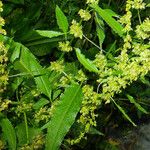
Rumex palustris
Marsh dock
Description
Source: leafsnapRumex palustris, commonly known as marsh dock or bog dock, is a perennial herbaceous plant in the Polygonaceae family. Native to North America, it is typically found in wetlands, marshes, and along the edges of streams and ponds. This plant features a deep taproot system that enables it to thrive in wet soils. It can grow up to 1 meter tall and has long, lance-shaped leaves that are green on top and reddish-purple underneath. The leaves have a sour taste due to the presence of oxalic acid. Rumex palustris produces small, greenish flowers on tall spikes from June through August. These flowers are followed by small, triangular seeds that turn brown when mature. Native Americans have traditionally used this plant for medicinal purposes to treat various ailments, including diarrhea, skin irritations, and respiratory problems. Beyond its medicinal uses, Rumex palustris also plays a critical role in wetland ecosystems. It provides an important food source for wildlife, such as waterfowl and muskrats. Overall, Rumex palustris is a vital species in wetland environments. Its ability to thrive in waterlogged soils, along with its significance as a food source for wildlife and its historical medicinal applications for humans, underscores its ecological and cultural importance.
Care Guide
💧 Water Every 7 days
☀️ Light Partial sun
Marsh dock is native to habitats with dappled light, such as forest understories or rocky spots that provide natural shade. It favors partial sun but can also tolerate full sun.
🌡️ Temperature 5–35°C
Marsh dock can tolerate a wide range of temperatures, but its distribution may still be constrained by particular combinations of moisture and heat. It performs best in warm summer climates with sufficient rainfall or watering. Extended periods of cloudy, rainy weather or prolonged high temperatures can raise the chance of Marsh dock dying. In winter, appropriate protection from cold can increase the plant's survival rate.
💨 Humidity
🪴 Soil 6-8
🌱 Fertilizer
Marsh dock responds well to regular, mild applications of fertilizer to encourage healthy leaf growth. You should apply fertilizer to Marsh dock about once a month during the summer. Nitrogen is essential for foliage, and supplying nitrogen-rich sources helps Marsh dock thrive.
🪴 Pot & Repot
✂️ Pruning
🌿 Propagating
🐛 Diseases & pets
☠️ Toxicity
Characteristics
- Plant Type
- Herb
- Life Cycle
- Annual
- Genus
- Rumex
- Family
- Polygonaceae
- Hardiness Zone
- 5-9
- Mature Height
- 30 cm to 91 cm
- Mature Spread
- 20 cm to 49 cm
- Leaf Color
- Green, Dark Green
- Leaf Type
- Deciduous
- Flower Size
- 0.20 cm to 0.25 cm
- Bloom Time
- Summer
- Planting Time
- Spring, Summer, Autumn
- Harvest Time
- Late summer, Early fall, Mid fall
- Native Area
- Turkey, Sweden, Austria, Czech Republic, Slovakia, Montenegro, Bulgaria, Poland, Greece, Croatia, Slovenia, Morocco, Belarus, Serbia, Norway, Hungary, Germany, Syria, Italy, Spain, Switzerland, Denmark, France, Albania, United Kingdom, Romania, Algeria, Belgium, Netherlands