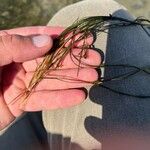
Ruppia maritima
Beaked tasselweed · Ditch-grass · Sea tassel · Sea-grass · Widgeon-grass
Description
Source: leafsnapRuppia maritima is an aquatic plant species commonly known as beaked tasselweed, ditch grass, tassel pondweed and widgeon grass. Despite its scientific name, it is not a marine plant; is perhaps best described as a salt-tolerant freshwater species. The generic name Ruppia was dedicated by Linnaeus to the German botanist Heinrich Bernhard Ruppius (1689-1719) and the specific name (maritima) translates to "of the sea".
Care Guide
💧 Water
Widgeongrass thrives in brackish coastal waters and is drought-tolerant due to its ability to conserve moisture. It needs weekly watering to mimic its natural environment. Being an aquatic plant, widgeongrass benefits from having its growing season align with local rainfall patterns to ensure optimal hydration.
☀️ Light Full sun
Widgeongrass does best in settings with plentiful daylight, favoring spots where the sun reaches it for most of the day. This sturdy plant can still grow under reduced light and is not harmed by different degrees of exposure. Native to habitats with abundant sunlight, neither a shortage nor an excess of light greatly affects its growth.
What are the sunlight requirements for Widgeongrass?
Widgeongrass, or Ruppia maritima, thrives best with more than 6 hours of sunlight each day. It's essential to observe the movement of sunlight through your garden to choose spots that offer a perfect balance of light and shade, ensuring your plants remain happy. Even though Widgeongrass originates from areas with abundant daylight and can adapt to varying light conditions, providing enough sunlight is crucial for its optimal growth.
Can Widgeongrass grow with artificial lighting?
Yes, Widgeongrass can grow with artificial lighting, especially when natural sunlight is insufficient, such as during winter or in less sunny spaces. Adequate lighting is essential for optimal growth. LED lights are recommended for their ability to provide specific wavelengths needed by the plants. Full sun plants require 30-50W/sq ft, partial sun plants need 20-30W/sq ft, and full shade plants require 10-20W/sq ft of artificial light. The light source should be placed 12-36 inches above the plant to mimic natural sunlight, with the duration mimicking natural daylight hours, typically 8-12 hours per day.
What are the signs of insufficient light for Widgeongrass?
Signs of insufficient light for Widgeongrass include smaller new leaves, leggy or sparse growth, faster leaf drop, slower or no new growth, lighter-colored new leaves, chlorosis (yellowing of leaves), sunscald (damage from intense sunlight), leaf curling, wilting, and leaf scorching. These symptoms indicate that the plant is not receiving adequate sunlight, which can affect its growth and overall health.
How can I improve Widgeongrass growth if it's not getting enough light?
To improve Widgeongrass growth under insufficient light conditions, gradually move your plants to a sunnier location each week until they receive at least 6 hours of direct sunlight daily. Utilize a south-facing window and keep curtains open during the day for maximum sunlight. For larger or immovable plants, consider using artificial light, keeping a lamp on for at least 8 hours a day or investing in professional plant grow lights. For outdoor plants, avoid sudden changes in light intensity to prevent sunburn. If natural light is blocked by obstacles, prune trees or move plants to sunnier spots. Remember, while parts of the plant affected by low sunlight may not recover, new growth will be healthy with increased light exposure.
🌡️ Temperature 0–25°C
Widgeongrass is native to habitats where temperatures generally range from 32 to 77°F (0 to 25℃). It favors cooler climates, and seasonal adjustments may be necessary to maintain optimum growth temperatures.
What is the native environment temperature range for Widgeongrass?
Widgeongrass, or Ruppia maritima, is native to environments where the temperatures typically vary between 32 to 77°F (0 to 25°C). It thrives in cooler climates, and depending on the season, adjustments may be needed to maintain these optimum growth temperatures. This plant is highly cold-tolerant and does not require additional frost protection measures. To best prepare it for winter, it's advised to water the plant generously before the first freeze in autumn to keep the soil moist and ready to freeze, helping to prevent winter drought.
How does Widgeongrass react to very low temperatures?
Widgeongrass is extremely cold-tolerant, capable of handling winter temperatures down to -35°C. However, if temperatures fall below this level, while there may not be any noticeable damage during the winter, there could be a reduction in or an absence of sprouting in spring. To manage this, in spring, remove any parts of the plant that have failed to sprout, allowing for the possibility of new growth.
What should be done if Widgeongrass experiences high temperatures?
Widgeongrass struggles in high temperatures, particularly those exceeding 25°C, at which point its growth might halt, and the plant becomes more prone to rot. To mitigate the effects of high temperature, affected parts of the plant should be trimmed away. It may be beneficial to move Widgeongrass to a shaded area during the hottest parts of the day or to employ shade cloth for protection. Ensuring the soil remains moist by watering in the morning and evening can also help reduce stress on the plant.
💨 Humidity
🪴 Soil
🌱 Fertilizer
🪴 Pot & Repot
✂️ Pruning
Widgeongrass is a submerged aquatic plant known for its thin stems and narrow leaves. To encourage healthy growth, prune the plant in the spring using clean tools. Regular pruning helps improve water flow and light access. Keep an eye on the plant for signs of invasiveness, and make sure to dispose of the trimmings responsibly.
🌿 Propagating
🐛 Diseases & pets
☠️ Toxicity
Characteristics
- Plant Type
- Herb
- Life Cycle
- Perennial
- Genus
- Ruppia
- Family
- Ruppiaceae
- Hardiness Zone
- 3
- Mature Height
- 30 cm to 91 cm
- Mature Spread
- 1.22 m to 3.05 m
- Leaf Color
- Dark Green
- Leaf Type
- Evergreen
- Flower Color
- White, Green
- Flower Size
- 2.54 cm
- Bloom Time
- Summer, Early fall, Mid fall
- Planting Time
- Spring, Summer, Autumn
- Harvest Time
- Late summer, Fall, Early winter
- Native Area
- Sri Lanka, Libya, Belize, India, Turkey, Sweden, Mexico, Guatemala, Madagascar, Montenegro, Pakistan, Thailand, Nigeria, Slovenia, Croatia, Morocco, Fiji, Tanzania, Germany, Indonesia, Koppen, Romania, Latvia, Belgium, Netherlands, Portugal, Saudi Arabia, Tunisia, Honduras, Peru, Philippines, Bulgaria, Bangladesh, Cyprus, Panama, Ukraine, China, Lebanon, Colombia, Syria, Italy, Kazakhstan, Japan, Mongolia, Finland, El Salvador, Senegal, Iran, Ecuador, Azerbaijan, Costa Rica, Congo (DRC), Egypt, Angola, Malaysia, Namibia, Eritrea, Yemen, Jamaica, Uzbekistan, Russia, Iraq, Cuba, Equatorial Guinea, Iceland, Venezuela, Estonia, Brazil, Ghana, South Korea, France, Tajikistan, South Africa, Poland, Greece, Lithuania, Norway, Bahamas, Spain, Bolivia, Denmark, Vietnam, Myanmar, Guyana, Nicaragua, Albania, Ireland, United Kingdom, Algeria, Turkmenistan