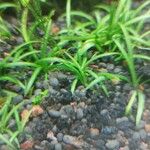
Sagittaria subulata
Narrow-leaf arrowhead · Awl-Leaf Arrowhead · Dwarf sagittaria · Narrow-leaved arrowhead · Rubbon wapato
Description
Source: leafsnapSagittaria subulata, commonly known as dwarf sagittaria or narrow-leaved arrowhead, is a popular aquatic plant in the Alismataceae family. Native to both North and South America, it thrives in the shallow waters of lakes, ponds, and slow-moving streams. This plant features narrow, green leaves that can grow up to 30 cm long and 1 cm wide. During the summer, it produces small white flowers on long stalks that rise above the water surface. The roots of Sagittaria subulata are fibrous and form a dense mat on the substrate. Dwarf sagittaria is easy to grow and can thrive in a variety of water conditions, ranging from soft to hard water, with pH levels between 6 and 8. While it prefers moderate lighting, it can also tolerate low light conditions. In aquariums, Sagittaria subulata is ideal for use as a foreground or midground plant due to its low-growing habit and its ability to form dense carpets when planted closely together. Additionally, its roots provide shelter for small fish fry. Overall, Sagittaria subulata is a versatile aquatic plant with attractive foliage that enhances the natural beauty of aquariums. It also benefits aquarium inhabitants by improving water quality through nutrient uptake.
Care Guide
💧 Water Every 7 days
The awl-leaf arrowhead is native to shallow wetlands and thrives in consistently moist conditions. While it can withstand short periods of dryness, it needs to be watered weekly. As an aquatic plant suitable for both indoor and outdoor environments, the awl-leaf arrowhead benefits from being submerged in water. This practice encourages lush growth and vibrant foliage.
☀️ Light Full sun
Awl-leaf arrowhead comes from habitats with plenty of sunlight, such as the shallow margins of ponds and lakes. It prefers full sun but can also tolerate partial sun.
🌡️ Temperature 10–37.8°C
Awl-leaf arrowhead comes from tropical areas, where the climate is generally warm and humid. As a result, it is well adapted to high temperatures and moisture. It does not tolerate sudden temperature changes and prefers a stable thermal environment, so avoiding temperature fluctuations indoors is important. It typically cannot endure cold conditions and requires warmer temperatures to grow. If the surrounding temperature falls too low, the plant may stop growing or even die.
💨 Humidity
🪴 Soil
🌱 Fertilizer
To promote optimal growth, fertilize the awl-leaf arrowhead every two weeks during the spring and summer with a balanced fertilizer. In the fall, reduce the frequency to once a month, and stop fertilizing entirely in the winter. Be sure to follow the product instructions to prevent nutrient overload. Use slow-release tabs to minimize root disturbance and help maintain water quality.
🪴 Pot & Repot
✂️ Pruning
Awl-leaf arrowhead is a wetland plant with narrow, grass-like leaves. To keep it healthy and well-maintained, prune it from early to late spring. During pruning, remove any dead foliage and spent flowers to encourage new growth and control its spread. Regular pruning improves the plant's appearance and vitality.
🌿 Propagating
🐛 Diseases & pets
☠️ Toxicity
Characteristics
- Plant Type
- Herb
- Life Cycle
- Perennial
- Genus
- Sagittaria
- Family
- Alismataceae
- Hardiness Zone
- 6-11
- Mature Height
- 5 cm to 15 cm
- Mature Spread
- 10 cm to 20 cm
- Leaf Color
- Light Green
- Leaf Type
- Deciduous
- Flower Color
- White
- Flower Size
- 1.02 cm to 1.52 cm
- Bloom Time
- Summer, Early fall, Mid fall
- Planting Time
- Spring, Summer, Autumn
- Harvest Time
- Late summer, Fall, Early winter
- Native Area
- Georgia, Colombia, Venezuela