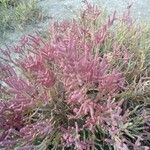
Salicornia bigelovii
Dwarf glasswort · Dwarf Saltwort
Description
Source: leafsnapSalicornia bigelovii, commonly known as dwarf glasswort or pickleweed, is a halophytic plant species belonging to the Amaranthaceae family. This succulent annual herb thrives in salt marshes and saline flats along the Pacific coast of North America, from Alaska to Baja California. This plant has a distinctive appearance with fleshy green stems and small, scale-like leaves. It can grow up to 30 cm in height and features an extensive root system that helps it absorb nutrients from saline soils. Salicornia bigelovii plays a crucial role in coastal ecosystems by providing habitat for various species of birds, insects, and small mammals. Additionally, it helps stabilize soil erosion by trapping sediments with its extensive root system. The plant is also edible and has been used for centuries by indigenous communities as both food and medicine due to its high nutritional value. Salicornia bigelovii is rich in vitamins A and C, as well as minerals like calcium, magnesium, potassium, and sodium chloride (salt), making it an excellent source of nutrients. In recent years, Salicornia bigelovii has gained attention for its potential use in biofuel production. It can grow on marginal lands unsuitable for conventional crops, thus not competing with food production. Overall, Salicornia bigelovii is a fascinating plant species with remarkable adaptations that allow it to thrive in harsh environments. It provides ecological benefits by creating habitats and stabilizing soil, while also offering potential economic benefits through its use in biofuel production and as a nutrient-rich food source.
Care Guide
💧 Water Every 7 days
Dwarf saltwort is a halophyte that thrives in saline marshes where other plants often struggle to survive. It is highly efficient in water conservation, requiring moisture replenishment only every two weeks. As an annual plant, dwarf saltwort stores water in its fleshy stems, which allows it to endure dry periods typical of its coastal habitats, where freshwater is available only sporadically.
☀️ Light Full sun
Dwarf saltwort comes from bright, open habitats and performs best in full sun. It can tolerate partial sun but favors direct sunlight for optimal growth. This plant, which can be annual or biennial, is known for its sun-loving nature.
🌡️ Temperature 15–37.8°C
Dwarf saltwort comes from tropical areas, where conditions are generally warm and humid. Because of this, it is adapted to high heat and moisture. It does not tolerate abrupt temperature shifts and favors a consistent temperature, so avoiding fluctuations indoors is important. It typically cannot withstand cold and needs warmer conditions to grow; if temperatures fall too low, growth may stop or the plant may die.
💨 Humidity normal (40-60%)
This plant will thrive in moderate humidity, which is probably the level in your home. However, misting it a few times a week can be very beneficial. Make sure the room has good ventilation.
🪴 Soil 6-8
🌱 Fertilizer
Dwarf saltwort does well with frequent, weak doses of fertilizer to encourage healthy leaf growth. You should fertilize dwarf saltwort about once a month during the summer. Nitrogen is important for foliage, and supplementing with nitrogen-rich sources helps dwarf saltwort thrive.
🪴 Pot & Repot
✂️ Pruning
Dwarf saltwort, known for its succulent stems, thrives in saline environments. To encourage healthy growth and a compact shape, prune it from early to late spring. Be cautious not to prune heavily in the summer, as this can cause stress to the plant. Regular pruning helps improve air circulation, reduces the risk of disease, and supports vigorous development.
🌿 Propagating
🐛 Diseases & pets
☠️ Toxicity
Characteristics
- Plant Type
- Herb
- Life Cycle
- Annual
- Genus
- Salicornia
- Family
- Amaranthaceae
- Hardiness Zone
- 8-11
- Mature Height
- 15 cm to 49 cm
- Mature Spread
- 10 cm to 30 cm
- Leaf Color
- Dark Green, Olive
- Leaf Type
- Evergreen
- Flower Size
- 0.10 cm to 0.20 cm
- Bloom Time
- Late summer, Early fall
- Planting Time
- Spring, Summer, Autumn
- Harvest Time
- Mid fall, Late fall
- Native Area
- Bahamas, Belize, Cuba, Haiti, Mexico, Georgia, Dominican Republic