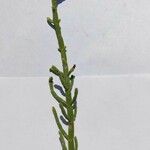
Salicornia depressa
Woody Saltwort · Virginia glasswort · Low Glasswort · Pickleweed · American glasswort
Description
Source: leafsnapSalicornia depressa, commonly known as the dwarf glasswort or creeping samphire, is a small succulent plant that belongs to the Amaranthaceae family. This plant is typically found in coastal regions around the world. With a prostrate growth habit, Salicornia depressa can reach up to 20 cm in height. Its leaves are reduced to tiny scales, and its stems are cylindrical with a greenish-grey hue. Remarkably well-adapted to saline environments, Salicornia depressa is an excellent candidate for salt marsh restoration projects. It can withstand high salt concentrations by excreting excess salt through specialized glands on its leaves. Additionally, Salicornia depressa possesses several medicinal properties. It is used as an herbal remedy for various ailments, including inflammation, pain relief, and digestive disorders. In summary, Salicornia depressa is a fascinating plant that not only thrives in harsh environments but also provides ecological benefits such as soil stabilization and creating habitats for wildlife.
Care Guide
💧 Water Every 7 days
Virginia glasswort flourishes in salty marshes and adapts well to environments with high moisture levels. To keep it healthy, it should be watered consistently on a weekly basis. As an herbaceous plant, Virginia glasswort is resilient during the growing season and efficiently uses water to support its succulent-like foliage.
☀️ Light Full sun
Virginia glasswort requires a generous amount of sunlight to grow well. The habitat where it originates receives abundant sun, which corresponds to its need for high light levels. Too little light can impede its development, while excessive exposure may stress the plant. Light requirements can vary somewhat at different growth stages, but ample light is generally necessary.
What are the sunlight requirements for Virginia glasswort?
Virginia glasswort requires full sun, which means it needs above 6 hours of sunlight daily for healthy growth. Originating from habitats with extensive sun exposure, it thrives best in spaces that offer a perfect balance of light and shade. Insufficient light may hinder its development, while too much exposure can cause stress. The growth stages of this plant might slightly alter its light needs, but generally, ample light is critical for its well-being. A useful tip is to observe how sunlight moves through your garden to choose the best spots for your plants.
How do I use artificial lighting for indoor Virginia glasswort plants?
For indoor Virginia glasswort plants that cannot receive enough natural sunlight, especially during winter or in less sunny spaces, artificial lighting is an excellent solution to ensure optimal growth. You should choose the right type of artificial light, with LED lights being a popular and effective choice because they can be customized to provide specific wavelengths of light. Full sun plants typically need 30-50W/sq ft of artificial light, partial sun plants require 20-30W/sq ft, and full shade plants need 10-20W/sq ft. The light source should be placed 12-36 inches above the plant, mimicking natural sunlight as closely as possible. In terms of duration, most plants benefit from 8-12 hours of artificial light per day, which should mimic the length of natural daylight hours for your plant species.
What are the symptoms of light deficiency in Virginia glasswort?
When Virginia glasswort is placed in inadequately lit rooms, it may exhibit several symptoms indicating light deficiency. These include smaller new leaves compared to mature ones, leggy or sparse growth, faster leaf drop, slower or halted new growth, and lighter-colored new leaves signaling a lack of chlorophyll and essential nutrients. Additionally, chlorosis, or the yellowing of leaves due to chlorophyll breakdown, sunscald with damaged plant tissues, leaf curling as a defense mechanism against excessive sunlight, wilting due to loss of turgor pressure, and leaf scorching characterized by brown, dry, and crispy leaf edges can occur.
How can I address sunlight-related issues for indoor, outdoor, and ground Virginia glasswort?
To address sunlight-related issues for Virginia glasswort, consider the following solutions based on your planting method: For indoor plants, gradually move them to a sunnier location each week until they receive at least 6 hours of direct sunlight daily. Use a south-facing window and keep curtains open during the day. If necessary, use artificial light, such as a desk or ceiling lamp for at least 8 hours a day, or invest in professional plant grow lights. For outdoor plants, move them gradually to sunnier spots, avoiding abrupt light intensity changes that may cause sunburn. Note that parts of the plant affected by insufficient sunlight may not recover, but new growth will be healthy after adjusting light exposure. For plants in the ground, reduce obstructions by pruning trees or branches that block sunlight, and consider transplanting smaller plants during their dormant period to locations with ample sunlight and good drainage.
🌡️ Temperature 10–35°C
Virginia glasswort does best in moderate temperatures, roughly similar to what people commonly find comfortable. It grows well in conditions that are neither overly hot nor overly cold. The primary concern with high temperatures is the increased risk of sunburn, so providing some shade in summer is recommended to avoid excessive heat. When temperatures fall, Virginia glasswort goes dormant. To maintain continuous growth, higher temperatures must be kept through winter. Frost can damage the plant and should be avoided.
💨 Humidity
🪴 Soil 6-8
🌱 Fertilizer
To maximize yield and flavor of Virginia glasswort, provide ample nitrogen throughout the entire growth cycle, from pre-planting through harvest. Well-watered and fertilized plants produce abundant, healthy leaves and reduce bitterness. Before planting, enrich the soil with organic matter like compost or manure, preferably 2 to 8 weeks in advance.
🪴 Pot & Repot
✂️ Pruning
To help Virginia glasswort thrive, prune it from early to late spring. This process involves trimming any leggy growth and removing damaged stems. Pruning encourages denser growth, helps maintain the plant's shape, improves air circulation, and reduces the risk of disease, leading to vigorous and healthy plants.
🌿 Propagating
🐛 Diseases & pets
☠️ Toxicity
Characteristics
- Plant Type
- Herb, Shrub
- Life Cycle
- Perennial
- Genus
- Salicornia
- Family
- Amaranthaceae
- Hardiness Zone
- 6-10
- Mature Height
- 10 cm to 61 cm
- Mature Spread
- 10 cm to 20 cm
- Leaf Color
- Dark Green
- Leaf Type
- Evergreen
- Flower Color
- Green
- Flower Size
- 0.25 cm to 0.51 cm
- Bloom Time
- Late summer, Early fall, Mid fall
- Planting Time
- Spring, Summer, Autumn
- Harvest Time
- Mid fall, Late fall
- Native Area
- Canada, Bahamas, Mexico, Jamaica