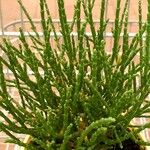
Salicornia perennis
Chickenclaws · Perennial Glasswort · Perennial Saltwort · Creeping shrubby glasswort
Description
Source: wikipedia (CC BY-SA)Salicornia perennis, synonym Sarcocornia perennis, otherwise known as perennial glasswort, is a species of halophytic perennial plant within the family Amaranthaceae. It has a widespread but patchy native distribution, being found in parts of Western Europe, northern and southern Africa, North America from southeast Alaska to south Mexico, the Caribbean, and South America. It is native to the coasts of southern Britain and Ireland, where it is classified as nationally scarce. The species flowers between July and October.
Care Guide
💧 Water
Perennial glasswort thrives in saline environments, particularly in coastal marshes, where it requires consistent moisture. To ensure healthy growth, water the plant weekly while considering the tidal cycles that influence soil moisture. Its adaptation to high soil salinity makes it an excellent choice for outdoor cultivation in saltwater habitats.
☀️ Light Full sun
Perennial glasswort is a sun-loving, herbaceous perennial that comes from open habitats and frequently thrives in meadows and grasslands. It prefers full sun but can also tolerate partial sun conditions.
🌡️ Temperature 5–35°C
Perennial glasswort can tolerate a wide range of temperatures, but its distribution can still be constrained by different combinations of moisture and heat. It does best in warm summer conditions with sufficient rainfall or watering. Extended periods of cloudy, rainy weather or prolonged high temperatures can raise the chances of Perennial glasswort dying. In winter, adequate protection from the cold can increase the plant's survival rate.
💨 Humidity
🪴 Soil 6-8
🌱 Fertilizer
One fertilizer application in spring is generally enough for Perennial glasswort, though repeated feedings can maximize growth. Feed every month to six weeks. Fertilizing improves leaf appearance and function, maintaining consistent color and a healthy texture. It also promotes root development and nutrient uptake for long-term plant health.
🪴 Pot & Repot
✂️ Pruning
Perennial glasswort is a low-growing, salt-tolerant plant with fleshy, jointed stems. For healthy growth, prune it from early to late spring to remove dead stems. Regular trimming not only enhances its appearance but also improves air circulation, promoting optimal growth. Make sure to use clean cuts during pruning for the best results.
🌿 Propagating
🐛 Diseases & pets
☠️ Toxicity
Characteristics
- Plant Type
- Herb
- Life Cycle
- Perennial
- Genus
- Salicornia
- Family
- Amaranthaceae
- Hardiness Zone
- 5-9
- Mature Height
- 10 cm to 30 cm
- Mature Spread
- 15 cm to 40 cm
- Leaf Color
- Dark Green, Olive
- Leaf Type
- Deciduous
- Flower Size
- 0.20 cm to 0.25 cm
- Bloom Time
- Late summer, Early fall
- Planting Time
- Summer
- Harvest Time
- Mid fall, Late fall
- Native Area
- Libya, Egypt, Mexico, Namibia, Dominican Republic, Croatia, Morocco, Jamaica, Uruguay, Cuba, Paraguay, Argentina, Haiti, Mozambique, Venezuela, Portugal, France, Tunisia, Peru, South Africa, Mauritania, Greece, Colombia, Bahamas, Italy, Spain, Israel, Albania, Ireland, United Kingdom, Algeria