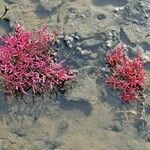
Salicornia rubra
Rocky Mountain glasswort · Red saltwort · Red swampfire · Western samphire · Red glasswort
Description
Source: leafsnapSalicornia rubra, the Rocky Mountain glasswort, is a species of flowering plant in the family Amaranthaceae. It is native to colder or higher areas of North America; the Yukon, Nunavut, British Columbia, Alberta, Saskatchewan, Manitoba, and Ontario in Canada, and the western and north-central US. It has been introduced to Quebec and Michigan, and has gone extinct in Illinois. A halophyte, it is one of the most salt-tolerant plants of North America.
Care Guide
💧 Water
☀️ Light Full sun
Red swampfire originates in bright, open habitats and thrives in full sun. It can tolerate partial sun but prefers direct sunlight for optimal growth. This plant, which can be annual or biennial, is known for its sun-loving nature.
🌡️ Temperature 10–35°C
Red swampfire can tolerate a wide range of temperatures, but its distribution may still be constrained by different combinations of water and heat. It performs best in warm summer climates with sufficient rainfall or watering. Extended periods of cloudy, rainy weather or prolonged high temperatures can raise the chance of Red swampfire dying. In winter, appropriate protection from cold can increase the plant's survival rate.
💨 Humidity
🪴 Soil 6-8
🌱 Fertilizer
Red swampfire responds well to regular, low-strength fertilizer applications to encourage healthy leaf development. Feed Red swampfire roughly once a month during the summer. Nitrogen is vital for foliage, and providing nitrogen-rich sources supports Red swampfire's vigorous growth.
🪴 Pot & Repot
✂️ Pruning
🌿 Propagating
🐛 Diseases & pets
☠️ Toxicity
Characteristics
- Plant Type
- Herb
- Life Cycle
- Annual
- Genus
- Salicornia
- Family
- Amaranthaceae
- Hardiness Zone
- 6-10
- Mature Height
- 3 cm to 20 cm
- Mature Spread
- 5 cm to 15 cm
- Leaf Color
- Green
- Leaf Type
- Evergreen
- Flower Color
- Red
- Flower Size
- 0.10 cm to 0.20 cm
- Bloom Time
- Mid summer, Late summer, Early fall
- Planting Time
- Spring, Summer, Autumn
- Harvest Time
- Early fall, Mid fall