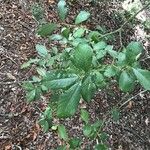
Salix atrocinerea
Grey Willow · Rusty sallow · Smooth-Twig Gray Willow · Large gray willow · Rusty Willow
Description
Source: leafsnapSalix atrocinerea, commonly known as Grey Willow, is a deciduous tree belonging to the Salicaceae family. Native to Europe and western Asia, it can grow up to 15 meters tall. The tree features a slender trunk, a rounded crown, and greyish-brown bark that becomes fissured with age. The leaves of Salix atrocinerea are lance-shaped, up to 10 cm long, and have finely serrated edges. They are dark green on the upper surface and paler underneath. In early spring, the tree produces catkins before the leaves emerge. Salix atrocinerea prefers moist soils in full sun or partial shade but can tolerate dry conditions once established. It is commonly used for erosion control along riverbanks and serves as an ornamental tree in gardens due to its attractive foliage. The wood of Grey Willow is utilized for making baskets, furniture, paper pulp, and charcoal. It is also valued as fuelwood due to its high calorific value. Overall, Salix atrocinerea is a versatile plant species. It serves multiple purposes, from being an ornamental plant for gardens and parks to controlling erosion along riverbanks. Additionally, its wood is useful for various applications, making it a valuable and adaptable plant.
Care Guide
💧 Water Every 7 days
The large gray willow naturally grows in moist environments and thrives with consistent watering. It prefers stable soil moisture and should be watered twice a week to meet its needs. Rainwater is particularly beneficial for the plant. Typically found outdoors, the large gray willow requires this level of care for optimal growth during its active seasons.
☀️ Light Full sun
Large gray willow is found in open habitats, such as sunny meadows and forest edges, where light is abundant. It does best in Full Sun but can also tolerate Partial Sun, adapting well to various light conditions.
What are the sunlight requirements for a Large Gray Willow (Salix atrocinerea)?
The Large Gray Willow (Salix atrocinerea) needs specific sunlight conditions to thrive. It requires full sun, which is above 6 hours of sunlight daily, or partial sun, which amounts to about 3-6 hours of sunlight daily. It's important to observe how sunlight moves through your garden to find the ideal location that offers a perfect balance of light and shade. This careful placement ensures the plant's happiness and health.
🌡️ Temperature 5–32.2°C
Large gray willow is highly adaptable to a wide range of climates, from blistering summers to freezing winters. It does, however, have a preferred temperature range for healthy growth. If temperatures rise too much, the plant becomes vulnerable to heat and humidity stress, which can kill it. In areas where temperatures approach the lower limit of its cold tolerance, insulating the plant is important to protect it.
💨 Humidity
🪴 Soil 6-8
🌱 Fertilizer
To encourage healthy growth, fertilize your Large gray willow in early spring. Regular feeding boosts overall health, leading to vigorous growth, greater tolerance of harsh conditions, and improved resistance to pests and diseases. Adhere to a consistent fertilization schedule for your Large gray willow to keep foliage vibrant with deep color and a lush appearance.
🪴 Pot & Repot
✂️ Pruning
The large gray willow is characterized by its silver-gray leaves and fast growth. To maintain its health and appearance, it is best to prune it in early spring. Focus on thinning out crowded branches to improve air circulation and removing any dead wood. This practice promotes a balanced structure, enhances the tree's aesthetics, and encourages vigorous growth, all of which contribute to a healthy and attractive presence in the landscape.
🌿 Propagating
🐛 Diseases & pets
☠️ Toxicity
Characteristics
- Plant Type
- Tree
- Life Cycle
- Perennial
- Genus
- Salix
- Family
- Salicaceae
- Hardiness Zone
- 4-8
- Mature Height
- 10.06 m
- Mature Spread
- 10.06 m
- Leaf Color
- Green, Gray, Silver
- Leaf Type
- Deciduous
- Flower Color
- Yellow
- Flower Size
- 2.03 cm to 3.05 cm
- Bloom Time
- Late winter, Early spring
- Planting Time
- Spring, Summer, Autumn
- Harvest Time
- Mid spring, Late spring
- Native Area
- Germany, Tunisia, Portugal, Spain, Ireland, United Kingdom, Algeria, Morocco, Belgium, France