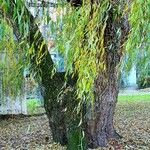
Salix babylonica
بید مجنون · Wala (ولہ)(in pashto ) Pakistani local name · Ιτιά Κλαίουσα (Itia Cleousa) (GR) (EL) · Weeping willow · Curly Willow
Description
Source: leafsnapSalix babylonica, commonly known as the weeping willow, is a deciduous tree from the Salicaceae family. Native to China, it has been widely cultivated around the world for its ornamental value and ability to thrive in wet soils. The weeping willow can grow up to 30 meters tall, featuring a broad crown with long, drooping branches that give it its distinctive appearance. The leaves of the Salix babylonica are narrow and lance-shaped, with serrated edges. They are typically green on the upper side and pale green underneath. In early spring, before the leaves emerge, the tree produces small yellow flowers. This tree prefers moist soils but can tolerate some drought once it is established. It is often planted near water bodies such as ponds and streams, where it helps stabilize banks against erosion. The wood of the Salix babylonica is soft and lightweight, making it unsuitable for construction but ideal for crafting baskets and other woven items. Overall, Salix babylonica is an attractive ornamental tree that enhances landscapes with its beauty while providing ecological benefits, such as erosion control and habitat for wildlife.
🌳 The weeping willow is most often used as an ornamental tree in parks and gardens due to its attractive, cascading branches. In open spaces, it serves as an effective windbreak. Additionally, it can help reduce erosion caused by wind and rain. Around the base of a weeping willow, you can plant perennial ground covers such as Creeping Myrtle or Carpet Bugle.
🎭 Affection, Fortune-telling, Safeguarding
Care Guide
💧 Water Every 3 days
The weeping willow, which originates from northern China, is highly tolerant of drought conditions. Typically, it needs to be watered every 1-2 weeks. However, during the spring and summer, its water requirements increase to support the growth of its foliage. This change reflects the seasonal fluctuations that are typical for a deciduous tree grown outdoors.
How should I water my Weeping willow tree in the best way?
To ensure excellent root development, it is recommended to water the plant base with a garden hose instead of spraying the leaves directly. If the plant is outdoors and exposed to direct sunlight, the leaves will require more watering. Bubblers can be used to moisten the roots, and soaker hoses are useful for covering the entire garden or bed when adding or removing plants. After watering, any excess water should be drained, and the soil should be allowed to dry before watering again. Watering at ground level helps prevent diseases. On a sunny day, it may be beneficial to spray the entire bush with water. It is important to note that whether the Weeping willow is in a pot or in the ground, it prefers deep watering instead of light sprinkling.
What should I do if I give too much or too little water to a Weeping willow?
Overwatering can cause a Weeping willow to exhibit symptoms like yellowing and wilting leaves, as well as a dull and unhealthy appearance. The stems may also become mushy. When these signs appear, it's important to adjust your watering schedule accordingly. Additionally, wilting can also be a sign of under watering, which is indicated by crispy and dry leaves. In such cases, it is necessary to check the soil moisture level and provide a full watering if needed. However, even with enough water, the Weeping willow may still have dry and yellow leaves due to root damage, though this will eventually stop once the plant recovers. It's advisable to regularly check the moisture levels of indoor potted Weeping willows and avoid overwatering. If black spots are present, allow the soil to dry out by withholding water for a few days. Root rot can occur with overwatering, so it's important to transfer the plant to a different pot if discolored and slimy roots are observed. Preventing root rot by avoiding excessively soggy soil is crucial. When planting a Weeping willow outdoors, it's recommended to dig a little deeper. If the soil feels too dry upon checking with your fingers, it may indicate underwatering, in which case adequate watering is needed to help the plant recover.
How frequently should I water my Weeping willow?
The Weeping willow prefers deep and infrequent watering. When planted in pots, soak them in a gallon of water each time to account for limited water storage. In cold regions, water every 3 to 5 days, in the morning when the soil is dry. Check the soil inside to determine if watering is needed - if the top 2-3 inches are dry, give the plant a full watering. During hot days, check the moisture daily to prevent soil from drying out quickly. For garden irrigation in hot climates, water once a week when about 2 to 3 inches of soil becomes too dry. Do not water if there is already ample rainfall to avoid root rot. During spring and fall, when Weeping willow is outdoors, add 3 to 4 inches of mulch to conserve water. In sandy soil, water more frequently as it drains faster. For clay soil, water less frequently, allowing the plant to dry out for 2-3 days to prevent root rot. Keep track of watering dates and look for droopy leaves as a sign that watering may be needed soon.
How much water should I give my Weeping willow?
The Weeping willow typically needs about a gallon of water on a regular basis. For potted plants, it's recommended to water them deeply until you see water dripping from the bottom of the pot. Allow the soil to dry before watering again, and you can use a water calculator or moisture meter to track how much water you've provided your plant in a week. During the flowering period, provide ample water but let the moisture evaporate afterwards to avoid root rot. If the Weeping willow is planted outdoors and receives sufficient rainfall, additional watering may not be necessary. However, if the tree is young or newly planted, ensure it receives 1-2 inches of rain per week. Once the Weeping willow is fully grown, it can rely solely on rainfall. Only in extreme weather conditions or prolonged periods without rain should you give the tree a thorough watering during cooler parts of the day to prevent heat damage. Additional watering will be needed during extended dry spells.
Should I change how often I water my Weeping willow tree depending on the time of year or the weather outside?
The Weeping willow thrives outdoors with sufficient rainfall, but can be watered during dry periods. In spring and fall, keep the soil moist but not soggy, with alternating dry and wet conditions promoting growth. During hot summers or droughts, water more frequently to maintain moisture. Less water is needed during winter as the tree becomes dormant. Use well-draining soil and terracotta pots to aid in water evaporation. Skip watering once the tree leafs out and relies on rainfall. Provide good drainage to prevent waterlogging, especially in pots. Water deeply once or twice a week and avoid shallow sprinkles. Avoid drying out the tree in fall or winter, but avoid waterlogging as well. Apply mulch for water conservation and healthy blooms.
☀️ Light Full sun
The weeping willow benefits from ample sunlight to grow vigorously. It can also tolerate locations with less intense sun. Its sunlight needs mirror those of its roots, which are usually in places with considerable sun exposure. Too little light restricts growth, while too much exposure can scorch the leaves.
What are the sunlight requirements for a weeping willow?
A weeping willow thrives in environments that provide generous exposure to sunlight, capable of tolerating both full and less intense sun conditions. It requires above 6 hours of sunlight for full sun exposure and about 3-6 hours for partial sun. Insufficient light can inhibit growth, whereas excessive direct sunlight may cause leaf scorching. Observing how sunlight moves through your garden helps in placing your plants in areas with an ideal balance of light and shade, ensuring their well-being.
How can artificial lighting be used for indoor weeping willows?
In scenarios where natural sunlight is lacking, especially during winter or in less sunny spaces, artificial lighting becomes essential for the growth of indoor weeping willows. LED lights are recommended due to their ability to be customized to the specific light wavelengths needed by plants. For full sun plants, 30-50W per square foot is ideal; partial sun plants require 20-30W per square foot, and full shade plants need 10-20W per square foot. The artificial light should be placed 12-36 inches above the plant, with a duration that mimics natural daylight hours, typically 8-12 hours per day.
What are the symptoms of improper lighting for weeping willows?
Weeping willows may show various symptoms if lighting conditions are suboptimal. In low light, new leaves might grow smaller, and the plant can exhibit leggy or sparse growth, indicating a need for more light. Faster leaf drop and stopped or slowed new growth are signs of insufficient light. Conversely, symptoms like chlorosis, sunscald, leaf curling, wilting, and leaf scorching indicate overexposure to sunlight. These symptoms highlight the plant's struggle to adapt to its lighting environment, signaling the need for adjustments.
What solutions can be implemented for weeping willows facing lighting issues?
For weeping willows facing lighting issues, several solutions can be employed. Indoors, you can gradually move the plant towards a sunnier spot each week until it gets at least 6 hours of direct sunlight daily or use artificial lighting, such as a desk lamp or professional grow lights, for at least 8 hours a day. Outdoors, adapt your plant to brighter conditions by incrementally moving it to sunnier spots to avoid sunburn. If physical obstructions limit sunlight, consider pruning obstructions or relocating the plant to sunnier areas. Remember, parts of the plant damaged by poor light may not recover, but new growth should be healthy with improved light conditions.
🌡️ Temperature 5–35°C
Weeping willows originate from temperate areas and grow best in temperatures between 41 and 95 ℉ (5 to 35℃). In colder months, their temperature needs can be met by moving them indoors or using protective coverings. In hotter months, increased watering may be needed to maintain suitable temperatures.
What is the native environment of the weeping willow and what are its temperature requirements?
The weeping willow, or Salix babylonica, is native to temperate regions, thriving in a temperature range of 41 to 95°F (5 to 35°C). To accommodate its temperature needs during colder seasons, the weeping willow may be brought indoors or protected with coverings. For hotter seasons, additional watering might be required to maintain optimal temperature conditions. Weeping willow possesses strong cold resistance, and special frost protection measures are generally not needed. However, if temperatures are expected to drop below -30°C, it's crucial to protect the plant by wrapping its trunk and branches with non-woven fabric or cloth, and to water it thoroughly before the first freeze of autumn to keep the soil moist.
What should be done if a weeping willow is exposed to temperatures below -25°C?
Weeping willows are cold-tolerant and thrive best at temperatures above 5°C, but they should be kept above -25°C during winter. If temperatures fall below -30°C, the tree can survive winter without visible damage, but come spring, its branches may become brittle, dry, and fail to produce new shoots. To mitigate this, it's advisable to prune away any dead branches that have not produced new leaves in spring.
How should a weeping willow be cared for in high temperatures?
During summer, the temperature around a weeping willow should be maintained below 35°C. If it exceeds 38°C, the leaves may start to lighten in color, tips might dry and wither, and the plant can become more prone to sunburn. To care for a weeping willow in such conditions, trim away the sunburned and dried parts of the plant. Moving the plant to a shadier location or using a shade cloth to protect it from the midday and afternoon sun can also help. Ensuring the soil remains moist through morning and evening watering is also crucial for the plant's health during high temperatures.
💨 Humidity
🪴 Soil 6-7
🌱 Fertilizer
Apply fertilizer to your weeping willow in early spring to encourage healthy growth. Regular feeding improves overall health, leading to vigorous growth, better tolerance of harsh conditions, and increased resistance to diseases and pests. Keep a consistent fertilization schedule for your weeping willow to preserve bright, richly colored foliage and a full, lush appearance.
Why should I put fertilizer on my Weeping willow tree?
No matter what kind of Weeping willow you have, regular fertilization is essential for promoting good overall health. Proper nutrients will encourage strong growth, making your tree more resilient to challenging conditions and better equipped to fight off diseases and pests. Since the foliage of your Weeping willow is a standout feature, it's important to prioritize its maintenance. This includes following a regular fertilization schedule tailored to your specific tree, which will result in vibrant leaves and a lush appearance.
When should I fertilize my Weeping willow tree?
To keep your Weeping willow healthy and strong, it's recommended to fertilize it twice a year. The first time should be in late winter or early spring, as this will provide the tree with the necessary nutrients for robust growth when the weather warms up. In warm climate regions, it's beneficial to give an additional fertilizer feeding in early fall. This will give the Weeping willow extra nutrients for the following growing season, as well as help it withstand the cold winter and avoid foliage damage. By fertilizing earlier, the new branches will have enough time to grow and be better equipped to handle the winter months.
When is it not a good idea to add fertilizer to my Weeping willow?
There are certain times of the year when it is not appropriate to fertilize your Weeping willow tree. One of these times is in the early and mid-winter, when the tree is dormant and does not require any feeding. Another time to avoid fertilizing is during late spring and all of summer, as the weather tends to be hotter and drier during this period. Fertilizing during these times can have a negative impact on the tree. To prevent any problems, it is recommended to only fertilize your Weeping willow in early spring and early fall.
What kind of fertilizer does my Weeping willow tree need?
When caring for a Weeping willow tree, it's important to remember that although nitrogen is the most crucial nutrient, phosphorus and potassium also play significant roles. Therefore, using a well-balanced fertilizer like a 10-10-10 is generally recommended. However, for optimal growth, it's worth considering a more refined nutrient ratio. In many cases, fertilizers with slightly higher nitrogen content, such as a ratio of 10-6-4, tend to yield better results. Whether you prefer granular or liquid fertilizers, both can be effective options.
How should I give nutrients to my Weeping willow tree?
To fertilize your Weeping willow tree, you have two options: granular fertilizer or liquid fertilizer. If you choose granular fertilizer, simply sprinkle it on the soil at the right time. This type of fertilizer slowly releases nutrients into the soil over time. It's best to lightly water your tree before applying the fertilizer. On the other hand, using liquid fertilizer is less common. To do this, mix the fertilizer with water and pour it around the base of your tree. Before fertilizing, it can be helpful to perform a soil test to check if the pH needs to be adjusted.
🪴 Pot & Repot 2-3 years
When repotting Weeping willow, choose a pot 1-2 inches (2.5–5.1 cm) larger with ample drainage. Use a well-draining potting mix. Repot in spring or fall, ensuring that the root ball is slightly lower than the rim of the flower pot. Water thoroughly after repotting and place in a warm spot with indirect sunlight.
✂️ Pruning
The weeping willow is known for its drooping branches and requires regular pruning to maintain its health and structure. Important techniques include removing damaged wood and thinning the branches to improve air circulation. It's best to perform pruning in early spring to minimize sap loss. This not only promotes vigorous regrowth but also helps prevent diseases, thereby enhancing the tree's attractiveness.
🌿 Propagating
🐛 Diseases & pets
☠️ Toxicity
Characteristics
- Plant Type
- Tree
- Life Cycle
- Perennial
- Genus
- Salix
- Family
- Salicaceae
- Hardiness Zone
- 4-9
- Mature Height
- 11.89 m to 17.98 m
- Mature Spread
- 9.14 m to 14.94 m
- Leaf Color
- Green, Silver
- Leaf Type
- Deciduous
- Flower Color
- Yellow
- Flower Size
- 1.52 cm to 3.05 cm
- Bloom Time
- Mid spring, Late spring
- Planting Time
- Spring
- Harvest Time
- Early summer, Mid summer
- Native Area
- Russia, Iraq, Turkey, Japan, Koppen, Iran, South Korea, China