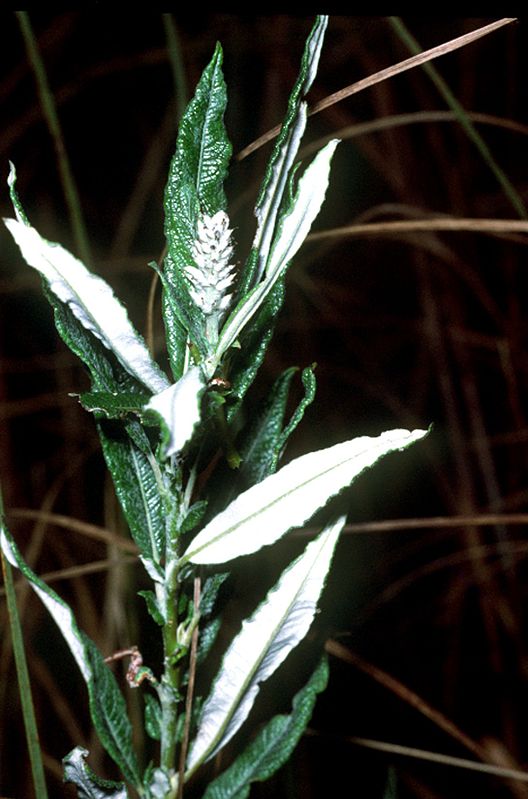
Salix candida
Sage Willow · Sageleaf willow · Hoary Willow · Sage-leaved Willow
Description
Source: leafsnapSalix candida, also known as sageleaf willow, is a shrub in the Salicaceae family found in northern United States and Canada. It is 0.5 to 3.5 m tall.
Care Guide
💧 Water
The sageleaf willow is well-suited to changing moisture levels and can tolerate moderate drought conditions. It should be watered every 2 to 3 weeks, allowing the soil to dry out slightly between waterings. This plant thrives in cooler outdoor climates, where it benefits from natural humidity. It prefers soil that is moist but drains well.
☀️ Light Full sun
Sageleaf willow is native to open habitats, such as sunny meadows and forest edges, which provide abundant light. It grows best in Full Sun but can also tolerate Partial Sun, adapting well to different sunlight conditions.
What are the sunlight requirements for plants?
Plants typically need varying amounts of sunlight to thrive, which can be classified as Full Sun or Partial Sun. Full Sun refers to areas that receive more than 6 hours of direct sunlight per day, ideal for plants that thrive in lots of light. Partial Sun means about 3-6 hours of sunlight each day, suitable for plants that can handle some shade. It's important to observe how sunlight moves through your garden to find spots that offer the right balance of light and shade, ensuring your plants' happiness and health.
What kind of environment does Sageleaf willow prefer?
Sageleaf willow flourishes in environments that offer ample light, such as sunny meadows and the edges of forests. These areas provide the Full Sun conditions the Sageleaf willow thrives in, though it can also adapt to Partial Sun, making it versatile in various lighting conditions. The plant's origin in open, sunny environments dictates its sunlight requirements and tolerance levels.
How can artificial lighting be used for indoor plants?
When natural sunlight is insufficient, especially during winter or in less sunny spaces, artificial lighting becomes crucial for indoor plants' growth. LED lights are a popular choice due to their efficiency and the ability to customize wavelengths needed by plants. For optimal growth, Full Sun plants should have 30-50W/sq ft of artificial light, Partial Sun plants require 20-30W/sq ft, and Full Shade plants need 10-20W/sq ft. The light source should be placed 12-36 inches above the plant, and the duration should mimic natural daylight hours, typically 8-12 hours per day.
What are the symptoms of light deficiency in Sageleaf willow?
Sageleaf willow may show various symptoms when experiencing light deficiency, including smaller new leaves, leggy or sparse growth due to longer spaces between leaves or stems, faster leaf drop, slower or no new growth, lighter-colored new leaves, and conditions such as chlorosis, sunscald, leaf curling, wilting, and leaf scorching. These symptoms indicate that the plant is not receiving adequate sunlight, impacting its health and growth.
What solutions can help plants affected by insufficient sunlight?
To combat insufficient sunlight, gradually moving plants to sunnier locations can help, aiming for at least 6 hours of direct sunlight daily. For indoor plants that are large or immobile, consider using artificial lighting, ensuring it's on for at least 8 hours a day. For outdoor plants, gradual relocation to sunnier spots is key to avoiding sunburn. Minimize obstructions to sunlight by pruning or relocating plants, especially during dormant periods. Remember, while parts of the plant affected by low light may not recover, new growth should be healthy with improved light exposure.
🌡️ Temperature 0–25°C
Sageleaf willow is highly adaptable to a wide range of climates, from sweltering summers to cold winters. Still, it has an optimal temperature range for growth. If temperatures climb too high, the plant is vulnerable to heat and humidity stress, which can cause it to die. In areas where temperatures reach the lower edge of its cold tolerance, it's important to use insulation measures to protect the plant.
What is Sageleaf willow?
Sageleaf willow, known botanically as Salix candida, is a type of willow. Unfortunately, the provided information does not include details about its essentials or symptoms associated with it. Further research may be required to understand more about its characteristics and any specific care or conditions it may need.
💨 Humidity
🪴 Soil 6-8
🌱 Fertilizer
Fertilize your Sageleaf willow in early spring to encourage healthy growth. Regular feeding improves overall health, leading to strong growth, better tolerance of harsh conditions, and increased resistance to pests and disease. Adhere to a consistent fertilization schedule for your Sageleaf willow to keep the foliage vivid in color and full in appearance.
🪴 Pot & Repot
✂️ Pruning
To keep your sageleaf willow healthy and well-shaped, prune it in early spring before new growth starts. Begin by removing any dead or damaged branches. Light annual trimming is beneficial for promoting airflow, reducing the risk of fungal issues, and encouraging new growth and flowering. However, be careful to avoid heavy pruning, as it can stress the plant.
🌿 Propagating
🐛 Diseases & pets
☠️ Toxicity
Characteristics
- Plant Type
- Shrub
- Life Cycle
- Perennial
- Genus
- Salix
- Family
- Salicaceae
- Hardiness Zone
- 2-6
- Mature Height
- 0.3 m to 1.07 m
- Mature Spread
- 0.91 m to 2.13 m
- Leaf Color
- Silver, Gray
- Leaf Type
- Deciduous
- Flower Color
- Yellow
- Flower Size
- 2.03 cm to 4.06 cm
- Bloom Time
- Early spring, Mid spring
- Planting Time
- Spring, Summer
- Harvest Time
- Late spring, Early summer