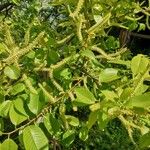
Salix chaenomeloides
Giant pussy willow · Japanese pussy willow
Description
Source: wikipedia (CC BY-SA)Salix chaenomeloides is a species of willow native to Japan, Korea, and China. The species was first described in 1938 by Arika Kimura.
Care Guide
💧 Water
The giant pussy willow needs regular watering, particularly in the summer when seedlings require daily moisture. While mature plants can handle some drought, they still benefit from daily watering during dry spells. Be careful not to drain excess water, as the mature roots can tolerate waterlogging quite well.
☀️ Light Full sun
Giant pussy willow is native to open habitats, such as sunny meadows and forest margins, which provide abundant light. It thrives in Full Sun but can also tolerate Partial Sun, adapting well to a range of sunlight conditions.
🌡️ Temperature 10–32.2°C
Giant pussy willow is highly adaptable to a range of climates, tolerating both blistering summers and cold winters. Nonetheless, it requires a specific temperature range for optimal growth. If temperatures climb too high, the plant can experience heat and humidity stress that may kill it. In areas where temperatures approach the lower boundary of its cold tolerance, taking insulating measures to protect the plant is important.
💨 Humidity
🪴 Soil 6-8
🌱 Fertilizer
Timing is important when fertilizing Giant pussy willow. Begin fertilizing in early spring and continue once a month until early summer. Fertilizer promotes attractive blooms and provides energy during both dormant and active growth periods.
🪴 Pot & Repot
✂️ Pruning
To ensure your giant pussy willow thrives, begin by pruning it in early spring. This helps remove any dead or damaged branches, improves light and air circulation, and promotes healthy growth. Be sure to prune back to healthy buds and use clean tools to prevent disease. Regular pruning encourages blooming and helps maintain the plant's shape.
🌿 Propagating
🐛 Diseases & pets
☠️ Toxicity
Characteristics
- Plant Type
- Tree
- Life Cycle
- Perennial
- Genus
- Salix
- Family
- Salicaceae
- Hardiness Zone
- 6-8
- Mature Height
- 10.06 m to 20.12 m
- Mature Spread
- 0.91 m to 1.83 m
- Leaf Color
- White, Green, Gray
- Leaf Type
- Deciduous
- Flower Color
- Yellow, White
- Flower Size
- 2.54 cm to 7.62 cm
- Bloom Time
- Late winter, Early spring
- Planting Time
- Spring
- Harvest Time
- Mid spring, Late spring
- Native Area
- South Korea, Japan, China