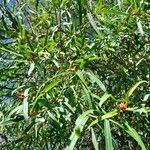
Salix humboldtiana
Humboldt's willow · Chile willow
Description
Source: leafsnapSalix humboldtiana, called Humboldt's willow, is a tree species of willow native to North and South America, growing along watercourses. Some authorities consider it a synonym of Salix chilensis, which Molina described in 1782. Willdenow described Salix humboldtiana in 1805.
Care Guide
💧 Water
The Chilean pencil willow is a drought-tolerant plant well-suited to varying moisture conditions. It typically needs watering every 2-3 weeks. As a riparian species, it naturally thrives along waterways. During its dormancy, the willow requires even less frequent irrigation, as its growth cycles align with the seasonal availability of water.
☀️ Light Full sun
Chilean pencil willow requires ample sunlight to grow vigorously, preferring direct daytime light to optimize photosynthesis. Its native temperate habitats provide plentiful light that supports effective growth. However, reduced sun exposure can still allow it to maintain a healthy growth cycle. Both excessive and insufficient light can hinder its overall growth.
What are the sunlight requirements for Chilean pencil willow?
Chilean pencil willow thrives best with abundant sun exposure, preferring the undiluted light of day to maximize photosynthesis. Originating from temperate environments, it requires more than 6 hours of sunlight daily (full sun) for robust growth. However, it can also manage with about 3-6 hours of sunlight (partial sun), although limited exposure may affect its growth. It's important to note that both excessive and insufficient sunlight can hinder the plant's overall health. Observing the movement of sunlight through your garden and choosing spots that offer a balance of light and shade can ensure the happiness and health of your plants.
What are the artificial lighting requirements for indoor Chilean pencil willows?
For indoor Chilean pencil willows or other plants that require ample light, artificial lighting can be a vital solution, especially when natural sunlight is insufficient. LED lights are recommended for their ability to be customized to provide specific wavelengths needed by plants. Full sun indoor plants need about 30-50W/sq ft of artificial light, partial sun plants require 20-30W/sq ft, and full shade plants need 10-20W/sq ft. The light source should be placed 12-36 inches above the plant to mimic natural sunlight, and the duration of light should mimic natural daylight hours, usually 8-12 hours per day for most plants.
What are the symptoms of insufficient or excessive sunlight in Chilean pencil willow?
The Chilean pencil willow shows several symptoms when it experiences suboptimal lighting conditions. Insufficient light can lead to smaller new leaves, leggy or sparse growth, faster leaf drop, slower or halted growth, and lighter-colored new leaves indicating a lack of chlorophyll. Excessive sunlight can cause chlorosis (yellowing leaves due to chlorophyll breakdown), sunscald (damage from intense exposure), leaf curling as a defense mechanism, wilting from increased water loss, and leaf scorching characterized by brown, dry edges on leaves. These symptoms reflect the plant's struggle with light conditions outside its preferential range.
How can the growth of Chilean pencil willow be optimized in terms of sunlight?
To optimize the growth of Chilean pencil willow, gradually acclimate the plant to the right amount of sunlight. For indoor plants, move them to a sunnier location weekly until they receive at least 6 hours of direct daily sunlight, typically using a south-facing window. Artificial lighting such as desk lamps or grow lights can supplement light for large or immobile plants. Outdoors, plants should be moved progressively to sunnier spots, avoiding sudden changes to prevent sunburn. Pruning obstacles or transplanting can also enhance sunlight access. It's vital to note that while parts of the plant damaged by insufficient sunlight may not recover, new growth will be healthier with improved light conditions.
🌡️ Temperature 0–32.2°C
Chilean pencil willow originates from temperate regions and performs best in cooler to moderately warm temperatures of 32 to 90 °F (0 to 32 ℃). Its adaptations include reducing water during freezing temperatures and moving the plant to cooler spots during periods of high heat.
What is the ideal temperature range for Chilean pencil willow?
The Chilean pencil willow thrives in temperate climates, preferring a temperature range from 32 to 90 °F (0 to 32 °C). This plant is adept at adjusting its water intake during freezing temperatures and should be moved to cooler areas when it's excessively hot.
Does the Chilean pencil willow require any special care during winter?
The Chilean pencil willow is remarkably tolerant to cold and does not require additional measures to protect it from frost during winter. To prepare for the first freeze of autumn, it's advisable to water the plant generously so the soil remains moist and enters a frozen state, which helps prevent drought and water scarcity for the plant throughout winter and into early spring.
What should I do if my Chilean pencil willow is exposed to temperatures below -40°C?
Although the Chilean pencil willow is extremely cold-tolerant, keeping winter temperatures above -40°C is crucial. Should temperatures fall below this, the plant may not show immediate distress, but its branches could become brittle and dry, failing to produce new shoots in spring. Pruning dead branches that have not produced new leaves is recommended in spring.
How does high temperature affect Chilean pencil willow and what are the remedies?
Chilean pencil willow is vulnerable to high temperatures; if the thermometer climbs above 32°C, the plant might lose leaves, or, in extreme cases, wither completely. Remedies include trimming sunburned or dried parts, relocating the plant to shaded areas or using shade cloth for protection, and ensuring the soil stays moist with morning and evening watering.
💨 Humidity
🪴 Soil 6-8
🌱 Fertilizer
Correct timing is vital for fertilizing the Chilean pencil willow. Apply fertilizer in early spring and continue once a month until early summer. Fertilizer promotes attractive blooms and supplies energy both during dormancy and in periods of active growth.
🪴 Pot & Repot
✂️ Pruning
To encourage healthy growth, the Chilean pencil willow should be pruned early in the spring. Effective pruning techniques include removing dead branches, thinning the tree for better airflow, and shaping it to ensure symmetry. Making clean cuts helps minimize damage to the plant. Regular pruning also aids in preventing diseases and pests, resulting in a stronger, more robust tree.
🌿 Propagating
🐛 Diseases & pets
☠️ Toxicity
Characteristics
- Plant Type
- Tree, Shrub
- Life Cycle
- Perennial
- Genus
- Salix
- Family
- Salicaceae
- Hardiness Zone
- 2-7
- Mature Height
- 24.99 m
- Mature Spread
- 20 cm to 76 cm
- Leaf Color
- Light Green, Yellow Green
- Leaf Type
- Deciduous
- Flower Color
- Yellow, Green
- Flower Size
- 0.25 cm
- Bloom Time
- Early spring, Mid spring
- Planting Time
- Spring, Summer, Autumn
- Harvest Time
- Late spring, Early summer
- Native Area
- Uruguay, Colombia, Chile, Belize, Paraguay, Argentina, Honduras, Mexico, Guatemala, Bolivia, Venezuela, Peru, Brazil, El Salvador, Nicaragua, Ecuador, Costa Rica, Panama