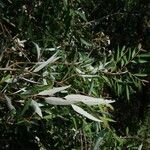
Salix laevigata
Polished Willow · Red willow
Description
Source: leafsnapSalix laevigata, commonly known as the red willow or polished willow, is a deciduous shrub or small tree belonging to the Salicaceae family. Native to Europe and western Asia, this plant can grow up to 10 meters tall. It features smooth, reddish-brown bark and shiny, lance-shaped leaves with serrated edges. The red willow blooms in early spring, producing small yellow flowers arranged in catkins. It prefers moist soils and is typically found near streams, rivers, wetlands, and other water bodies. Historically, the red willow has been utilized for medicinal purposes due to its anti-inflammatory properties. Its flexible branches have also made it a popular choice for basket weaving. Beyond its medicinal and practical uses, the red willow plays a crucial role in stabilizing riverbanks and preventing soil erosion with its extensive root system. Additionally, it provides vital habitat for various wildlife species, including birds and insects. In summary, Salix laevigata is an important plant species with numerous ecological benefits and traditional human uses throughout history.
🎭 Affection, Fortune-telling, Safeguarding
Care Guide
💧 Water Every 7 days
The Red Willow is well-adapted to withstand moderate drought conditions and flourishes in environments with balanced humidity. Originating from arid regions, it needs to be watered every 2-3 weeks. As a deciduous plant, the Red Willow sheds its leaves seasonally to conserve water during the drier months.
☀️ Light Full sun
Red Willow flourishes with ample light but can tolerate dimmer conditions. Sunlight plays a major role in its healthy development. In its native habitat, it is found in areas with abundant sunshine. Excessive exposure can cause light damage, while too little light can restrict its growth.
What are the sunlight requirements for Red Willow?
Red Willow requires full sun, which means it thrives in conditions with more than 6 hours of direct sunlight per day. However, it can also tolerate partial sun, receiving about 3-6 hours of sunlight daily. It's essential to observe how sunlight moves through your garden to ensure that you're providing the right balance of light for the plant's optimum growth. Incorrect sunlight exposure can either result in light damage from overexposure or hinder growth due to insufficient light.
What essentials should be considered for growing Red Willow?
Red Willow thrives best in plentiful illumination and requires significant sun exposure for healthy growth, as it originates from regions abundant in sunshine. Insufficient sunlight can impede its growth, whereas too much direct sunlight might cause light damage. In cases where natural sunlight is inadequate, especially during winter or in spaces with less natural light, artificial lighting can be beneficial. LED lights are recommended for their efficiency and the ability to tailor specific wavelengths needed by the plant. The required wattage depends on the type of plant, with full sun plants needing 30-50W\/sq ft, partial sun plants 20-30W\/sq ft, and full shade plants 10-20W\/sq ft. The artificial light source should be placed 12-36 inches above the plant and kept on for 8-12 hours per day to mimic natural sunlight conditions.
What are the symptoms of light deficiency or overexposure in Red Willow?
In conditions of light deficiency, Red Willow may show several symptoms including smaller new leaves, leggy or sparse growth, accelerated leaf drop, slower or halted growth, lighter-colored new leaves, and potential chlorosis, where leaves lose their green color. Overexposure to sunlight can lead to symptoms such as sunscald, which appears as pale, bleached areas on the plant, leaf curling as a defense mechanism against sunlight, wilting due to excessive water loss, and leaf scorching characterized by brown, dry edges on leaves. These symptoms indicate the plant's struggle with the current light conditions, whether it's too much or too little light.
What solutions can alleviate symptoms of improper lighting for Red Willow?
For optimal growth under indoor conditions, gradually move the Red Willow towards a sunnier spot each week, aiming for at least 6 hours of direct sunlight daily. Utilize south-facing windows and keep curtains open. If the plant is large or not easily movable, consider artificial lighting, keeping it on for at least 8 hours a day. For outdoor plants, also opt for a gradual increase in sunlight exposure to prevent sunburn. If your outdoor environment blocks sunlight, such as through trees or buildings, pruning or relocating the plants can help. When transplanting smaller plants, do so during their dormant period and ensure the new location offers ample sunlight and good drainage. It's important to note that parts of the plant already damaged by insufficient lighting might not recover, but new growth should be healthy with proper care.
🌡️ Temperature 5–35°C
Red Willow is native to habitats with a moderate temperature range of 41 to 95 °F (5 to 35 ℃). It generally favors cooler temperatures. When temperatures fluctuate, it's important to adjust Red Willow's exposure to extreme heat or cold to ensure healthy growth.
What is the native environment and preferred temperature for Red Willow?
Red Willow, also known by its botanical name Salix laevigata, is native to environments that have moderate temperature ranges between 41 to 95 °F (5 to 35 °C), generally preferring cooler temperatures. It exhibits strong cold resistance, making it adaptable to various climates while thriving best within its preferred temperature range.
How should Red Willow be protected during extreme temperatures?
To protect Red Willow from extreme temperatures, adjustments should be made to its exposure to heat or cold. While special frost protection measures are usually not necessary thanks to its strong cold resistance, it's important to provide extra protection if temperatures are expected to drop below -25°C. This can be done by wrapping the trunk and branches with insulating materials like non-woven fabric or cloth. Before the onset of the first freeze in autumn, it's also recommended to water the plant abundantly to maintain soil moisture, which helps prevent drought and water scarcity during winter and early spring.
What are the symptoms and solutions for Red Willow in low temperatures?
In low temperatures, Red Willow exhibits remarkable cold tolerance, best thriving when the temperature is above 5°C and should ideally be kept above -20°C. If temperatures fall below -25°C, the branches may become brittle and dry by spring, with a noticeable lack of new shoots. The solution for these symptoms is to prune away any dead branches that have failed to produce new leaves in spring.
What are the symptoms and solutions for Red Willow in high temperatures?
During the summer, it's crucial for Red Willow's health to keep temperatures below 35°C. If the temperature exceeds 41°C, symptoms such as lighter leaf color, dry and withered tips, and increased susceptibility to sunburn may appear. To mitigate these effects, trim away sunburned and dried parts, move the plant to a shaded location or use a shade cloth to protect it from midday and afternoon sun, and ensure the soil remains moist by watering in the morning and evening.
💨 Humidity
🪴 Soil 6-7
🌱 Fertilizer
Fertilize your Red Willow in early spring to encourage healthy growth. Regular feeding improves its overall health, leading to vigorous growth, better tolerance of harsh conditions, and greater resistance to diseases and pests. Keep to a consistent fertilization schedule for your Red Willow to preserve lively, deeply colored foliage and a lush appearance.
🪴 Pot & Repot
✂️ Pruning
Red Willow flourishes when pruned regularly, preferably in early spring. Important techniques include removing dead wood, thinning out crowded branches, and shaping the plant for aesthetic appeal. Using clean, sharp tools to make cuts just above bud nodes promotes healthy growth and helps prevent disease.
🌿 Propagating
🐛 Diseases & pets
☠️ Toxicity
Characteristics
- Plant Type
- Tree
- Life Cycle
- Perennial
- Genus
- Salix
- Family
- Salicaceae
- Hardiness Zone
- 5-10
- Mature Height
- 14.02 m
- Mature Spread
- 10.36 m to 11.89 m
- Leaf Color
- Dark Green, Olive Drab
- Leaf Type
- Deciduous
- Flower Color
- Yellow, Green
- Flower Size
- 2.03 cm to 5.08 cm
- Bloom Time
- Early spring, Mid spring
- Planting Time
- Spring, Autumn
- Harvest Time
- Late spring, Early summer
- Native Area
- Mexico