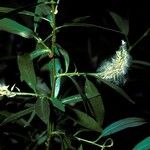
Salix lasiandra
Pacific Willow · Western black willow · Golden willow
Description
Source: leafsnapSalix lucida, the shining willow, Pacific willow, red willow, or whiplash willow, is a species of willow native to northern and western North America, occurring in wetland habitats. It is the largest willow found in British Columbia.It is a deciduous large shrub or small tree growing to 4–15 metres (13–49 ft) tall. The shoots are greenish-brown to grey-brown. The leaves are narrow elliptic to lanceolate, 4–17 centimetres (1+1⁄2–6+1⁄2 in) long and 1–3.5 cm (1⁄2–1+1⁄2 in) broad, glossy dark green above, usually glaucous green below, hairless or thinly hairy. The flowers are yellow catkins 1–9 cm (1⁄2–3+1⁄2 in) long, produced in late spring after the leaves emerge.The subspecies are: S. l. lucida – shining willow, Newfoundland west to eastern Saskatchewan, and south to Maryland and South Dakota S. l. lasiandra (Benth.) E.Murray (syn. S. lasiandra Benth.) – Pacific willow, Alaska east to Northwest Territory, and south to California and New Mexico. S. l. caudata (Nutt.) E.Murray – whiplash willow, interior western North America from eastern British Columbia south to eastern California and Nevada, included in S. l. lasiandra by some authors.It is closely related to Salix pentandra of Europe and Asia.
Care Guide
💧 Water
☀️ Light Full sun
The subspecies Salix lucida lasiandra is native to open habitats like sunny grasslands and borders of forests that offer plentiful sunlight. Though it flourishes in conditions of Full Sun, it can withstand Partial Sun as well, demonstrating apt adaptation in various light conditions.
🌡️ Temperature 5–32.2°C
Salix lucida subsp. lasiandra shows exceptional adaptability to different weather conditions, be it blazing hot summers or freezing winters. Nonetheless, there is an ideal temperature range for its development. If temperatures get extremely high, the plant can suffer from heat and humidity stress, potentially leading to its death. In areas where temperatures near the lower end of its cold tolerance, it's crucial to use insulation techniques to safeguard the plant.
💨 Humidity
🪴 Soil 6-8
🌱 Fertilizer
Encourage healthy development in your Salix lucida subsp. lasiandra by applying fertilizer in the early spring. Regular application of fertilizer boosts its general health, leading to robust growth, increased ability to withstand harsh conditions, and heightened resistance to diseases and pests. Adhering to a particular fertilization regimen for your Salix lucida subsp. lasiandra will ensure its leaves are vibrant, deeply colored, and maintain a lush look.
🪴 Pot & Repot
✂️ Pruning
🌿 Propagating
🐛 Diseases & pets
☠️ Toxicity
Characteristics
- Plant Type
- Tree
- Life Cycle
- Perennial
- Genus
- Salix
- Family
- Salicaceae
- Hardiness Zone
- 4-8
- Mature Height
- 6.1 m to 11.89 m
- Mature Spread
- 3.96 m to 7.92 m
- Leaf Color
- Dark Green, Green
- Leaf Type
- Deciduous
- Flower Color
- Yellow
- Flower Size
- 1.02 cm to 2.03 cm
- Bloom Time
- Early spring, Mid spring
- Planting Time
- Spring, Summer
- Harvest Time
- Late spring, Early summer