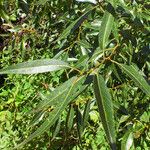
Salix lucida
Shining willow · Shinging willow · Pacific willow · Whiplash willow · Glossy Willow
Description
Source: leafsnapSalix lucida, commonly known as the shiny willow or Pacific willow, is a deciduous shrub or small tree native to North America. It can reach up to 10 meters in height and features a narrow crown with slender branches. The leaves are glossy, lance-shaped, and have finely serrated edges, typically measuring 5-10 cm in length. The bark of the shiny willow is smooth and grayish-brown. In early spring, before the leaves emerge, the shiny willow produces small yellowish-green flowers. These flowers are followed by small capsules containing numerous tiny seeds that are dispersed by the wind. This plant thrives in moist soils typically found alongside streams, rivers, and wetlands, or in areas with high water tables. However, it can also tolerate drier soils once established. The shiny willow provides essential habitat for wildlife, including birds that use its branches for nesting. Traditionally, the bark of Salix lucida has been used by indigenous peoples for its medicinal properties, such as treating headaches and fever due to its anti-inflammatory effects. Overall, Salix lucida is an ecologically important species. It helps stabilize stream banks and provides habitat for wildlife. Additionally, it holds cultural significance for indigenous peoples in North America, who have utilized it for traditional medicinal purposes.
Care Guide
💧 Water Every 7 days
Shining willow thrives in moist environments and flourishes in wet soil, even tolerating short periods of flooding. To maintain optimal conditions, water the plant every 2-3 weeks, ensuring the soil remains damp but not waterlogged. Generally, shining willow is best suited for outdoor cultivation, where conditions mimic those found near riverbanks or lakeshores, with consistently moist soil.
☀️ Light Full sun
Shining willow does best in places where sunlight is uninterrupted all day, ensuring ideal light exposure. Both excessive and insufficient light can impede growth: too much may scorch the leaves, while too little can leave it with a dull appearance. It originated in habitats that receive abundant sunshine throughout the day.
What are the sunlight requirements for Shining Willow?
Shining Willow requires full sun, defined as more than 6 hours of sunlight per day, to thrive optimally. It can also tolerate partial sun, receiving about 3-6 hours of sunlight daily. It's essential to observe your garden's sunlight patterns to ensure your plants are positioned to receive the appropriate balance of light and shade for their health.
How does Shining Willow respond to different lighting conditions?
Shining Willow thrives under full sun exposure throughout the day without any obstructions, which is vital for its growth and health. Excessive light can cause leaf burn, while insufficient light leads to a dull appearance. In situations where natural light is not adequate, especially indoors during winter or in less sunny areas, artificial lighting can be used to promote healthier growth. LED lights are recommended for indoor plants, with varying wattage based on the plant's sunlight needs: 30-50W/sq ft for full sun plants, 20-30W/sq ft for partial sun plants, and 10-20W/sq ft for full shade plants. The ideal placement is 12-36 inches above the plant to mimic natural sunlight, and the duration should mimic natural daylight hours, typically 8-12 hours per day.
What are the signs of improper lighting for Shining Willow?
Symptoms of light deficiency in Shining Willow include smaller new leaves, leggy or sparse growth, faster leaf dropping, slower or stopped growth, lighter-colored new leaves, and symptoms of too much light include chlorosis, sunscald, leaf curling, wilting, and leaf scorching. These symptoms indicate the plant is not receiving the optimal amount of sunlight, leading to poor health and growth.
How can I address lighting issues for Shining Willow?
To address lighting issues for Shining Willow, gradually move the plants to sunnier locations to ensure they receive at least 6 hours of sunlight daily. This can be achieved by using south-facing windows indoors and keeping obstructions like curtains open during the day. If moving the plant is not feasible, consider supplemental artificial lighting for at least 8 hours daily. Outdoors, avoid sudden changes in sunlight exposure. If light obstruction is an issue, prune blocking branches or relocate smaller plants to sunnier spots, especially during their dormant period. Note that parts of the plant damaged by insufficient sunlight may not recover, but new growth will be healthy with improved light conditions.
🌡️ Temperature 5–35°C
Shining willow originates from temperate climates and grows best in temperatures between 41 and 95 °F (5 and 35 ℃). It is recommended to keep the plant well insulated during the winter months so it can cope with cooler temperatures.
What is the ideal temperature range for Shining Willow?
Shining Willow thrives best in temperate climates with ideal temperatures ranging from 41 to 95 °F (5 to 35 °C). It is adapted to cooler temperatures and has strong cold resistance. Even though special frost protection measures are usually not needed, ensuring the plant is well insulated during the winter months is advised, especially if winter temperatures are expected to drop below -25°C.
How should Shining Willow be protected during winter?
During winter, it is important to protect Shining Willow if temperatures are expected to drop below -25°C by wrapping the trunk and branches with non-woven fabric or cloth. Before the first freeze in autumn, watering the plant abundantly to ensure the soil remains moist and enters a frozen state is recommended. This helps prevent drought and water scarcity for the plant during winter and early spring.
What are the symptoms of exposure to low temperatures for Shining Willow, and how can they be addressed?
Shining Willow is cold-tolerant and thrives when temperature is maintained above 5°C, but should be kept above -20°C during winter. If temperatures fall below -25°C, the branches may become brittle and dry during spring, and no new shoots will emerge. To address this, prune away any dead branches that have failed to produce new leaves in spring.
What are the symptoms of exposure to high temperatures for Shining Willow, and how can they be mitigated?
During summer, it is important to keep Shining Willow below 35°C. Exposure to temperatures above 38°C may cause the leaves to become lighter in color, the tips may become dry and withered, and the plant may become more susceptible to sunburn. Mitigate these issues by trimming away sunburned and dried-up parts, moving the plant to a shaded location or using a shade cloth to protect it from midday and afternoon sun, and watering the plant in the morning and evening to maintain soil moisture.
💨 Humidity
🪴 Soil 5-7
🌱 Fertilizer
Fertilize your Shining willow in early spring to encourage healthy growth. Regular feeding boosts overall health, producing vigorous growth, greater tolerance of harsh conditions, and improved resistance to pests and disease. Keep a specific fertilization schedule for your Shining willow to maintain vibrant, deep-colored foliage and a lush appearance.
🪴 Pot & Repot
✂️ Pruning
The Shining Willow, known for its shimmering, lance-shaped leaves, is a fast-growing tree. To maintain its health and appearance, prune it in early spring. This helps remove dead or crossing branches and improves air circulation. Regular pruning not only encourages vigorous growth but also prevents the plant from becoming too dense. Always clean your tools before pruning to prevent the spread of disease and ensure the willow remains robust and attractive.
🌿 Propagating
🐛 Diseases & pets
☠️ Toxicity
Characteristics
- Plant Type
- Tree, Shrub
- Life Cycle
- Perennial
- Genus
- Salix
- Family
- Salicaceae
- Hardiness Zone
- 5-9
- Mature Height
- 0.91 m to 6.1 m
- Mature Spread
- 3.66 m to 6.1 m
- Leaf Color
- Dark Green, Forest Green
- Leaf Type
- Deciduous
- Flower Color
- Yellow
- Flower Size
- 2.54 cm to 5.08 cm
- Bloom Time
- Early spring, Mid spring
- Planting Time
- Spring, Autumn
- Harvest Time
- Late spring, Early summer