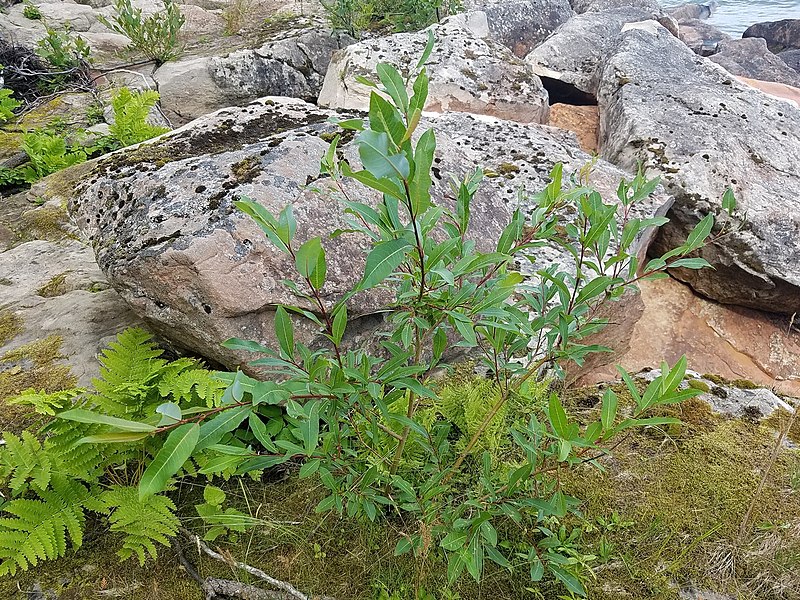
Salix myricoides
Blue-leaf willow · Broadleaf willow · Bayberry willow · Blue-leaved willow · Shoreline willow
Description
Source: leafsnapSalix myricoides, the bayberry willow or blue-leaf willow, is a species of flowering plant in the family Salicaceae, native to the Great Lakes region of the Midwestern United States, and to eastern Canada. It is typically found on beaches and dunes of the Lakes, and occasionally along inland streams and in fens, if calcareous. For example, in Maine it is found only on the ice-scoured shore of the St. John River.
Care Guide
💧 Water
The bayberry willow needs regular watering, especially when it is a seedling during the summer. It is best to water it daily around 5 PM. While mature plants are drought-resistant and their roots can handle excess moisture, you don't need to water them during rainy seasons. However, when it's dry, daily irrigation can be helpful.
☀️ Light Full sun
Bayberry willow is native to open habitats—such as sunny meadows and forest edges—where light is plentiful. It grows best in Full Sun but will also tolerate Partial Sun, showing good adaptability to different sunlight conditions.
What are the sunlight requirements for Bayberry willow (Salix myricoides)?
Bayberry willow (Salix myricoides) thrives in areas that fulfill its sunlight requirements. It needs full sun, meaning it should receive above 6 hours of sunlight daily. For those spots that can't provide as much light, partial sun, which equates to about 3-6 hours of sunlight, can also be sufficient. It's crucial to observe how sunlight moves through your garden throughout the day. Identifying spots that offer a harmonious balance of light and shade will ensure your Bayberry willow, along with other plants, are content and healthy.
🌡️ Temperature 0–25°C
Bayberry willow is highly adaptable to a range of climates, coping with both hot summers and cold winters. Nonetheless, it has an optimal temperature range for growth. When temperatures become too high, the plant is vulnerable to heat and humidity stress, which can lead to its death. In areas where temperatures approach the lower limit of its cold tolerance, it is important to provide insulation to protect the plant.
💨 Humidity
🪴 Soil 6-7
🌱 Fertilizer
Fertilize your Bayberry willow in early spring to encourage healthy growth. Regular feeding improves overall health, leading to vigorous growth, stronger tolerance of harsh conditions, and increased resistance to disease and pests. Stick to a consistent fertilization schedule for your Bayberry willow to preserve vibrant foliage with deep color and a lush appearance.
🪴 Pot & Repot
✂️ Pruning
The bayberry willow is a deciduous shrub with slender branches and narrow leaves. To maintain its health and appearance, prune it in early spring by removing dead wood and thinning out the branches to enhance airflow. This practice encourages robust growth, promotes strong new shoots, and helps reduce the risk of fungal issues. For more detailed pruning techniques, consult horticultural guidelines.
🌿 Propagating
🐛 Diseases & pets
☠️ Toxicity
Characteristics
- Plant Type
- Shrub
- Life Cycle
- Perennial
- Genus
- Salix
- Family
- Salicaceae
- Hardiness Zone
- 2-6
- Mature Height
- 2.13 m to 3.96 m
- Mature Spread
- 1.52 m to 3.05 m
- Leaf Color
- Dark Green, Olive Drab
- Leaf Type
- Deciduous
- Flower Color
- White, Yellow
- Flower Size
- 1.02 cm to 2.03 cm
- Bloom Time
- Early spring, Mid spring
- Planting Time
- Spring, Summer
- Harvest Time
- Late spring, Early summer