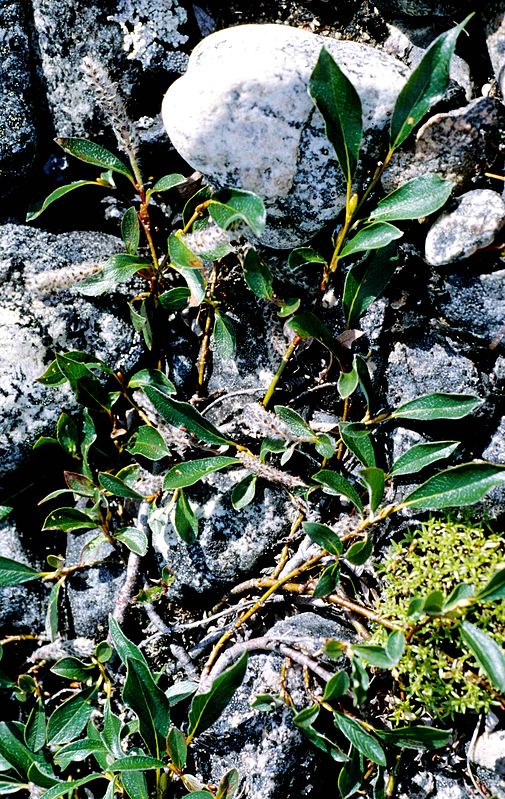
Salix planifolia
Mountain willow · Diamondleaf willow · Plainleaf Willow · Tea-Leaf Willow · Tea-leafed Willow
Description
Source: leafsnapSalix planifolia is a species of willow known by the common names planeleaf willow, diamondleaf willow, and tea-leafed willow. It is native to northern and western North America, including most of Canada and the western United States. It grows in many types of arctic and alpine habitats in the north, and mountainous areas in the southern part of its range.
Care Guide
💧 Water
The mountain willow needs regular watering, particularly for seedlings during the summer. In contrast, mature plants are more drought-tolerant. It's best to water the plants daily at around 5 p.m., but this should be adjusted according to the soil's moisture levels. During the rainy season, additional watering is not needed, as mature roots can handle waterlogging and do not require drainage.
☀️ Light Full sun
Mountain willow is native to open spaces like bright meadows and the outskirts of forests, where there is plenty of light. It flourishes under intense sunlight but can also withstand moderate sunlight, exhibiting good adaptability to different levels of sunlight exposure.
What are the sun requirements for Mountain Willow (Salix planifolia)?
Mountain Willow (Salix planifolia) thrives in various sunlight conditions. It requires full sun, which is above 6 hours of direct sunlight daily, to flourish fully. However, it can also adapt to partial sun, receiving about 3-6 hours of sunlight each day. When selecting a planting location, it's crucial to observe how sunlight moves through your garden. This observation will help you find spots that offer the perfect balance of light and shade, ensuring the plants grow happy and healthy.
🌡️ Temperature 0–32.2°C
Mountain willow is native to northern areas and high-mountain locales. It is highly sensitive to temperature and prefers cool conditions with good airflow in summer. Elevated summer heat can injure Mountain willow and even cause its death. Providing proper shade and regular misting during the hot months can help it get through the season. Typically, Mountain willow does not need special winter protection, but it is important to water it sufficiently before the ground freezes.
💨 Humidity
🪴 Soil 6-7
🌱 Fertilizer
To foster healthy development, administer fertilizer to your Mountain willow at the onset of spring. Systematic fertilization boosts the overall wellbeing, leading to robust growth, durability in challenging environments, and enhanced resistance to diseases and pests. Uphold a particular fertilization timetable for your Mountain willow to guarantee radiant foliage of intense color and a dense appearance.
🪴 Pot & Repot
✂️ Pruning
Mountain willow benefits from pruning early in the spring. This involves removing dead or damaged branches and thinning out dense areas to improve air circulation. Pruning after the last frost also encourages new growth and helps maintain the plant's shape and size. Be sure to use clean, sharp tools to prevent disease and ensure precise cuts.
🌿 Propagating
🐛 Diseases & pets
☠️ Toxicity
Characteristics
- Plant Type
- Shrub
- Life Cycle
- Perennial
- Genus
- Salix
- Family
- Salicaceae
- Hardiness Zone
- 2-7
- Mature Height
- 0.3 m to 3.96 m
- Mature Spread
- 0.91 m to 2.13 m
- Leaf Color
- Dark Green, Olive Drab
- Leaf Type
- Deciduous
- Flower Color
- Yellow
- Flower Size
- 1.02 cm to 2.03 cm
- Bloom Time
- Early spring, Mid spring
- Planting Time
- Spring, Summer
- Harvest Time
- Late spring, Early summer