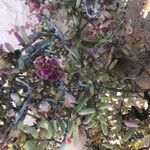
Salsola oppositifolia
Spanish gorse · Pink Saltwort
Description
Source: leafsnapSalsola oppositifolia, commonly referred to as the opposite-leaved saltwort, is a small shrub that belongs to the family Amaranthaceae. Native to the Mediterranean region, it thrives in arid and semi-arid environments. This plant features a woody stem that can reach up to 50 cm in height and has small, narrow, succulent leaves arranged oppositely. From June to September, Salsola oppositifolia produces tiny greenish-white flowers clustered at the branch tips. Its fruit is a small capsule containing a single seed. The plant is well-adapted to saline soils with high salt content. Traditionally, it has been used for medicinal purposes, such as treating skin diseases, fever, coughs, and colds. Moreover, Salsola oppositifolia plays a crucial role in soil conservation by stabilizing soil and preventing erosion caused by wind and water. In summary, Salsola oppositifolia is an intriguing shrub with unique adaptations for survival in harsh environmental conditions. It is valuable for ecological restoration projects and serves as an ornamental plant due to its attractive foliage, which exhibits varying colors throughout the year.
Care Guide
💧 Water Every 7 days
☀️ Light Full sun
Spanish gorse comes from bright, open habitats where it does best in full sun. It can tolerate some partial sun but prefers direct sunlight for optimal growth. This plant, which may be annual or biennial, is noted for its sun-loving nature.
🌡️ Temperature 5–35°C
Spanish gorse can tolerate a wide range of temperatures, but its distribution may still be restricted by different combinations of moisture and heat. It does best in warm summer climates with sufficient rainfall or irrigation. Extended periods of cloudy, rainy weather, as well as prolonged high temperatures, can increase the risk of Spanish gorse dying. In winter, adequate protection from cold can boost the plant’s survival rate.
💨 Humidity
🪴 Soil 6-8
🌱 Fertilizer
Spanish gorse benefits from regular, low-strength fertilizer applications to encourage healthy leaf growth. You should fertilize Spanish gorse about once a month during the summer months. Nitrogen is essential for foliage, and supplementing with nitrogen-rich sources helps Spanish gorse thrive.
🪴 Pot & Repot
✂️ Pruning
🌿 Propagating
🐛 Diseases & pets
☠️ Toxicity
Characteristics
- Plant Type
- Herb
- Life Cycle
- Annual
- Genus
- Salsola
- Family
- Amaranthaceae
- Hardiness Zone
- 4-9
- Mature Height
- 20 cm to 49 cm
- Mature Spread
- 15 cm to 30 cm
- Leaf Color
- Green, Gray
- Leaf Type
- Deciduous
- Flower Size
- 0.20 cm to 0.51 cm
- Bloom Time
- Summer
- Planting Time
- Autumn
- Harvest Time
- Late summer, Early fall, Mid fall
- Native Area
- Saudi Arabia, Libya, Egypt, Tunisia, Italy, Spain, Israel, Algeria, Morocco