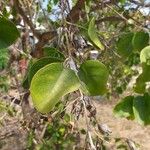
Salvadora persica
درخت مسواک · Toothbrushtree · Tooth-brush tree · Mustard tree · Mswaki
Description
Source: leafsnapSalvadora persica, commonly known as the toothbrush tree or miswak, is a small evergreen tree or shrub native to the arid regions of Africa and the Middle East. It can grow up to 6 meters tall and features a dense crown of small leaves. For centuries, the plant has been revered in traditional medicine for its antibacterial, anti-inflammatory, and analgesic properties. The twigs of Salvadora persica have been used as natural toothbrushes in many cultures for thousands of years. These twigs are chewed until they form bristles that can effectively clean teeth and gums. Research has demonstrated that using miswak can be just as effective at removing plaque as conventional toothbrushes. Beyond its dental benefits, Salvadora persica has been employed in traditional medicine to treat various ailments, including asthma, rheumatism, fever, and skin diseases. The plant contains compounds such as alkaloids and flavonoids, which are believed to possess medicinal properties. In arid regions, Salvadora persica is particularly valuable due to its ability to withstand drought conditions. Additionally, it serves as an important source of food for livestock, including camels. Overall, Salvadora persica is a versatile plant with a wide range of uses, from dental hygiene to medicinal applications, making it an essential part of many cultures around the world today.
Care Guide
💧 Water Every 7 days
The toothbrush tree is a drought-tolerant plant native to arid regions, which means it requires only infrequent watering – about every 2-3 weeks. It thrives outdoors, benefiting from natural rainfall and storing water in its tissues. Its adaptability makes it ideal for hot climates and xeriscaping.
How should I water my Toothbrush tree?
You can water your Toothbrush tree with any common watering tool, such as watering cans, hoses, or cups. It's important to water the soil directly and make sure all areas are equally moistened to support the root system. Using filtered water is recommended to avoid harmful particles in tap water. It's also best to use water that is at or slightly above room temperature, as extreme temperatures can shock the plant. However, the Toothbrush tree generally does well with any type of water.
What should I do if I give my Toothbrush tree too much or too little water?
Outdoor plants, especially newly planted ones or seedlings, are prone to lack of watering. It's important to water them enough for a few months while they are small or newly planted. Once the roots are established, Toothbrush trees can rely on rain most of the time. When planting Toothbrush trees in pots, overwatering is more likely to happen. If you accidentally overwater your Toothbrush tree, you should act immediately to fix the situation. First, stop watering the plant right away to minimize the damage caused by overwatering. Then, remove the Toothbrush tree from its pot to check its roots. If there is no root rot, you can return the plant to its container. However, if you find any signs of root rot, trim away the affected roots and consider using a fungicide to prevent further damage. Finally, repot the Toothbrush tree in well-draining soil. On the other hand, if your Toothbrush tree is underwatered, simply water it more frequently. Dealing with underwatering is usually a straightforward fix. When underwatered, the leaves of the plant will droop, dry out, and fall off. However, once you water it properly, the leaves will quickly go back to their normal fullness. Remember to adjust your watering frequency as soon as you notice underwatering.
How frequently should I water my Toothbrush tree?
Most outdoor plants can grow naturally with rainfall. However, if your area lacks rainfall, provide adequate watering every 2 weeks in the spring and fall. During the summer, more frequent watering is necessary, while in the winter, less water is needed. Young or newly planted Toothbrush trees require more frequent watering to establish themselves and become more adaptable to drought conditions. For potted plants, there are two ways to determine watering frequency for your Toothbrush tree. The first is to follow a predetermined schedule of once a week or every other week. However, this may not always be effective as it does not consider the specific growing conditions of your tree. Watering frequency can also vary depending on the season. During the summer, when water needs are highest, a predetermined schedule may not be enough. Alternatively, you can base your watering frequency on soil moisture. It is best to wait until the top two to four inches of soil (about ⅓ to ½ of the pot depth) have completely dried out before watering again.
How often should I water my Toothbrush tree?
When watering your Toothbrush tree, it's important to note that it doesn't always require a large amount of water. If only a few inches of soil have dried since your last watering, giving it about five to ten ounces of water each time will promote healthy growth. You can also determine how much water to give based on the moisture level of the soil. Take note of how many inches of soil have dried out before watering again. To ensure your Toothbrush tree receives enough moisture, water all the layers of dry soil since the last watering. If more than half of the soil has dried out, you may need to give more water than usual. In such cases, continue watering until excess water drains from the pot's drainage holes. If your Toothbrush tree is planted in a location that receives ample rain, it may not need additional watering. When the tree is young or establishing, provide 1-2 inches of rain per week. As it grows and becomes established, it can rely solely on rainwater, except during hot weather with no rainfall for 2-3 weeks. In those situations, a full watering is necessary to prevent stress.
How can I know if I'm giving enough water to my Toothbrush tree?
The Toothbrush tree is more commonly affected by overwatering. When this happens, there are several signs to look out for. The leaves of an overwatered Toothbrush tree will turn yellow and some may even fall off. Additionally, overwatering can cause the plant's overall structure to shrink and result in root rot. On the other hand, an underwatered Toothbrush tree will also begin to droop and wilt. Its leaves may become brown or brittle to the touch. Regardless of whether you notice signs of overwatering or underwatering, it is important to take action and restore the health of your Toothbrush tree.
☀️ Light Full sun
Preferring direct sunlight, the toothbrush tree prospers with maximum light exposure for vigorous growth. It developed in environments where shade is uncommon. Nevertheless, both excessive and insufficient light can, to some degree, affect the plant's health, resulting in stunted or irregular growth.
What are the sunlight requirements for a Toothbrush tree?
The Toothbrush tree requires full sun, which means it needs above 6 hours of sunlight daily to thrive effectively. It's important to observe the movement of sunlight through your garden to find spots that provide a perfect balance of light and shade, ensuring the plant's happiness. This care in placement will support the robust growth of the Toothbrush tree.
How does the Toothbrush tree respond to light and shade?
The Toothbrush tree thrives best under unobstructed rays of sunlight, as it evolved in habitats where shade is scarce. While this tree favors maximum light exposure for robust growth, both overexposure and underexposure to light can negatively impact its health, leading to stunted or irregular growth patterns. If natural sunlight is insufficient, especially during winter or in less sunny spaces, artificial lighting such as LED lights, can be utilized to provide the necessary wavelengths of light for optimal growth. For full sun plants, 30-50W/sq ft of artificial light is recommended.
What are common symptoms of light deficiency in Toothbrush trees?
When a Toothbrush tree doesn't receive adequate sunlight, it may exhibit symptoms like smaller new leaves, leggy or sparse growth, faster leaf drop, and slower or no new growth. Insufficient sunlight can also cause leaves to develop lighter colors or irregular patterns, indicating a lack of chlorophyll and essential nutrients. Other symptoms include chlorosis, sunscald, leaf curling, wilting, and leaf scorching, each representing different stress responses to varying light conditions.
How can I improve the light conditions for my Toothbrush tree?
To optimize growth, gradually increase the Toothbrush tree's exposure to sunlight by moving it to a sunnier location each week until it receives at least 6 hours of direct sunlight daily. For indoor plants, consider using artificial lighting, like desk lamps or professional plant grow lights, for at least 8 hours a day. For outdoor plants, ensure a gradual adaptation to prevent sunburn. If necessary, prune nearby trees to reduce shade or transplant smaller plants to sunnier spots. Note that while parts of the plant affected by insufficient light might not recover, new growth should be healthy with improved light conditions.
🌡️ Temperature 20–37.8°C
The Toothbrush tree is native to tropical areas, which are usually warm and humid. Consequently, it is suited to high temperatures and moisture. It is sensitive to sudden temperature changes and favors a steady thermal environment, so preventing indoor temperature swings is important. It typically does not tolerate cold and needs warmer conditions to grow. If the ambient temperature becomes too low, the plant may stop growing or even die.
💨 Humidity
🪴 Soil 7-8
🌱 Fertilizer
Fertilization is essential for the care of the Toothbrush tree. Regular feeding during the growing season helps maintain the energy required for its showy leaves and supports overall growth. Neglecting to fertilize can lead to unhealthy foliage, reduced ornamental appeal, and stunted or weak growth that is prone to breaking.
🪴 Pot & Repot
✂️ Pruning
Prune toothbrush trees from early to late winter to maintain their health and shape. Remove dead branches to improve airflow and light penetration. Thinning the branches helps to prevent disease and encourages new growth. Always use sterilized tools to ensure the tree remains healthy and vigorous.
🌿 Propagating
🐛 Diseases & pets
☠️ Toxicity
Characteristics
- Plant Type
- Tree, Shrub
- Life Cycle
- Perennial
- Genus
- Salvadora
- Family
- Salvadoraceae
- Hardiness Zone
- 10-11
- Mature Height
- 6.1 m to 7.01 m
- Mature Spread
- 7.92 m
- Leaf Color
- Green
- Leaf Type
- Evergreen
- Flower Color
- White
- Flower Size
- 10.16 cm
- Bloom Time
- Mid spring, Late spring, Early summer
- Planting Time
- Spring, Summer, Autumn
- Harvest Time
- Mid summer, Late summer, Early fall
- Native Area
- Sri Lanka, Libya, Somalia, Egypt, India, Burkina Faso, Angola, Namibia, Eritrea, Pakistan, Nigeria, Morocco, Yemen, Kenya, Niger, Tanzania, Zimbabwe, Mali, Mozambique, Oman, Ethiopia, Botswana, Saudi Arabia, Malawi, South Africa, Zambia, Sudan, Mauritania, Chad, Senegal, Iran, Algeria