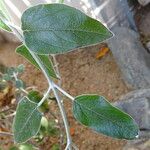
Salvia discolor
Andean sage
Description
Source: leafsnapSalvia discolor (Andean sage) is a herbaceous perennial flowering plant, growing in a very localized area in Peru. It is equally rare in horticulture and in its native habitat. William Robinson wrote of its charms in 1933. The plant is scandent, meaning that it climbs without the use of tendrils, with wiry white stems growing from its base. Mistletoe-green leaves of various sizes grow in pairs about 1–2 in apart on the stem, with the undersides covered in white hairs. The leaves, stem and flower buds all exhibit a strong and distinct odour of blackcurrant. The 1 in long deeply saturated dark purple flowers are held in a pistachio-green calyx, growing on 1 ft or longer inflorescences. The stems of the inflorescences are shiny and covered with glands, which frequently have insects stuck to them. It blooms during hot spells through summer and autumn and is a frequently grown ornamental on the French and Italian Rivieras, where it grows 3 ft high and wide.
🌳 Aside from its visual appeal, Mexican bush sage has ecological importance by attracting bees, hummingbirds, and butterflies, acting as an important nectar source in gardens. Its long-lasting, attractive flower spikes also make it a popular option as fresh or dried cut flowers for ornamental use in floral arrangements.
Care Guide
💧 Water
Andean Silver-Leaf Sage is well-suited for arid environments, thanks to its impressive drought tolerance. It needs to be watered every one to two weeks while maintaining balanced humidity. As an evergreen plant, Andean Silver-Leaf Sage retains its leaves throughout the year, which helps it optimize water retention and usage.
☀️ Light Full sun
Mexican Bush Sage grows best where it receives the most sun. It copes with reduced light, though this may diminish its vigorous growth. In its native habitat it is used to full sun, which promotes flowering. Prolonged lack of adequate sunlight can inhibit bud formation, while excessive sun exposure can weaken its vigor.
🌡️ Temperature 15–35°C
Mexican Bush Sage is native to warm climates and does best in temperatures from 68 to 95 °F (20 to 35 ℃). In colder settings, it is advisable to protect the plant from winter frost.
💨 Humidity
🪴 Soil 6-7
🌱 Fertilizer
The best time to fertilize a Mexican Bush Sage is in early spring, when it’s coming out of dormancy and starting active growth. Fertilization supplies essential nutrients needed for healthy growth. Although Mexican Bush Sage has relatively low fertilizer requirements, applying fertilizer annually can improve its survival and encourage better, longer-lasting blooms.
🪴 Pot & Repot Every 12 months
✂️ Pruning
The Andean Silver-Leaf Sage is known for its striking silver leaves and dark flowers. To keep the plant healthy and vibrant, it requires pruning in early spring. Trim one-third of the plant to maintain its shape and encourage new growth. Additionally, cut older stems down to the base to stimulate the development of new shoots, improve flowering, and enhance air circulation. Following these steps will ensure a lively and beautiful garden.
🌿 Propagating
🐛 Diseases & pets
☠️ Toxicity
Characteristics
- Plant Type
- Herb
- Life Cycle
- Perennial, Annual
- Genus
- Salvia
- Family
- Lamiaceae
- Hardiness Zone
- 7-10
- Mature Height
- 1.22 m
- Mature Spread
- 46 cm
- Leaf Color
- Green, Gray, Silver
- Leaf Type
- Evergreen
- Flower Color
- Purple, White
- Flower Size
- 2.03 cm
- Bloom Time
- Mid summer, Late summer, Early fall
- Planting Time
- Spring
- Harvest Time
- Mid summer, Late summer, Fall
- Native Area
- Honduras, Mexico, Venezuela, El Salvador, Costa Rica, Panama