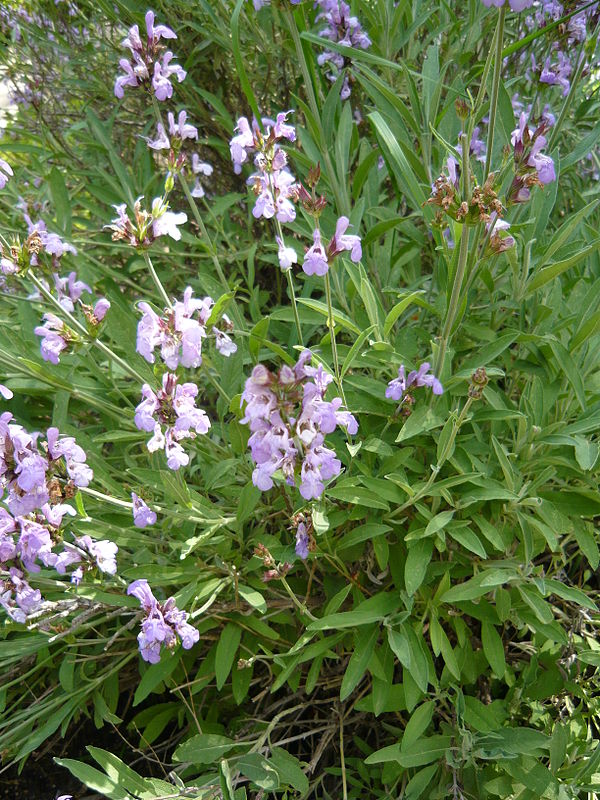
Salvia Lavandulifolia
Spanish Sage
Description
Source: leafsnapSalvia lavandulifolia (Spanish sage) is a small woody herbaceous perennial native to Spain and southern France, growing in rocky soil in Maquis shrubland, often found growing with rosemary, Lavandula lanata, and Genista cinerea.S. lavandulifolia grows 30 centimetres (1 ft) tall and wide, with a reclining habit and narrow, lanceolate, whitish-gray evergreen leaves that are less than 50 mm (2 in) long. The leaves grow opposite each other on the stem and appear to grow in bunches. When the leaves are rubbed, oils give off a fragrance similar to rosemary. These oils are used for scenting soaps. The 25 mm (1 in) long, pale lavender flowers grow on short inflorescences, blooming for about one month in late spring and early summer. The flowering stems have very few flowers on widely spaced whorls. Some varieties have a dark calyx.
Care Guide
💧 Water
☀️ Light Full sun
Spanish sage is native to areas with plenty of sunlight, including wide-open fields and sun-drenched meadows. While its optimal light situation is direct sunlight, it can also manage in partially sunlit conditions.
🌡️ Temperature 5–35°C
Spanish sage prefers a moderate climate, much like conditions that humans typically find pleasant. This plant does best in temperatures that aren't excessively hot or uncomfortably cold. Extreme heat presents a problem due to the possibility of sun scorching, and during the summer months, it is recommended to offer some shade to guard against overheating. In cooler temperatures, Spanish sage becomes dormant. If the goal is to have the plant grow continuously, sustaining warmer temperatures during winter months is important. Frost has the potential to harm the plant and should be kept at bay.
💨 Humidity normal (40-60%)
This plant will thrive in moderate humidity, which is probably the level in your home. However, misting it a few times a week can be very beneficial. Make sure the room has good ventilation.
🪴 Soil 6-7
🌱 Fertilizer
For optimal yield and taste of Spanish sage, it's important to provide enough nitrogen during all stages of growth, from before planting to harvesting. Plants that are sufficiently watered and fertilized will yield plenty of healthy leaves while keeping bitterness at bay. Before you plant, enhance the soil with organic substances such as compost or manure, ideally doing this between 2 to 8 weeks before.
🪴 Pot & Repot
✂️ Pruning
🌿 Propagating
🐛 Diseases & pets
☠️ Toxicity
Characteristics
- Plant Type
- Herb
- Life Cycle
- Perennial
- Hardiness Zone
- 5-9
- Mature Height
- 30 cm
- Mature Spread
- 30 cm
- Leaf Color
- Green, Gray, Silver
- Leaf Type
- Evergreen
- Flower Color
- Lavender
- Flower Size
- 1.02 cm to 1.52 cm
- Bloom Time
- Late spring, Early summer, Mid summer
- Planting Time
- Spring, Summer, Autumn
- Harvest Time
- Late summer, Early fall