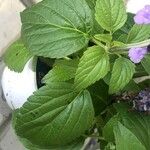
Salvia longispicata
Description
Source: leafsnapSalvia longispicata is a perennial shrub native to southwestern Mexico, growing between 1,000 and 6,500 feet (300 and 2,000 m) elevation. The specific epithet "longispicata" gives the impression that the plant has "long spikes", but instead refers to the many projecting clusters of short flowering spikes that resemble small ears of corn.Salvia longispicata is a large, fast growing Salvia, reaching 4 to 5 feet (1.2 to 1.5 m) high and 3 to 4 feet (0.9 to 1.2 m) wide in one season. While not particularly showy, it has unusual dark purple flowers and an upright habit—both qualities are valued by salvia hybridizers. The mid-green ovate leaves are many sizes, and connected to the petiole at the broader end. Small - less than 0.5 inches (1 cm) - dark purple flowers begin appearing in summer and bloom into late autumn. The pale green calyces are about the same length as the flower. The 6 to 8 inches (15 to 20 cm) inflorescences have tight whorls of flowers, which do not rise above the foliage as many other species of Salvia do. In 1979 a spontaneous sterile hybrid was found at Huntington Botanical Garden that was believed to be from a cross between Salvia longispicata and S. farinacea. It was introduced as the highly popular Salvia farinacea × longispicata 'Indigo Spires'. Other cultivars of this hybrid include 'Mystic Spires Blue'.
Care Guide
💧 Water
☀️ Light Full sun
Salvia longispicata is a perennial herbaceous plant that prefers sunny conditions and is native to open habitats, commonly found in meadows and grasslands. It favors full sun but can tolerate partial sun.
🌡️ Temperature 15–37.8°C
Salvia longispicata can tolerate a wide range of temperatures, though its distribution can still be restricted by specific combinations of moisture and heat. It grows best in warm summer climates with adequate rainfall or watering. Extended periods of cloudy, rainy weather or prolonged high temperatures can raise the chance of Salvia longispicata dying. In winter, proper protection from cold can increase the plant's survival rate.
💨 Humidity
🪴 Soil 6-7
🌱 Fertilizer
The best time to fertilize Salvia longispicata is in early spring, as it exits dormancy and starts active growth. Fertilizing supplies essential nutrients needed for healthy development. Although Salvia longispicata has fairly low fertilizer requirements, an annual application can boost its survival and encourage better, longer-lasting flowers.
🪴 Pot & Repot Every 12 months
✂️ Pruning
Salvia longispicata is known for its long flower spikes and fragrant leaves. To maintain its health and appearance, prune in early spring. Start by removing any dead wood and thinning out crowded areas to enhance air circulation. Cut the plant back by one-third to encourage a bushier growth. Regular deadheading will increase the number of blooms. Proper pruning not only improves the plant's health and aesthetic appeal but also reduces the risk of fungal diseases.
🌿 Propagating
🐛 Diseases & pets
☠️ Toxicity
Characteristics
- Plant Type
- Herb
- Life Cycle
- Perennial
- Genus
- Salvia
- Family
- Lamiaceae
- Hardiness Zone
- 8-11
- Mature Height
- 30 cm
- Mature Spread
- 40 cm
- Leaf Color
- Green, Dark Green
- Leaf Type
- Deciduous
- Flower Color
- Blue, Purple
- Flower Size
- 1.02 cm to 1.52 cm
- Bloom Time
- Summer, Fall
- Planting Time
- Spring, Summer, Autumn
- Harvest Time
- Late summer, Fall, Early winter
- Native Area
- Mexico