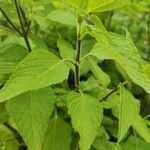
Salvia tiliifolia
Lindenleaf sage · Linden-leaf sage · Linden-leaved sage
Description
Source: leafsnapSalvia tiliifolia, commonly known as Mexican sage or lime-leaved sage, is a perennial herbaceous plant in the Lamiaceae family. Native to Mexico and Central America, it can grow up to 1.5 meters tall. The plant features large, heart-shaped leaves that are light green and emit a lime scent when crushed. Its flowers are tubular, appearing in shades of blue or purple with white markings on the lower lip. Salvia tiliifolia thrives in well-drained soil and full sun but can also tolerate partial shade. While it is drought-tolerant once established, it requires regular watering during its growing season. For centuries, indigenous people have used the plant for its anti-inflammatory properties. Additionally, it attracts pollinators such as bees, butterflies, and hummingbirds, making it an excellent addition to any garden or landscape. In summary, Salvia tiliifolia is an attractive herbaceous perennial that adds color and fragrance while offering medicinal benefits, making it a popular choice among gardeners worldwide.
Care Guide
💧 Water Every 7 days
Drought-resistant varieties of lindenleaf sage require very little watering and should be watered mainly during drought periods. On the other hand, tender varieties and young plants need regular watering, receiving about 2.5 cm (1 in) every 7-10 days to maintain proper soil moisture.
☀️ Light Full sun
Lindenleaf sage is a perennial herbaceous plant that favors sunny sites and originates from open habitats, frequently flourishing in meadows and grasslands. It prefers full sun but can also tolerate partial sun conditions.
🌡️ Temperature 20–37.8°C
Lindenleaf sage comes from tropical areas where the weather is generally warm and humid. Consequently, it is adapted to high temperatures and moisture. It dislikes abrupt temperature shifts and does best in a steady thermal environment, so indoor temperature swings should be avoided. It typically cannot tolerate cold and needs warmer conditions to grow. If the ambient temperature falls too low, the plant's growth may stop or it may die.
💨 Humidity
🪴 Soil 6-7
🌱 Fertilizer
Proper fertilization is vital for Lindenleaf sage's health and appearance. Fertilize Lindenleaf sage in summer, repeating the application monthly throughout the season. Nutrients fuel growth and help maintain the plant's parts. Fertilization improves Lindenleaf sage's flower display, promoting the best blooms.
🪴 Pot & Repot
✂️ Pruning
Lindenleaf sage is known for its aromatic leaves and vibrant flowers. To encourage growth and better sunlight access, prune the plant in early spring, cutting back one-third of the dead or damaged branches. Regular pruning helps prevent legginess and promotes a healthy structure. Always use sterilized tools when pruning to reduce the risk of disease.
🌿 Propagating
🐛 Diseases & pets
☠️ Toxicity
Characteristics
- Plant Type
- Herb
- Life Cycle
- Perennial
- Genus
- Salvia
- Family
- Lamiaceae
- Hardiness Zone
- 9-11
- Mature Height
- 30 cm to 91 cm
- Mature Spread
- 20 cm to 49 cm
- Leaf Color
- Green, Dark Green
- Leaf Type
- Evergreen
- Flower Color
- Blue, Purple
- Flower Size
- 0.51 cm to 0.76 cm
- Bloom Time
- Summer, Early fall, Mid fall
- Planting Time
- Spring, Summer, Autumn
- Harvest Time
- Late summer, Fall, Early winter
- Native Area
- Colombia, Honduras, Mexico, Guatemala, Venezuela, Peru, El Salvador, Nicaragua, Costa Rica