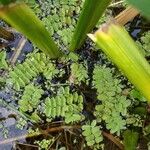
Salvinia natans
Floating Fern · Floating Water-Moss · Floating watermoss · Water butterfly wings · Eared Watermoss
Description
Source: leafsnapSalvinia natans is a floating aquatic plant belonging to the family Salviniaceae. It is commonly found in freshwater environments like ponds, lakes, and slow-moving streams. The plant features small, oval-shaped leaves arranged in pairs along a stem-like structure. These leaves are covered with fine hairs that assist the plant in floating on the water's surface. Salvinia natans is notable for its ability to form dense mats on the water surface. These mats can provide shelter and food for aquatic animals such as fish and insects. However, if left uncontrolled, they can block sunlight from reaching other plants beneath the water, causing ecological imbalances. Traditionally, this plant has been used in medicine to treat ailments such as fever and inflammation. Additionally, it shows potential in wastewater treatment due to its capability to absorb nutrients from polluted waters. In summary, Salvinia natans is a vital part of freshwater ecosystems, offering both ecological and medicinal benefits.
Care Guide
💧 Water Every 3 days
Floating watermoss thrives in environments with high humidity and consistent moisture. It needs weekly watering but can tolerate short periods of dryness. Indoors, it serves as an ornamental floating plant, flourishing in stable temperatures and water features that mimic its natural habitat. Providing adequate water will ensure its continued health and growth.
How should I water my Floating watermoss?
To water Floating watermoss, you have various options such as using a garden hose with a spray nozzle, a watering can, or any other common watering tool. Floating watermoss is not too particular about the type of water it receives, and can thrive off of rainwater, tap water, or filtered water. It is generally best to avoid watering this plant from above, as it can harm the leaves and flowers and potentially lead to disease. A drip irrigation system is often the ideal method for watering Floating watermoss, as it evenly applies water directly to the soil. When watering a container-grown Floating watermoss, you can use a cup, watering can, or tap water to directly water the soil.
What do I do if I give my Floating watermoss too much or too little water?
To remedy underwatering for Floating watermoss, simply water the plant more regularly when it lacks moisture. Overwatering, on the other hand, can be more harmful as it can lead to diseases and death if not caught early. Prevent overwatering by selecting a proper growing location with plenty of sunlight and good drainage to allow excess water to drain. If you overwater the plant in a pot, consider changing to a new pot with better drainage and add loose soils during repotting.
How frequently should I water my Floating watermoss?
Floating watermoss requires regular watering throughout the growing season. In the beginning of spring, watering once a week is sufficient. However, as the season progresses and temperatures rise, you may need to increase watering to two or three times per week. It's important not to exceed this rate, as it can harm the plant. Regardless of the frequency, the soil should be kept relatively moist but not soaked. When watering Floating watermoss in a pot, be aware that the soil can dry out faster compared to ground soil. Therefore, you will generally need to water a potted Floating watermoss a few times per week, as opposed to just once per week for a plant in the ground.
How much water does my Floating watermoss need?
There are a few ways to decide how much water to give your Floating watermoss. Some gardeners choose to feel the soil for moisture and water until the first six inches feel moist. Others prefer using a specific measurement, like two gallons per week, depending on the heat and soil dryness. However, be cautious of overwatering if your plant actually needs less than two gallons. When growing Floating watermoss in a container, you need to check all layers of soil for dryness and moisten them. Stick your finger in the soil or wait for excess water to trickle out of the pot's drainage holes as indicators.
How do I know if I'm giving enough water to my Floating watermoss?
Taking care of your Floating watermoss can be a bit tricky. On one hand, you need to water the soil weekly to cater to its deep roots. But be cautious because Floating watermoss is prone to root rot, which can cause browning. Thankfully, these plants are quite resilient and can survive for some time without watering. However, if you neglect watering for too long, the plant may start wilting and have dry leaves.
☀️ Light Full sun
The floating watermoss grows best when it receives abundant sunlight throughout the day. It can tolerate some shade, however. Because it comes from habitats with high light levels, extended periods of low light can result in stunted growth and pale coloration.
What are the sunlight requirements for Floating Watermoss?
Floating Watermoss thrives best with ample sunlight throughout the day, requiring full sun or partial sun conditions. Full sun means the plant should receive above 6 hours of sunlight daily, while partial sun refers to about 3-6 hours of sunlight. It's vital to observe how sunlight traverses your garden to find locations that offer a beneficial mix of light and shade, promoting the well-being of your plants. Adaptability to some degree of shade exists, yet insufficient light exposure may lead to stunted growth and pale coloring, indicative of the plant's struggle.
How do artificial lighting solutions support indoor growth of Floating Watermoss?
When natural sunlight is lacking, especially during winter or in less sunny interior locations, artificial lighting becomes crucial for the optimal growth of indoor plants like Floating Watermoss. Selecting the proper type of artificial light, such as LED, which can cater to specific light wavelength needs of plants, is central. Full sun plants necessitate 30-50W/sq ft, partial sun plants need 20-30W/sq ft, and shade-loving plants require 10-20W/sq ft of artificial light. Correct positioning involves placing the light source 12-36 inches from the plant and ensuring it receives 8-12 hours of light daily to mirror natural daylight hours closely.
What are the signs of inadequate light exposure in Floating Watermoss?
Floating Watermoss, ideally growing in full sunlight, may show several symptoms when light is deficient, especially indoors. These include smaller-than-usual new leaves, leggy or sparse growth, accelerated leaf drop, halted or absent new growth, lighter colored new leaves, chlorosis, sunscald, leaf curling, wilting, and leaf scorching. These conditions reflect stress responses to inadequate sunlight, affecting the plant's health and growth.
How can I manage Floating Watermoss experiencing light deficiency?
To manage light deficiency in Floating Watermoss, gradually increasing light exposure is beneficial. For indoor plants, moving them to sunnier spots by the week, until achieving at least 6 hours of direct sunlight, is advisable. Using south-facing windows or supplementing with artificial light, such as desk or ceiling lamps for a minimum of 8 hours daily, can be effective. Outdoors, find optimal sunlight spots, moving plants gradually to prevent sunburn. Pruning or transplanting can aid outdoor plants by reducing light obstructions or relocating to sunnier sites. While some damage from insufficient light may be irreversible, new growth following improved light conditions should be healthy.
🌡️ Temperature 20–35°C
Floating watermoss originates from temperate regions and prefers temperatures between 68 and 95 °F (20 and 35 ℃). It may need adjustments during different seasons.
What is the native region and temperature preference for Floating watermoss?
Floating watermoss, botanically known as Salvinia natans, is native to temperate regions. It prefers a temperature range between 68 to 95 °F (20 to 35 °C). Due to its preference for warmer climates, it is crucial to make seasonal adjustments to maintain its ideal growing conditions. This heat-loving plant suffers in cold temperatures, so it is advised to bring it indoors during autumn to a spot near a bright window, albeit not too close to heaters to avoid harm. Ensuring the temperature remains above 20°C during winter is beneficial, while temperatures nearing 5°C can be harmful to the plant.
How does low temperature affect Floating watermoss and what are the solutions?
Low temperatures have a significant adverse effect on Floating watermoss, which thrives best in warmth, ideally above 20°C. During winter, it is essential to keep the plant's environment above 5°C to prevent damage. Exposure to temperatures below 1°C can cause the leaves to lighten in color, and frost damage may lead to the leaves turning brown or black, accompanied by wilting and drooping. To combat this, trim the frost-damaged parts and move the plant to a warm indoor space immediately. Placing the plant near a south-facing window ensures it receives enough sunlight, but it should be kept away from heaters or air conditioning vents to avoid air dryness.
What should be done when Floating watermoss experiences high temperatures?
Floating watermoss should ideally be kept below 35°C during summer. Temperatures exceeding 41°C can cause the leaves to lighten and increase the risk of sunburn. To mitigate high temperature effects, trim away the sunburned and dried parts. Relocate the plant to a shaded area, especially away from the midday and afternoon sun, to prevent further damage. It's essential to water the plant in the morning and evening to keep the soil moist and provide relief from the heat.
💨 Humidity high (>60%)
This plant needs special care because it loves high humidity levels of 60-80% or more. The best way to achieve this is by placing a humidifier near the plant. Daily misting is also essential! Make sure the room has good ventilation.
🪴 Soil
🌱 Fertilizer
Floating watermoss thrives when it receives liquid fertilization every two weeks during the growing season, using either balanced or high-nitrogen formulas. To protect aquatic environments, it is important to avoid over-fertilizing. During dormancy, reduce the frequency of fertilization and dilute the fertilizers to ensure even distribution and to prevent nutrient runoff.
Why should I use fertilizer on my Floating watermoss?
Plants require nutrients to grow, but some can obtain all the necessary nutrients without any extra fertilizers. Floating watermoss, like other plants, relies on nutrients for growth and internal processes. The main nutrients that plants use, such as nitrogen, phosphorus, and potassium, play essential roles in a plant's functions. Nitrogen, specifically, provides significant support to foliage. However, obtaining enough nitrogen from the soil can be a challenge for Floating watermoss. As a result, many gardeners opt to provide additional nitrogen through feeding.
When should I fertilize my Floating watermoss?
To ensure the healthy growth of floating watermoss, it is recommended to apply fertilizer once a month while the plant is actively growing. This should be done during the spring and summer months, but not during fall and winter when the plant is less active. Look for signs of new growth to determine when to start fertilizing. Regardless of whether the plant is grown outdoors or indoors in a container, the fertilization schedule remains the same. However, if your floating watermoss is in a container, you may not need to fertilize for the first one to two months. This is because potting soil made for container plants already contains sufficient nutrients, and fertilization can be started after the plant has been in the same soil for a while.
When is the best time to not give fertilizer to my Floating watermoss?
To ensure proper growth, it is important to keep a few key things in mind when fertilizing your Floating watermoss. Firstly, avoid fertilizing if the plant is unhealthy due to disease or insect pests. Similarly, do not fertilize if the plant is dehydrated, as this can worsen the problem. Only healthy plants should be fertilized. Additionally, when watering, be cautious not to splash fertilizer onto the leaves or stem, as this can cause damage. Unless you have a special fertilizer designed for applying to the foliage, avoid direct contact between the fertilizer and the plant.
What kind of fertilizer does my Floating watermoss need?
Floating watermoss requires certain nutrients, including nitrogen, potassium, phosphorus, iron, manganese, and zinc, in order to grow. A balanced fertilizer, such as one with a 10-10-10 NPK ratio, is suitable for Floating watermoss. Natural fertilizers like blood meal or worm castings can also be effective. Alternatively, you may opt for a fertilizer higher in nitrogen, which helps support leaf growth - a desirable trait of Floating watermoss. If your goal is not to promote flower or seed production, there is no need to provide excessive supplements.
How should I give nutrients to my Floating watermoss?
To ensure proper fertilizer application for your Floating watermoss, follow these guidelines. Begin by using half-strength fertilizer to prevent over-fertilization, as this plant is sensitive to excessive nutrients. Remember that it's better to add more fertilizer gradually than to save an over-fertilized plant. It is important to fertilize when the soil is already somewhat moist, as dry soil can delay absorption and cause fertilizer burn. After applying dry fertilizers, be sure to water the soil. Depending on the fertilizer type, you may need to mix it into the soil during planting or apply it on top of the soil and then water in. For Floating watermoss, water-soluble fertilizers are recommended. Simply mix the fertilizer solution with water according to the recommended dosage and water the plant as usual. Alternatively, slow-release granules or fertilizer spikes can be used if you prefer monthly fertilization without much effort.
🪴 Pot & Repot
✂️ Pruning
Floating watermoss has fern-like leaves that float on the surface of the water and benefits from regular pruning from early to late spring to control its growth. For better water quality and light penetration, trim any dead or yellowing leaves. During the growing season, thinning out the plants helps maintain balance in water gardens and prevents them from overshadowing other plants.
🌿 Propagating
🐛 Diseases & pets
☠️ Toxicity
Characteristics
- Plant Type
- Herb
- Life Cycle
- Annual, Perennial
- Genus
- Salvinia
- Family
- Salviniaceae
- Hardiness Zone
- 10
- Mature Height
- 8 cm to 8 cm
- Mature Spread
- 49 cm
- Leaf Color
- Green, Blue
- Leaf Type
- Deciduous
- Planting Time
- Spring, Summer, Autumn
- Native Area
- Turkey, India, Slovakia, Pakistan, Slovenia, Croatia, Belarus, Uzbekistan, Russia, Iraq, Germany, Indonesia, Romania, South Korea, Belgium, Netherlands, Nepal, France, Tajikistan, Tunisia, Czech Republic, Bulgaria, Bangladesh, Poland, Turkmenistan, Greece, Armenia, Ukraine, Serbia, China, Lithuania, Syria, Italy, Kazakhstan, Spain, Vietnam, Japan, Iran, Albania, Azerbaijan, Algeria, Hungary, Thailand