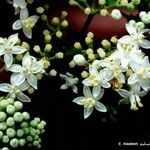
Sambucus javanica
Chinese elder
Description
Source: leafsnapSambucus javanica, commonly known as the Java elderberry or Chinese elderberry, is a deciduous shrub belonging to the Adoxaceae family. Native to East Asia, it can be found in countries such as China, Japan, Korea, and Taiwan. The plant can grow up to 5 meters tall and has a spreading habit with multiple stems. The leaves of Sambucus javanica are pinnately compound, comprising 5-9 leaflets that are ovate in shape. These leaflets feature serrated edges and are dark green in color. In spring, the plant produces clusters of small, white flowers that emit a sweet fragrance. The fruit of Sambucus javanica is an edible berry that changes color as it ripens—from green to red, then black. Although small, the berries are rich in nutrients such as vitamin C and antioxidants. Sambucus javanica has been used for medicinal purposes for centuries, prized for its anti-inflammatory properties, which make it effective against ailments such as colds, flu symptoms, and arthritis pain. In addition to its medicinal properties, Sambucus javanica is also valued for its ornamental appeal. Its attractive foliage turns yellow in autumn before falling off during the winter months. Overall, Sambucus javanica is an appealing shrub with both ornamental and medicinal benefits, making it a popular choice among gardeners who appreciate both beauty and functionality in their gardens or landscapes.
Care Guide
💧 Water Every 7 days
The Chinese elder plant flourishes in environments with high humidity and balanced moisture levels. To replicate its natural habitat, water it weekly. Being an evergreen, the Chinese elder maintains its lush foliage throughout the year, so it requires consistent watering, even during the cooler months.
☀️ Light Partial sun
Chinese elder comes from habitats such as forest understories and rocky areas where it grows in natural shade. It prefers partial sun but can tolerate full sun or full shade, showing its hardy and adaptable nature.
What are the sunlight requirements for Chinese Elder (Sambucus javanica)?
The Chinese elder (Sambucus javanica) flourishes in partial sun conditions, necessitating about 3-6 hours of sunlight daily. It is adaptable and can also thrive in full shade, making it an excellent choice for various garden spots. Observing how sunlight moves through your garden will help in selecting ideal locations that offer a mix of light and shade, promoting the plant's health and happiness.
How can artificial lighting be used for growing Chinese Elder indoors?
For indoor Chinese elder plants, artificial lighting can be critical, especially when natural sunlight is insufficient. LED lights are recommended due to their ability to provide specific light wavelengths needed by plants. For effective growth, full sun plants require 30-50W per square foot, partial sun plants need 20-30W per square foot, and full shade plants should have 10-20W per square foot. The lights should be placed 12-36 inches above the plants, mimicking natural sunlight, and kept on for 8-12 hours daily to ensure healthy growth.
What are common symptoms of light deficiency in Chinese Elder?
Light deficiency in Chinese elder plants can lead to various symptoms, including the development of smaller new leaves, leggy or sparse growth, accelerated leaf drop, stunted growth or cessation of new growth, lighter-colored or irregularly patterned new leaves, and chlorosis or yellowing of leaves. Other signs can include damage from excessive sunlight, such as sunscald, leaf curling, wilting, and leaf scorching. These symptoms indicate that the plant is not receiving the optimal light conditions for its growth.
How should one address insufficient light conditions for indoor and outdoor Chinese Elder plants?
To combat insufficient light conditions, gradually acclimate your Chinese elder plant to more sunlight by moving it to sunnier spots each week, aiming for 3-6 hours of direct sunlight daily. For indoor plants that are too large or challenging to move, supplementing with artificial light such as desk lamps or professional grow lights for at least 8 hours daily can help. Outdoors, ensure that plants are moved progressively to avoid shock and sunburn. Always consider natural growth patterns and remove any obstructions to sunlight, or transplant smaller plants to better-lit areas during their dormant period for optimal health and growth.
🌡️ Temperature 20–37.8°C
Chinese elder comes from tropical areas, which have generally warm and humid climates. Consequently, it is well suited to high heat and humidity. It does not tolerate abrupt temperature shifts and prefers a steady thermal environment, so avoiding indoor temperature fluctuations is important. It typically cannot withstand cold and needs relatively warm temperatures to grow. If the surrounding temperature falls too far, the plant may stop growing or could die.
What is the common name for Sambucus javanica?
The common name for Sambucus javanica is Chinese elder.
What are the essential characteristics of Chinese elder?
There are no specifics provided about the essential characteristics of Chinese elder in the provided data.
What are the known symptoms of interacting with or consuming Chinese elder?
There were no symptoms mentioned in relation to interacting with or consuming Chinese elder in the provided data.
💨 Humidity
🪴 Soil 5-7
🌱 Fertilizer
Proper fertilization is essential for the health and appearance of Chinese elder. Apply fertilizer to Chinese elder in summer, repeating once a month throughout the season. Nutrients supply energy for growth and help maintain the plant’s parts. Fertilizing improves the Chinese elder’s flower display, ensuring the best blooms.
🪴 Pot & Repot
✂️ Pruning
To help a Chinese elder thrive, it's important to prune it from early to late spring. Focus on removing weak or overcrowded stems to improve air circulation and foster better growth. Regular thinning can reduce pests and enhance flowering. Make sure to make clean cuts to prevent disease and encourage vigorous new growth from the base.
🌿 Propagating
🐛 Diseases & pets
☠️ Toxicity
Characteristics
- Plant Type
- Herb, Shrub
- Life Cycle
- Perennial
- Genus
- Sambucus
- Family
- Adoxaceae
- Hardiness Zone
- 9-11
- Mature Height
- 0.91 m to 2.13 m
- Mature Spread
- 0.91 m to 1.22 m
- Leaf Color
- Green
- Leaf Type
- Deciduous
- Flower Color
- White
- Flower Size
- 2.54 cm
- Bloom Time
- Summer, Early fall, Mid fall
- Planting Time
- Spring, Summer, Autumn
- Harvest Time
- Late summer, Fall, Early winter
- Native Area
- Indonesia, Cambodia, Myanmar, Philippines, Bangladesh, Laos, Thailand