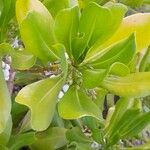
Scaevola taccada
Sea lettucetree · Pipetree · Beach naupaka · Beach scaevola · Beach-cabbage
Description
Source: leafsnapScaevola taccada, commonly known as beach naupaka or sea lettuce, is a flowering plant species belonging to the Goodeniaceae family. It is native to the tropical and subtropical regions of the Pacific and Indian Oceans, including areas such as Australia, Polynesia, Melanesia, and Southeast Asia. The plant typically grows as a shrub or small tree, reaching up to 10 meters in height, with thick branches that extend horizontally. Its leaves are thick and leathery, featuring a glossy green color on top and a pale green underneath. The flowers are small, white, or pale blue, with five petals fused together in a distinctive fan shape. Scaevola taccada is commonly found on sandy beaches near coastlines, where it can withstand the salt spray from ocean waves. It plays a vital role in stabilizing sand dunes by trapping sand particles with its roots. Traditional healers have used the plant for centuries for various medicinal purposes, including treating skin infections, wounds, fever, and respiratory problems. In addition to its medicinal uses, Scaevola taccada is also popular for ornamental purposes due to its attractive, year-round blooming flowers, making it an ideal choice for landscaping projects in coastal areas. Overall, Scaevola taccada is a significant species of flora that plays important ecological roles, offers medicinal benefits, and provides aesthetic value. This makes it highly valued by many cultures around the world.
🎭 Lovers separated and never reunited.
Care Guide
💧 Water Every 7 days
☀️ Light Full sun
The beach naupaka plant prefers sunlight for the majority of the day but can also manage with reduced lighting. Having its roots in a beach setting, beach naupaka is capable of thriving under intense sun exposure and can grow well. Frequent exposure to sunlight promotes a healthy leaf and flowering cycle, though too much can result in leaf burn.
🌡️ Temperature 20–37.8°C
The naupaka plant, which thrives in tropical and subtropical coastal areas, prefers temperatures between 68 and 100 ℉ (20 to 38 ℃). In the summertime, it has a higher tolerance towards elevated temperatures, yet in the winter, it may require safeguarding from frost or sub-zero temperatures. To guarantee the best growth, it's advised to maintain moderate temperatures and shield the plant from severe temperature variations.
💨 Humidity
🪴 Soil 6-7
🌱 Fertilizer
The care of Beach naupaka greatly depends on fertilization. Consistent feeding throughout the growth period is essential for maintaining vibrant leaves and encouraging robust growth. The lack of adequate fertilization can lead to the development of unhealthy leaves, reduced aesthetic charm, and inhibited or frail growth that is susceptible to breaking.
🪴 Pot & Repot 2-3 years
When transplanting Beach naupaka, opt for a container that's 1-2 inches (2.5-5 cm) bigger with sufficient draining capacity. Implement a well-percolating potting mixture. The best periods to repot are spring or fall, making certain the plant's root mass settles a bit beneath the top of the pot. Drench thoroughly post-repotting and position in a toasty location with softened sunlight.
✂️ Pruning
🌿 Propagating
🐛 Diseases & pets
☠️ Toxicity
Characteristics
- Plant Type
- Shrub
- Life Cycle
- Perennial
- Genus
- Scaevola
- Family
- Goodeniaceae
- Hardiness Zone
- 10-11
- Mature Height
- 3.96 m
- Mature Spread
- 3.05 m
- Leaf Color
- Green, Yellow
- Leaf Type
- Evergreen
- Flower Color
- White
- Flower Size
- 2.03 cm
- Bloom Time
- All year round
- Planting Time
- Spring, Summer, Autumn
- Harvest Time
- All year round
- Native Area
- Sri Lanka, Malaysia, Indonesia, Vietnam, Myanmar, Japan, Vanuatu, South Africa, Philippines, Madagascar, Singapore, Pakistan, Thailand, Kenya, Australia, Fiji, Tanzania