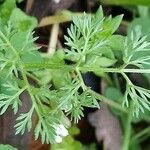
Scandix pecten-veneris
شانه ونوس · Lady's Venus-comb · Shepherd's-needle · Venus's-comb · Shepherdsneedle
Description
Source: leafsnapScandix pecten-veneris, commonly known as Shepherd's-needle, is a delicate and graceful annual plant belonging to the Apiaceae family. Native to Europe and Asia, it has also spread to other parts of the world. The plant can grow up to 60 cm tall, featuring finely divided leaves arranged in a basal rosette. The slender, erect stem branches at the top. The flowers of Scandix pecten-veneris are small and either white or pinkish-white, with five petals forming an umbrella-like shape. They bloom from May to August on long stalks that emerge from the upper leaf axils. The fruit of Scandix pecten-veneris is a small, oval-shaped capsule containing two seeds. The seeds are flattened on one side with numerous ridges on their surface. Scandix pecten-veneris thrives in well-drained soils and can grow well in both full sun and partial shade conditions. It is commonly found along roadsides, in meadows, and in disturbed areas such as abandoned fields. In traditional medicine practices across Europe and Asia, various parts of this plant have been used for their medicinal properties, especially for treating respiratory ailments like coughs and bronchitis due to its expectorant qualities. Overall, this delicate annual herbaceous plant not only adds beauty wherever it grows but also provides medicinal benefits for those who seek them out!
Care Guide
💧 Water Every 7 days
Shepherd's-needle thrives in environments similar to its natural habitat, needing soil that is consistently moist along with weekly watering to prevent waterlogging. It is usually cultivated outdoors, where it benefits from natural rainfall and seasonal variations in moisture, supporting its growth cycles for optimal health.
How should I water my Shepherd's-needle plant?
To water Shepherd's-needle, you have a few options. You can use a garden hose with a spray nozzle, a watering can, or any other common watering tool. Shepherd's-needle is not too picky about the water it receives. It can thrive on rainwater, tap water, or filtered water. However, try to avoid watering it from above as this can harm the leaves and flowers and may result in disease. Instead, a drip irrigation system is often the best choice for watering this plant. It ensures even and direct water application to the soil. If you have a container-grown Shepherd's-needle, you can use a cup, watering can, or tap to water it directly into the soil.
What if I give my Shepherd's-needle plant too much or too little water?
Underwatering Shepherd's-needle is easily fixed by watering it more regularly. Overwatering, on the other hand, can be more serious. It can cause diseases that lead to the decline and death of the plant. To prevent this, choose a location with plenty of sunlight to help dry the soil and good drainage to avoid waterlogging. If your potted Shepherd's-needle is overwatered, consider changing it to a new pot with better drainage. Use loose soils and a pot that drains efficiently when repotting.
How often should I water my Shepherd's-needle plant?
Shepherd's-needle requires regular watering throughout the growing season. In spring, water it once a week. As the season progresses and it gets warmer, increase watering to two to three times a week. Overwatering can harm the plant, so keep the soil relatively moist but not wet. If you have Shepherd's-needle in a pot, you'll need to water it more often. Potted soil tends to dry out faster than ground soil, so water container-grown plants a few times a week compared to just once a week for those in the ground.
How much water does my Shepherd's-needle plant need?
Determining how much water to give your Shepherd's-needle can be approached in a few ways. One method is to feel the soil to gauge its moisture level. If you want to use this method, water your plant until the top six inches of soil feel moist. Another option is to use a set measurement. In general, giving about two gallons of water per week to your Shepherd's-needle is recommended, taking into consideration the temperature and how quickly the soil dries. However, it's important to be cautious with this approach as it may lead to overwatering if your plant actually needs less water. When growing Shepherd's-needle in a container, a different method is necessary. Watering should be done until all layers of dry soil are moistened. To check for moisture, you can insert your finger into the soil. Additionally, you can water until you notice a slight amount of excess water coming out of the pot's drainage holes.
How can I know if I am giving enough water to my Shepherd's-needle plant?
Avoiding overwatering your Shepherd's-needle can be a bit challenging. On one hand, these plants need weekly watering because of their deep roots. However, Shepherd's-needle plants are highly prone to root rot and browning if overwatered. While underwatering is less of a concern, these plants can survive without additional watering for some time. However, if you wait too long to water, they will start to wilt and you may notice dry leaves.
☀️ Light Full sun
Shepherd's-needle does best when it gets light for most of the day, a trait retained from its original habitat that receives abundant sun. It can also withstand periods when sunlight is only partly available. Both too much and too little sun can cause stunted growth or wilting.
What are the sunlight requirements for Shepherd's-needle?
Shepherd's-needle requires full sun, which means it needs above 6 hours of sunlight, but it can also thrive in partial sun, with about 3-6 hours of sunlight. It’s important to observe how sunlight moves through your garden to find the optimal balance of light and shade for the plant, ensuring it grows healthy and happy.
What essentials should be considered for growing Shepherd's-needle successfully?
Growing Shepherd's-needle successfully requires exposure to light for most of the day, a characteristic inherent to its native habitat that experiences substantial sunlight. It can still perform well during periods of partial sunshine. Both overexposure and underexposure to sunlight could impede its growth or cause the plant to wilt. If natural sunlight is insufficient, especially during winter or in less sunny locations, artificial lighting can be a vital solution for indoor plants, promoting healthier growth. Optimal artificial lighting involves choosing the right type of light—LED lights are recommended, determining the appropriate distance (12-36 inches above the plant), and the duration of exposure (8-12 hours per day) to mimic natural conditions.
What are the symptoms of insufficient or excessive light in Shepherd's-needle?
Shepherd's-needle shows various symptoms when light conditions are not optimal. Insufficient light can cause small leaves, leggy or sparse growth, faster leaf drop, slower or no new growth, lighter-colored new leaves, and chlorosis. Excessive sunlight leads to symptoms like sunscald, leaf curling, wilting, and leaf scorching. Observing these symptoms helps in diagnosing and correcting light issues to ensure the plant's health.
What solutions can be provided for Shepherd's-needle struggling with light conditions?
To address light conditions for Shepherd's-needle, consider the following solutions: For indoor plants needing more light, gradually shift them to sunnier locations each week until they get at least 6 hours of direct sunlight, use a south-facing window, or supplement with artificial lighting for at least 8 hours daily. For outdoor plants, gradually acclimatize them to brighter spots, avoiding sudden changes to prevent sunburn. To maximize exposure, reduce obstructions like branches or leaves blocking sunlight, and consider transplanting smaller plants during their dormant period to a location with better sunlight and drainage. Note that damage from insufficient light may not be reversible, but new growth should be healthy once conditions improve.
🌡️ Temperature 15–35°C
Shepherd's-needle is a native plant of natural temperate environments and prefers moderate temperatures of 68 to 95°F (20 to 35°C). When seasonal temperatures change drastically, adjustments may be required to keep conditions within its comfort zone.
What is the native environment of Shepherd's-needle?
Shepherd's-needle, also known by its botanical name Scandix pecten-veneris, thrives in natural temperate environments. This plant prefers moderate temperatures, flourishing in conditions ranging from 68 to 95°F (20 to 35°C). It has a strong tolerance for cold, making it resilient to the seasonal temperature changes that occur within its comfort zone.
How should Shepherd's-needle be protected during extreme winter conditions?
Although Shepherd's-needle has a high cold resistance, in regions where winter temperatures are expected to plummet below -15°C, implementing cold protection measures is wise. This protection can be provided by covering the plant with insulating materials like soil or straw. To further support the plant, it's advisable to water it abundantly before the first freeze of autumn, ensuring the soil stays moist and enters winter in a frozen state. This approach helps the plant avoid drought and water scarcity during the colder months and into early spring.
What are the symptoms and solutions for Shepherd's-needle in low temperatures?
In low temperatures, Shepherd's-needle shows a remarkable cold tolerance but ideally should be kept above 0°C. Exposure to temperatures below -15°C may not visibly affect the plant during winter, but come spring, there might be a noticeable decline in sprouting, or the plant may not sprout at all. The solution for such a scenario involves removing any parts of the plant that fail to sprout in the spring, allowing it to recover and continue growing.
How does high temperature affect Shepherd's-needle and what are the countermeasures?
In higher temperatures, particularly above 35°C and especially when exceeding 41°C, Shepherd's-needle's leaves may exhibit signs of stress such as lightening color, curling, becoming prone to sunburn, and in extreme cases, wilting and drying out. To combat these issues, it's recommended to trim away the sunburned and dried parts. Moving the plant to a shaded area or using a shade cloth can provide relief from the intense midday and afternoon sun. Additionally, watering the plant in the morning and evening helps keep the soil adequately moist.
💨 Humidity
🪴 Soil 6-7
🌱 Fertilizer
Shepherd's-needle does well with regular, light applications of fertilizer to encourage healthy foliage. Fertilize Shepherd's-needle about once a month during the summer. Nitrogen is important for leaf growth, and adding nitrogen-rich supplements helps Shepherd's-needle thrive.
🪴 Pot & Repot
✂️ Pruning
Shepherd's-needle is an annual herb characterized by its fine leaves and delicate white flowers. For optimal growth, prune the plant in early spring. This helps improve air circulation, reduces the risk of disease, and encourages healthy development. To maintain its vigor and attractive shape, regularly monitor the plant's needs.
🌿 Propagating
🐛 Diseases & pets
☠️ Toxicity
Characteristics
- Plant Type
- Herb
- Life Cycle
- Annual
- Genus
- Scandix
- Family
- Apiaceae
- Hardiness Zone
- 7-10
- Mature Height
- 15 cm to 30 cm
- Mature Spread
- 15 cm to 30 cm
- Leaf Color
- Green
- Leaf Type
- Evergreen
- Flower Color
- White
- Flower Size
- 0.20 cm to 0.25 cm
- Bloom Time
- Spring
- Planting Time
- Spring, Summer
- Harvest Time
- Summer
- Native Area
- Libya, Egypt, India, Turkey, Sweden, Austria, Slovakia, Montenegro, Pakistan, Croatia, Slovenia, Morocco, Belarus, Uzbekistan, Russia, Iraq, Germany, Romania, Belgium, Portugal, Netherlands, Saudi Arabia, France, Tajikistan, Tunisia, Cyprus, Bulgaria, Poland, Armenia, Greece, Serbia, Lebanon, Afghanistan, Syria, Kyrgyzstan, Kazakhstan, Italy, Spain, Switzerland, Denmark, Iran, Albania, Ireland, United Kingdom, Hungary, Algeria, Azerbaijan, Turkmenistan