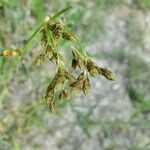
Scirpus pendulus
Rufous Bulrush · Pendulous Bulrush · Nodding Bulrush · Lined bulrush
Description
Source: leafsnapScirpus pendulus is a species of flowering plant in the sedge family known by the common names pendulous bulrush, rufous bulrush, and nodding bulrush. It is native to North America, where it can be found throughout the eastern United States and Canada, through the American midwest, some areas of the western United States, and into Mexico. It is also known as an introduced species in Australia. It grows in many types of moist and wet habitat, including disturbed areas such as ditches, and sometimes in drier areas. It is a perennial herb growing from a short, thick rhizome system. The erect, three-angled stems grow singly or in tufts and clumps, easily reaching one meter tall. Sheathing leaves occur at the stem bases as well as higher up the stems, the blades reaching up to 40 centimeters. The inflorescence is a panicle of many clusters of spikelets which hang on long, thin branches, often nodding or drooping, especially as the fruit develops.
🎭 Submissiveness
Care Guide
💧 Water
The rufous bulrush is native to wetland habitats and thrives in consistently moist soil, benefiting from weekly watering. While it can tolerate short periods of dryness, this plant is best suited for outdoor environments. It is an excellent choice for rain gardens, where it enhances the benefits of natural rainfall and contributes to the water cycle.
☀️ Light Full sun
Rufous bulrush comes from habitats with plentiful sunlight, such as the shallow margins of ponds and lakes. It prefers full sun but can also tolerate partial sun.
What are the sunlight requirements for Rufous bulrush?
Rufous bulrush, with its botanic name Scirpus pendulus, is a perennial herbaceous plant that loves the sun. It thrives best in full sun conditions, which means it needs more than 6 hours of sunlight daily. However, it can also tolerate partial sun, requiring about 3-6 hours of sunlight. When planning where to place your Rufous bulrush, observe the sunlight's movement through your garden throughout the day. It's crucial to find a location that offers the perfect mix of light and shade to ensure your plant grows healthy and strong.
How can artificial lighting support the growth of Rufous bulrush indoors?
When natural sunlight isn't enough, especially during winter or in areas of your home that don't get much sunlight, artificial lighting can be a life-saver for your Rufous bulrush. Indoor plants benefit from artificial lighting, which promotes faster and healthier growth. Using LED lights is advisable as they can be customized to provide specific wavelengths of light your plant needs. Full sun plants require 30-50W/sq ft of artificial light, while partial sun plants need 20-30W/sq ft. To mimic natural sunlight, place the light source 12-36 inches above the plant and keep it on for 8-12 hours per day, depending on the specific needs of your Rufous bulrush.
What are the signs that Rufous bulrush is not getting enough light?
If Rufous bulrush doesn't receive adequate sunlight, several symptoms may appear. These include smaller new leaves, leggy or sparse growth, a quicker dropping of older leaves, and either slower growth or a complete halt in new leaf production. Leaves might also show lighter colors or experience chlorosis, where they turn yellow due to a lack of chlorophyll. Other symptoms include sunscald, leaf curling, wilting, and leaf scorching, which are signs of both insufficient and excessive sunlight exposure.
What can be done if Rufous bulrush is not getting enough sunlight?
To ensure Rufous bulrush receives adequate sunlight, gradually increase its exposure. For indoor plants, move them to a sunnier spot each week, aiming for at least 6 hours of direct sunlight daily, and use artificial light if necessary. Outdoors, move your plants gradually to avoid shock and allow them to adapt to the increased light. It's essential to manage obstructions by pruning trees or relocating the plant to a sunnier spot. Unfortunately, parts of the plant that have been severely affected may not recover, but new growth should be healthy with improved light conditions.
🌡️ Temperature 0–35°C
Rufous bulrush is naturally adapted to environments with temperatures between 32 and 95 °F (0 to 35 ℃). In its native range, rufous bulrush grows well under these conditions. When seasons shift, careful adjustments should be made to keep the temperature within the preferred range.
What is the preferred temperature range for Rufous Bulrush?
Rufous Bulrush, also known by its botanical name Scirpus pendulus, thrives in environments where the temperature ranges from 32 to 95 °F (0 to 35 °C). These conditions mirror its native habitats, allowing the plant to grow optimally. To support its growth through changing seasons, it's crucial to make careful adjustments to maintain this preferred temperature range.
How does Rufous Bulrush handle cold temperatures and frost?
Rufous Bulrush has a strong resistance to cold and usually does not require special frost protection measures even in winter. If, however, winter temperatures are expected to fall below -35°C, it is important to protect the plant from the cold. This protection can be provided by covering the plant with insulating materials such as soil or straw. Additionally, watering the plant abundantly before the first freeze in autumn helps to ensure the soil remains moist and enters a frozen state, preventing drought and water scarcity for the plant during winter and early spring.
What signs indicate Rufous Bulrush is experiencing low temperature stress?
Rufous Bulrush is cold-tolerant and performs best when temperatures stay above 0°C. During the winter, it's advisable to keep the temperature above -30°C to prevent damage. If the temperature drops below -35°C, there might not be noticeable changes during winter; however, this could lead to decreased sprouting or even a lack of sprouting in springtime. In such cases, removing any parts that have failed to sprout in spring is a recommended solution.
How should I care for Rufous Bulrush in high temperatures?
During the summer months, it's important to ensure that Rufous Bulrush is kept in conditions below 35°C. Exceeding a temperature of 38°C could result in the plant's leaves becoming lighter in color, curling, experiencing sunburn, or in severe cases, the entire plant may wilt and become dry. To mitigate these risks, trim away any sunburned or dried-up parts of the plant. Relocating the plant to a shaded area or using a shade cloth to protect it from the midday and afternoon sun can also be helpful. Regular watering in the morning and evening will help to keep the soil moist and further protect the plant from high temperature stress.
💨 Humidity
🪴 Soil
🌱 Fertilizer
🪴 Pot & Repot
✂️ Pruning
To improve the health and appearance of rufous bulrush, prune it between early and late spring. Start by trimming any dead stems and thinning out clumps that are too crowded; this will improve air circulation. Regular pruning not only enhances the plant's appearance and vitality but also prolongs blooming and maintains its structural integrity, according to reputable horticultural sources.
🌿 Propagating
🐛 Diseases & pets
☠️ Toxicity
Characteristics
- Plant Type
- Herb
- Life Cycle
- Perennial
- Genus
- Scirpus
- Family
- Cyperaceae
- Hardiness Zone
- 3-9
- Mature Height
- 0.61 m to 1.22 m
- Mature Spread
- 30 cm to 61 cm
- Leaf Color
- Dark Green
- Leaf Type
- Semi-evergreen
- Flower Color
- White, Yellow, Brown
- Flower Size
- 0.25 cm to 0.51 cm
- Bloom Time
- Early summer, Mid summer
- Planting Time
- Spring, Summer, Autumn
- Harvest Time
- Late summer, Early fall
- Native Area
- Mexico