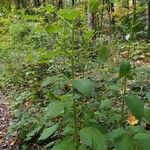
Scrophularia marilandica
Figwort · Carpenter's-square · Eastern figwort · Simpson's Honey Plant · Maryland Figwort
Description
Source: leafsnapScrophularia marilandica, also called late figwort, Maryland figwort, carpenter's square, or eastern figwort, is a flowering plant in the family Scrophulariaceae, native throughout eastern and central North America, where it is found growing in dry woods from Manitoba and Quebec south to Texas and Florida. It grows 1.5–3 metres (4 ft 11 in – 9 ft 10 in) tall, with opposite, ovate leaves up to 15 centimetres (5.9 in) long and 9 centimetres (3.5 in) broad. The flowers are rounded, 8–9 millimetres (0.31–0.35 in) long, with a cup-like mouth that look somewhat like a horse's mouth with a bad overbite; they are a deep reddish-purple color on the inside, with a greenish to almost brown cast on the outside. They are commonly visited by hummingbirds in late summer.Past common names for Scrophularia marilandica have included heal-all, pilewort, and scrofula-plant. It was once used in an ailment called "figs" to treat piles. During the 19th century, the root was used in an infusion to treat insomnia and anxiety.
🎭 Wellness, Safeguarding
Care Guide
💧 Water
The carpenter's square plant thrives in moist environments and requires regular hydration. For optimal moisture, it is recommended to water it weekly. This herbaceous perennial is moderately drought-tolerant, but it needs more frequent watering during its active growth periods, especially when influenced by rainfall patterns.
☀️ Light Full sun
The carpenter's square prefers strong sun exposure and does best in places where sunlight is unobstructed. It remains resilient when sunbeams are somewhat veiled. Excessive or insufficient light can impede its healthy development, since it is attuned to the sun rhythms of its native habitats.
What are the sunlight requirements for Carpenter's square?
Carpenter's square thrives in conditions where it can receive a robust exposure to sunlight, signifying its preference for environments where sunlight is plentiful and unobstructed. It is capable of growing in both full sun, defined as above 6 hours of sunlight, and partial sun, about 3-6 hours of sunlight. The plant exhibits resilience even when sun beams are somewhat veiled, however, both overexposure and underexposure to sunlight can hinder its healthy development. It's crucial to observe how sunlight moves through your garden to find spots that offer the ideal balance of light and shade, ensuring the plant's wellbeing.
How can artificial lighting be used for indoor plants like Carpenter's square?
Indoor plants, including Carpenter's square, require adequate lighting for optimal growth, especially when natural sunlight is insufficient. Artificial lights serve as an essential solution, promoting faster, healthier growth by offering a crucial source of light. Key considerations for using artificial light include choosing the right type, such as LED lights, which can be customized to provide specific wavelengths needed by the plants. Full sun plants need 30-50W/sq ft of artificial light, partial sun plants require 20-30W/sq ft, and full shade plants need 10-20W/sq ft. The appropriate distance for the light source is 12-36 inches above the plant to mimic natural sunlight conditions, and most plants will need 8-12 hours of light per day to mimic the natural daylight hours specific to the plant species.
What are the symptoms of light deficiency in Carpenter's square?
When Carpenter's square is placed in rooms with inadequate lighting, several symptoms of light deficiency might emerge, albeit not always readily apparent. These include the development of smaller new leaves compared to older ones, a leggy or sparse growth pattern with increased space between leaves or stems, faster dropping of older leaves as the plant conserves resources, delayed growth or a complete stop in new leaf production, the appearance of lighter-colored or irregularly patterned new leaves indicating a lack of chlorophyll and nutrients, and conditions such as chlorosis where leaves lose their green color, sunscald with damaged plant tissue from intense sun exposure, leaf curling as a defense mechanism against overexposure, wilting due to increased water loss, and leaf scorching characterized by brown, dry, and crispy leaf edges.
What solutions are available for adapting Carpenter's square to varying sunlight conditions?
To ensure Carpenter's square receives optimal sunlight, gradually adapt the plant to sunnier locations if indoor, by moving it closer to a south-facing window or using artificial light, such as desk lamps or professional grow lights, for at least 8 hours daily. For outdoor plants, similarly, adjust by gradually moving them to sunnier spots each week to prevent sunburn. If obstructions like trees block sunlight, consider pruning to allow more light through. For smaller plants that can be moved, transplanting during the dormant period (late winter or early spring) to a sunnier location with good drainage is advised. It's important to note that parts of the plant affected by previous insufficient sunlight may not fully recover, but new growth should be healthy following the adjustment to better lighting.
🌡️ Temperature 10–35°C
Carpenter's square originates from temperate areas, where temperatures range from 50 to 95 °F (10 to 35 ℃). As a woody plant, it does best in cooler conditions, especially during transitional seasons. In very hot or very cold weather, provide shade or a protective cover, respectively, to moderate the temperature.
What is Carpenter's square and where is it native to?
Carpenter's square, botanically known as Scrophularia marilandica, is native to temperate regions where the temperature fluctuates between 50 to 95 °F (10 to 35 °C). As a woody plant, it prefers cooler climates, especially during the changing of seasons.
How does Carpenter's square react to extreme temperatures?
Carpenter's square exhibits strong resistance to cold and usually doesn't require special frost protection measures during winter. However, if temperatures are expected to drop below -25°C, providing cold protection with materials like soil or straw is important. In contrast, during high temperatures or intense heat, providing shade or cover to adjust the temperature is recommended to ensure the plant's well-being.
What are some important care tips for Carpenter's square in winter?
Before the first freeze in autumn, it is recommended to water Carpenter's square abundantly to ensure the soil remains moist and enters a frozen state. This helps prevent drought and water scarcity for the plant during winter and early spring. Even though Carpenter's square has strong cold resistance, special attention should be given if winter temperatures are expected to drop below -25°C, protecting the plant with soil or straw.
How does Carpenter's square handle low temperature conditions?
Carpenter's square is notably cold-tolerant and thrives best when the temperature is above 10°C. In winter, it should be kept above -15°C. If the temperature falls below -25°C, there may not be any noticeable changes during winter, but there might be a decrease in sprouting or even no sprouting during springtime. In such cases, removing any parts that have failed to sprout in spring is advised.
What should be done if Carpenter's square experiences high temperatures?
During summer, it is crucial to ensure that the temperature surrounding Carpenter's square remains below 35°C. Should the temperature exceed 38°C, the leaves may start showing signs of stress such as becoming lighter in color, curling, becoming susceptible to sunburn, and, in severe cases, the entire plant may wilt and dry out. To mitigate this, trim away the sunburned and dried-up parts and move the plant to a shadier location or use a shade cloth to protect it from midday and afternoon sun. Additionally, watering the plant in the morning and evening helps keep the soil moist and supports the plant's recovery and health.
💨 Humidity
🪴 Soil 6-7
🌱 Fertilizer
Usually one application of fertilizer in spring is enough for Carpenter's square, although repeated feedings can enhance growth. Apply fertilizer about once every month to every month and a half. Fertilizing improves the look and function of the leaves, helping maintain even color and a healthy texture. It also encourages root development and nutrient uptake for long-term plant health.
🪴 Pot & Repot
✂️ Pruning
To encourage bushier growth and improve air circulation, prune the carpenter's square annually from early to late spring. Make cuts above outward-facing nodes to help maintain the plant's shape and vitality. Avoid heavy pruning in late fall or winter to minimize the risk of frost damage.
🌿 Propagating
🐛 Diseases & pets
☠️ Toxicity
Characteristics
- Plant Type
- Herb
- Life Cycle
- Perennial
- Genus
- Scrophularia
- Family
- Scrophulariaceae
- Hardiness Zone
- 6-9
- Mature Height
- 1.52 m to 3.05 m
- Mature Spread
- 0.3 m to 1.22 m
- Leaf Color
- Green, Dark Green
- Leaf Type
- Deciduous
- Flower Color
- Brown
- Flower Size
- 2.54 cm
- Bloom Time
- Summer
- Planting Time
- Spring, Summer, Autumn
- Harvest Time
- Late summer, Early fall, Mid fall