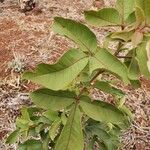
Searsia pyroides
Common taaibos · Thorny karee · Common wild currant
Description
Source: leafsnapSearsia pyroides, commonly known as African sumac or wilde-riet, is a small to medium-sized tree native to southern Africa. Belonging to the Anacardiaceae family, it can grow up to 10 meters tall. This tree features a rounded crown and smooth grey bark that peels off in patches. The leaves of Searsia pyroides are compound, consisting of 3 to 7 oval-shaped leaflets with serrated edges. They are green but turn yellow or red in the autumn. In spring, the African sumac produces small yellow-green flowers, which develop into small red berries during the summer. These berries attract birds such as bulbuls, starlings, and barbets. Searsia pyroides is drought-tolerant and can thrive in various soil types, including sandy soils. It is commonly found along riverbanks or on rocky hillsides throughout southern Africa. In traditional medicine, various parts of the Searsia pyroides plant have been used to treat ailments such as diarrhea, stomach pains, feverish conditions, and skin conditions like eczema. Overall, this plant offers ornamental value due to its attractive autumn foliage and ecological benefits by attracting birds with its berries. Additionally, it has medicinal uses within local communities throughout southern Africa, making it an important species in its range.
Care Guide
💧 Water Every 7 days
Common wild currant thrives in arid regions due to its strong drought tolerance. To prevent waterlogging, it only needs watering every 2-3 weeks. As an evergreen plant, it retains its leaves year-round and requires consistent hydration to support its continuous growth.
☀️ Light Full sun
Common wild-currant is native to open habitats, such as sunny meadows and forest margins, where light is plentiful. It performs best in Full Sun but can also tolerate Partial Sun, adapting well to a range of light conditions.
What are the sunlight requirements for Common wild-currant?
Common wild-currant thrives in environments with ample sunlight, originating from open spaces like sunny meadows and forest edges. It requires full sun, meaning above 6 hours of sunlight a day, but can also adapt to partial sun, which is about 3-6 hours of sunlight. It's important to watch how sunlight moves through your garden to ensure you choose a location that provides a balance of light and shade, catering to the plant's needs and ensuring its happiness.
How can artificial lighting support the growth of indoor Common wild-currant plants?
Indoor Common wild-currant plants require adequate lighting for optimal growth, especially when natural sunlight is insufficient, such as in winter or less sunny spaces. Artificial lights can be a vital solution, promoting healthier and faster growth. LED lights are a popular choice because they can be customized to provide the specific wavelengths of light the plants need. For full sun plants, 30-50W/sq ft is recommended; partial sun plants need 20-30W/sq ft, and full shade plants require 10-20W/sq ft. It's also essential to place the light source 12-36 inches above the plant and mimic natural daylight hours, with most plants needing 8-12 hours of light per day.
What are the symptoms of light deficiency in Common wild-currant?
When Common wild-currant is grown in suboptimal lighting, it may exhibit symptoms such as smaller-sized new leaves, leggy or sparse growth, faster leaf drop, slower or no new growth, lighter-colored new leaves, chlorosis (leaves losing their green color), sunscald (damage from intense sunlight), leaf curling (a defense mechanism to reduce sunlight exposure), wilting (due to increased water loss), and leaf scorching (brown, dry, or crispy leaf edges). These symptoms indicate that the plant needs more light to thrive.
How can I address and prevent light deficiency issues in Common wild-currant?
To optimize growth and address light deficiency in Common wild-currant, gradually move the plants to a location where they receive at least 6 hours of direct sunlight daily, such as near a south-facing window. For plants that are large or not easily movable, artificial light, such as desk or ceiling lamps or professional plant grow lights, should be used for at least 8 hours daily. For outdoor plants, avoid sudden changes in light intensity to prevent sunburn and consider pruning or transplanting to reduce obstructions and ensure ample sunlight. Note, parts of the plant affected by light deficiency may not recover, but new growth will be healthy with increased light exposure.
🌡️ Temperature 20–37.8°C
Common wild-currant is fairly adaptable to temperature, able to endure high heat and wide temperature swings. In hot conditions, attention should be paid to irrigation and providing suitable shade to avoid sunburn. On the other hand, Common wild-currant is not very tolerant of low temperatures. It can handle some cold, but very cold conditions may cause frost damage.
💨 Humidity
🪴 Soil 5-7
🌱 Fertilizer
Timing is important when fertilizing Common wild-currant. Apply fertilizer in early spring and repeat monthly up to early summer. Fertilizer encourages attractive blooms and supplies energy during both dormant and active growth phases.
🪴 Pot & Repot
✂️ Pruning
The common wild currant is a robust shrub known for its vibrant foliage and edible berries. For optimal health and fruit production, prune it in early spring by removing any dead branches and thinning crowded areas. This will help improve air circulation and promote healthy growth. Be sure to use sharp, clean tools to prevent the spread of disease.
🌿 Propagating
🐛 Diseases & pets
☠️ Toxicity
Characteristics
- Plant Type
- Tree
- Life Cycle
- Perennial
- Genus
- Searsia
- Family
- Anacardiaceae
- Hardiness Zone
- 9-11
- Mature Height
- 4.88 m to 7.01 m
- Mature Spread
- 2.13 m to 3.96 m
- Leaf Color
- Green
- Leaf Type
- Deciduous
- Flower Color
- Yellow, Green
- Flower Size
- 2.03 cm to 6.35 cm
- Bloom Time
- Mid fall, Late fall
- Planting Time
- Spring, Summer, Autumn
- Harvest Time
- Winter
- Native Area
- Malawi, Lesotho, Namibia, South Africa, Zambia, Rwanda, Sudan, Kenya, Uganda, Tanzania, Zimbabwe, Chad, Cameroon, Burundi, Mozambique, Eswatini, Ethiopia, Congo (DRC), Botswana, Central African Republic