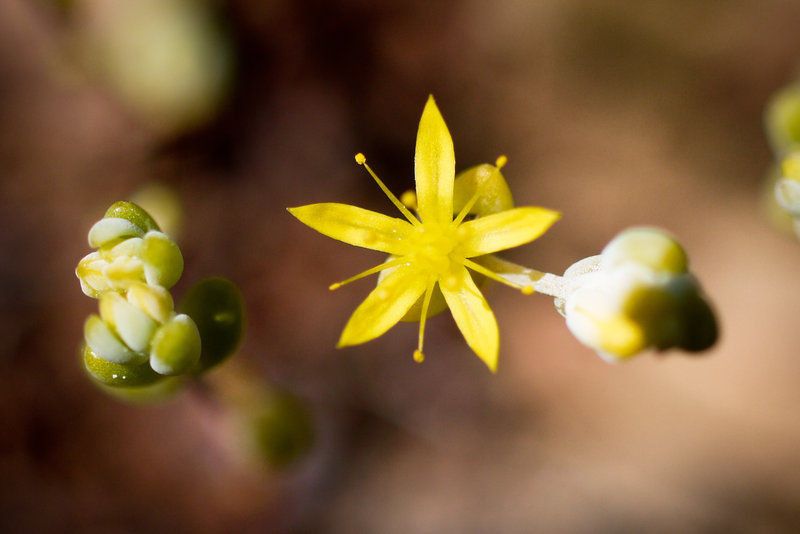
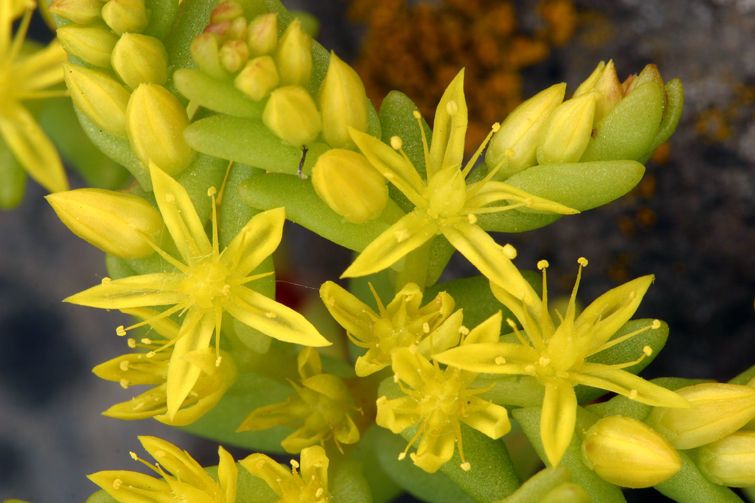
Sedella pumila is a species of flowering plant in the family Crassulaceae known by the common name Sierra mock stonecrop. It is native to California, where it grows in the North Coast Ranges and adjacent sections of the Central Valley to the Sierra Nevada foothills. It is a plant of vernal pools and similar habitat, growing in rocky and gravelly flats of serpentine soils, limestone, and soils of volcanic origin, often alongside mosses. This is an annual herb growing 2 to 17 centimeters high, in shades of green, yellow, and red. It has small knobby succulent leaves each a few millimeters long. The flowers atop the threadlike stems have fleshy sepals and yellowish petals a few millimeters in length. The flowers have a musty scent.
Sierra mock stonecrop has moderate disease resistance but is more sensitive to humidity. It is vulnerable to disease when humidity is high and is prone to root rot while dormant. In terms of care, Sierra mock stonecrop is drought-tolerant yet requires more water during the growing season. Watering should be sharply reduced or stopped entirely during the dormant period. Sierra mock stonecrop is suitable for growers with some experience, though it can be difficult to maintain, particularly during dormancy. It is especially appropriate for people who can devote time to its care during the winter months.
How to keep Sedella Pumila.
Light
The Sierra mock stonecrop, indigenous to dry areas, flourishes in direct sunlight, reflecting its natural habitat which is typified by intense solar exposure and scanty shade. It can also tolerate semi-sunlight, demonstrating some flexibility in its development.
Water
The Sierra mock stonecrop, native to rocky environments, is highly efficient at retaining moisture and needs very little water to thrive. During its growth period, it does best with a watering schedule of twice a week, as it prefers drier conditions to avoid overwatering. This evergreen plant is also well-suited for indoor cultivation, where you can maintain controlled humidity levels.
Temperature
Sierra mock stonecrop can handle some warmth, but it largely flourishes and develops during the colder seasons, becoming inactive in summer. It's critical to supply shade in hot summer weather to avoid burning from harsh sunlight. Moreover, watering should be limited or stopped during the peak heat to avert root decay. The Sierra mock stonecrop sees vigorous growth in winter and spring. Provided the temperature does not fall too far, its growth remains constant.
Fertilizer
The Sierra mock stonecrop requires minimal fertilizer, only 1-2 instances per year throughout its growth phase. Do not fertilize it during its dormant seasons, which are summer and winter. After repotting, hold off on fertilization for a couple of months and lessen the amount used. Fertilization promotes vigorous growth and fosters blooming.
Pruning
The Sierra mock stonecrop is a small, low-growing succulent that produces yellow, star-shaped flowers. To encourage growth and maintain its shape, prune the plant from early to late spring. Remove any dead stems and trim back leggy growth to improve compactness, enhance air circulation, and boost overall vitality.
Botanical profile.
- Plant Type
- Herb
- Life Cycle
- Annual
- Genus
- Sedella
- Family
- Crassulaceae
- Hardiness Zone
- 8-10
- Mature Height
- 2 cm to 5 cm
- Mature Spread
- 3 cm to 8 cm
- Leaf Color
- Green, Yellow Green
- Leaf Type
- Evergreen
- Flower Size
- 0.25 cm to 0.51 cm
- Bloom Time
- Mid spring, Late spring
- Planting Time
- Spring, Autumn
- Harvest Time
- Early summer, Mid summer
Other names.
Reader questions.
What is the Sierra mock stonecrop?
The Sierra mock stonecrop, known botanically as Sedella pumila, is a plant species without further detailed information provided on its essentials or symptoms. There's no additional data shared about its characteristics, habitat, or care instructions. If you're looking for specific information regarding this plant, please consult a detailed botanical guide or database.