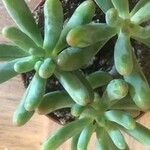
Sedum allantoides
Sana777 · Flowering Stonecrop
Description
Source: leafsnapSedum allantoides, commonly known as the "Narrowleaf Stonecrop," is a succulent plant in the Crassulaceae family. Native to North America, it thrives in rocky areas, cliffs, and dry slopes. The plant features narrow leaves arranged in a rosette pattern and can grow up to 6 inches tall. The leaves of Sedum allantoides are fleshy and green, with red tips during the growing season. In late summer or early fall, it produces small white or pink flowers that bloom in clusters at the top of its stems. This plant is easy to care for, requiring minimal watering and thriving in well-draining soil with full sun exposure. Its drought tolerance also makes it an ideal choice for xeriscaping gardens. Moreover, Sedum allantoides has several medicinal properties. When applied topically, it has anti-inflammatory effects on skin irritations like burns or insect bites. It also contains antioxidants that help protect against cellular damage caused by free radicals. Overall, Sedum allantoides is an excellent addition to any garden due to its unique appearance, low maintenance requirements, and medicinal benefits, along with its ability to thrive in drought conditions!
Care Guide
💧 Water Every 7 days
☀️ Light Full sun
Native to dry habitats, Sedum allantoides performs best in full sun, its natural setting marked by intense sunlight and scarce shade. It can also tolerate partial sun, which provides some flexibility in its growth.
🌡️ Temperature 20–37.8°C
Although Sedum allantoides can endure some heat, it mainly does well in cooler periods and becomes dormant during summer. In very hot summer weather, shade should be given to avoid scorching from intense sun. Watering ought to be reduced or ceased in the hottest part of the year to prevent root rot. Winter and spring are the times when Sedum allantoides grows vigorously, and if temperatures do not drop too low it will continue to grow steadily.
💨 Humidity
🪴 Soil 0-0
🌱 Fertilizer
For Sedum allantoides, light applications of fertilizer once or twice a year during the growing season are adequate. Avoid fertilizing in winter and in summer when the plant is dormant. Cut back on fertilizer for plants that have been repotted and wait a couple of months after repotting before applying fertilizer. Fertilizing helps maintain healthy growth and promotes blooming.
🪴 Pot & Repot
✂️ Pruning
🌿 Propagating
🐛 Diseases & pets
☠️ Toxicity
Characteristics
- Plant Type
- Succulent
- Life Cycle
- Perennial
- Genus
- Sedum
- Family
- Crassulaceae
- Hardiness Zone
- 9-11
- Mature Height
- 30 cm
- Mature Spread
- 46 cm
- Leaf Color
- Light Green, Pale Green
- Leaf Type
- Evergreen
- Flower Color
- White
- Flower Size
- 0.51 cm to 1.02 cm
- Bloom Time
- Early spring, Mid spring
- Planting Time
- Summer, Autumn
- Harvest Time
- Late spring, Early summer
- Native Area
- Mexico