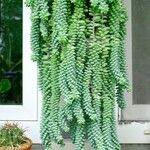
Sedum burrito
Burro's Tail · Burro’s tail (donkey tail plant) · Donkey's tail · Jelly bean · Burros tail
Description
Source: leafsnapSedum burrito, commonly known as Burro's Tail or Donkey's Tail, is a succulent plant from the Crassulaceae family. Native to Mexico and Honduras, it’s a favored houseplant due to its distinctive appearance and low maintenance requirements. The plant features long, trailing stems that can extend up to three feet. These stems are adorned with small, plump blue-green leaves that are cylindrical or oblong and can grow up to one inch in length. Sedum burrito thrives in bright, indirect light but can also endure low light conditions. It needs well-draining soil and should be watered sparingly to avoid root rot. During the summer, the plant produces small pink or red flowers, although they are not as showy as those of some other succulents. With its trailing habit, Sedum burrito is perfect for hanging baskets or as a trailing accent in mixed container gardens. Its unique appearance adds interest and texture to any indoor space with cascading foliage that enhances visual appeal.
💡 Golden sedum is a beautiful succulent with spoon-shaped leaves and a lotus-like form. Each leaf has a small tip at its end. The plant appears golden or yellow-green, making it instantly charming and delightful at first sight.
🌳 Although the baby burro's tail has a distinctive trailing, donkey-tail-inspired appearance that enlivens homes and green spaces, it is not known for any significant uses beyond decoration. It has not been used to produce essential oils, culinary spices, drinks, or as a protein source for animal feed.
🎭 Calm and serenity
Care Guide
💧 Water Every 7 days
Burro's tail is well-suited for arid climates because it efficiently stores water in its succulent leaves, making it highly drought-tolerant. To care for this plant, water it every three weeks and allow the soil to dry out completely between waterings. As an indoor plant, it thrives on sunny windowsills and does well in containers with low humidity.
☀️ Light Full sun
Baby burro's tail does best with abundant sunlight and can tolerate some periods of gentler light. It shows especially fine growth when given continuous, ample sun that mimics its natural surroundings. Too much sun can cause leaf scorch, while too little light may stunt its growth.
What are the sunlight requirements for Burro's tail?
Burro's tail thrives in abundant sunshine and can tolerate a bit of less intense sun. It requires full sun, which is above 6 hours of sunlight daily, for optimal growth. Partial sun, about 3-6 hours of sunlight daily, is also acceptable but not ideal. Ensuring the plant receives ample and uninterrupted sun exposure, similar to its natural habitat, promotes exquisite growth. However, overexposure to sunlight can lead to leaf scorch, and inadequate sun may stunt the plant's growth. Observing how sunlight moves through your garden will help you choose the perfect spots that provide the right balance of light and shade for your plants.
How can artificial lighting be used for Burro's tail indoors?
Indoor Burro's tail requires adequate lighting for optimal growth, especially when natural sunlight is insufficient, like in winter or less sunny spaces. Artificial lights can provide a vital solution. LED lights are recommended because they can be tuned to offer specific wavelengths needed by plants. Full sun plants need 30-50W/sq ft, partial sun plants 20-30W/sq ft, and full shade plants 10-20W/sq ft of artificial light. The light source should be placed 12-36 inches above the plant to mimic natural sunlight, and the duration should mimic natural daylight hours, generally 8-12 hours per day.
What are common symptoms of insufficient light in Burro's tail?
Common symptoms of insufficient light in Burro's tail include lighter-colored new leaves, indicating a lack of chlorophyll and essential nutrients; leggy or sparse growth, making the plant look weak; faster leaf drop as the plant tries to conserve resources; and slower or no new growth as the plant enters a survival mode. Additionally, chlorosis, sunscald, leaf curling, wilting, and leaf scorching can occur, all of which negatively impact the plant's health and appearance. These symptoms suggest that the plant requires either a location with better natural sunlight or supplemental artificial light.
How can I address and prevent light deficiency problems in Burro's tail?
To address light deficiency in Burro's tail, gradually move the plants to a sunnier location each week until they receive at least 6 hours of direct sunlight daily. For indoor plants, use a south-facing window and keep curtains open during the day. If the plant is large or not easily movable, consider using artificial light, keeping a desk or ceiling lamp on for at least 8 hours daily or investing in professional grow lights. For outdoor plants, avoid sudden changes in light intensity to prevent sunburn. If necessary, minimize obstructions like trees by pruning, or transplant smaller plants during their dormant period to a location with ample sunlight and good drainage. Note that parts of the plant affected by insufficient sunlight may not recover, but new growth will be healthy after increasing light exposure.
🌡️ Temperature 20–37.8°C
The baby burro's tail is native to warmer climates and does best in temperatures between 68 to 100 ℉ (20 to 38 ℃). In colder seasons, keep the temperature above 55 ℉ (13 ℃) to prevent frost damage. During hotter months, give it some shade to stop the leaves from scorching.
What is Burro's Tail and where is it native to?
Burro's tail, known botanically as Sedum burrito, is native to warmer regions. It thrives in temperatures that range from 68°F to 100°F (20°C to 38°C). This plant prefers warm conditions and requires specific care to maintain its health and vitality, particularly in terms of temperature management.
How should Burro's Tail be cared for during colder seasons?
During the colder seasons, it's important to keep Burro's tail at a temperature above 55°F (13°C) to prevent frost damage. The winter season is its growing period, so maintaining temperatures above 20°C is crucial for its optimal growth. If the outdoor temperature falls below 0°C, it's advisable to bring the plant indoors to a well-lit area. Overwintering the plant outside requires a sheltered spot with plenty of sunlight, and in consistently low temperatures, consider setting up a temporary greenhouse to protect it, keeping the plant adequately moist.
What are the symptoms of cold damage in Burro's Tail, and how can it be treated?
Burro's tail shows a lack of tolerance for extremely cold temperatures, thriving best between 20°C and 38°C. In winter, it should be kept above 0°C. Exposure to temperatures below -5°C can cause the leaves to exhibit water-soaked necrosis and wilting. After mild frost damage, leaves may significantly wilt and eventually fall off within a week. To treat cold damage, trim the frostbitten areas and move the plant to a warmer indoor spot near a south-facing window for sunlight, or set up a makeshift greenhouse for protection. Ensure good airflow in the greenhouse to avoid plant decay.
How does high temperature affect Burro's Tail, and what are the solutions?
In summer, it's advisable to keep Burro's tail in conditions below 38°C. When temperatures rise above 43°C, the plant enters a dormant state and becomes more susceptible to rot, especially in high humidity. To address heat stress, remove any dry and rotten parts of the plant, and relocate it to a partially shaded area to protect it from direct midday and afternoon sunlight. Stop watering until the weather cools down to prevent further stress on the plant.
💨 Humidity
🪴 Soil 6-7
🌱 Fertilizer
Baby burro's tail only needs light fertilizer applied once or twice a year during the growing season. Do not fertilize in winter or summer when the plant is dormant. Use less fertilizer for repotted plants and wait a couple of months after repotting before you start feeding. Fertilizing helps maintain healthy growth and can encourage blooms.
🪴 Pot & Repot Every 2 years
When repotting a Baby burro's tail, choose a pot slightly larger than the current one that has good drainage. Use a gritty, well-draining succulent or cactus mix. Gently remove the plant from its old pot, dust off excess soil, and replant it at the same depth. Wait a few days before watering so any root damage can heal. Repot in spring or fall and place it in a brightly lit spot.
✂️ Pruning
To keep a burro's tail looking its best, it’s important to prune it in the spring and fall. This involves removing any dense or extra branches. For propagation, choose a healthy stem with 5 to 6 leaves. Cut the stem and apply sulfur powder to the cut surface. Then plant the stem in slightly moist soil.
🌿 Propagating
🐛 Diseases & pets
☠️ Toxicity
Characteristics
- Plant Type
- Succulent, Herb, Vine
- Life Cycle
- Perennial
- Genus
- Sedum
- Family
- Crassulaceae
- Hardiness Zone
- 9-11
- Mature Height
- 30 cm
- Mature Spread
- 46 cm
- Leaf Color
- Green, Blue
- Leaf Type
- Evergreen
- Flower Color
- Pink, White
- Flower Size
- 0.51 cm to 1.02 cm
- Bloom Time
- Early summer, Mid summer
- Planting Time
- Spring, Summer, Autumn, Winter
- Harvest Time
- Mid summer
- Native Area
- Mexico