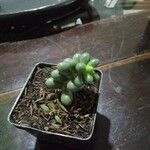
Sedum hernandezii
Care Guide
💧 Water Every 2-3 weeks
The jellybean plant thrives in rocky, arid environments and demonstrates excellent drought tolerance. Water it once every 2-3 weeks, making sure the soil completely dries out between waterings. Although it is often grown indoors for its aesthetic appeal, be cautious of overwatering, as this can lead to root rot.
☀️ Light Full sun
The jellybean plant does best in locations that receive full sun all day, though it can tolerate areas with moderate sun. It comes from habitats where sunlight is plentiful. Insufficient sun can cause poor development, while too much sun may result in leaf scorch.
What are the sunlight requirements for a Jellybean Plant?
The Jellybean Plant, known botanically as Sedum hernandezii, thrives in environments with full sun, requiring more than 6 hours of sunlight daily, but it can also grow well in partial sun, with about 3 to 6 hours of sunlight. It's important to watch how sunlight moves through your garden to pick spots that offer a good balance of light and shade, ensuring the plant's health and happiness.
How does sun exposure affect the Jellybean Plant?
Sun exposure is crucial for the Jellybean Plant's growth as it performs best with full sun exposure throughout the day, originating from regions with abundant solar radiation. Insufficient sun can result in poor development, while excessive exposure may lead to leaf scorch. Thus, balancing sun exposure is key, recognizing the plant's adaptability to moderate sun as well.
Can artificial lighting be used for Jellybean Plants, and how?
Yes, artificial lighting can be beneficial for Jellybean Plants, especially when natural sunlight is insufficient, like in winter or less sunny spaces. Adequate lighting is essential for optimal growth. LED lights are recommended due to their ability to provide specific wavelengths needed by plants. For full sun plants, 30-50W per square foot is needed, 20-30W for partial sun plants, and 10-20W for full shade plants. The light source should be 12-36 inches above the plant for 8-12 hours per day to mimic natural daylight conditions.
What are common symptoms of light deficiency in Jellybean Plants?
Jellybean Plants may exhibit several symptoms when light conditions are not optimal, including smaller new leaves, leggy or sparse growth, faster leaf drop, slower or halted growth, and lighter-colored or yellowish leaves indicating chlorosis. Excessive sunlight exposure can cause symptoms like sunscald, leaf curling, wilting, leaf scorching, and diminished health.
How can I address lighting issues for my Jellybean Plant?
To address light deficiencies, gradually move your Jellybean Plant to a sunnier location each week until it receives at least 6 hours of sunlight daily. A south-facing window is ideal for indoor plants. Consider using artificial lighting if the plant is large or not easily movable, keeping lights on for at least 8 hours daily. For outdoor plants, avoid sudden changes in light intensity to prevent sunburn. Removing obstructions or transplanting to a sunnier location can improve outdoor light exposure. Note that parts of the plant affected by prior insufficient light may not recover, but new growth should be healthy with improved lighting conditions.
🌡️ Temperature 20–37.8°C
The jellybean plant is native to areas where average temperatures range from 68 to 100 °F (20 to 38 ℃). It thrives in warm climates and needs temperature adjustments to grow optimally as the seasons change.
What are the ideal growing conditions for a Jellybean plant?
The Jellybean plant, botanically known as Sedum hernandezii, thrives in regions with average temperatures ranging from 68 to 100 °F (20 to 38 °C). It is a heat-loving plant that prefers warm climates for optimal growth. During the changing seasons, it may require temperature adjustments. As temperatures drop, particularly below 0°C, the Jellybean plant gradually stops growing and enters a dormant state. To protect the plant during colder months, it should be moved indoors, ideally near a south-facing window to maximize sunlight exposure. If natural light is insufficient, supplemental lighting is recommended. Additionally, when temperatures fall below 20°C, it's advised to reduce or halt watering to prevent root rot, especially for plants grown outdoors. In extreme cases, setting up a temporary greenhouse or using insulating materials such as plastic film or fabric can help protect the plant from cold.
How should you care for a Jellybean plant during low temperatures?
In low temperatures, particularly under 20°C, the Jellybean plant's growth slows down and it may enter a dormancy period. If temperatures drop below 0°C, the plant should be moved indoors to prevent it from freezing. To ensure the plant remains healthy, place it near a south-facing window to get as much sunlight as possible or use supplemental lighting if necessary. It's important to reduce or stop watering to avoid root rot during cooler temperatures. In the case of exposure to temperatures below -5°C, the Jellybean plant might show signs of weakness, wilting, and become prone to root rot. If frost damage occurs, the frostbitten areas should be trimmed off, checking for root rot. If detected, the affected roots should be cut off and the plant can be propagated through cuttings. The plant should then be moved to a warm environment to encourage recovery.
What steps should be taken if a Jellybean plant experiences high temperatures?
During the summer, when temperatures might exceed the ideal range for a Jellybean plant, care should be taken to keep it below 38°C. Exposure to temperatures above 43°C can halt the plant's growth, lead to water loss, wilting, and increase the risk of sunburn. To help the plant recover from heat stress or sunburn, remove any sunburned or rotten parts of the plant. Providing shade during the intense afternoon sun can help the plant recover and resume growth. If root rot has occurred due to overwatering, it's essential to stop watering until new, healthy roots begin to form. This will help the Jellybean plant to recover from heat-induced stress.
💨 Humidity normal (40-60%)
This plant will thrive in moderate humidity, which is probably the level in your home. However, misting it a few times a week can be very beneficial. Make sure the room has good ventilation.
🪴 Soil 6-7
🌱 Fertilizer
For the Jellybean plant, light applications of fertilizer once or twice a year during the growing season are adequate. Do not fertilize in winter or summer while it's dormant. Cut back on fertilizer for recently repotted plants and wait a couple of months after repotting before feeding. Fertilizing helps maintain healthy growth and promotes blooms.
🪴 Pot & Repot Every 2 years
When repotting a Jellybean plant, choose a pot slightly larger than the current one that provides good drainage. Use a gritty, well-draining cactus or succulent mix. Gently remove the plant from its old pot, brush off excess soil, and place it at the same depth in the new pot. Wait a few days before watering so any root injury can heal. Repot during spring or fall, and keep the plant in a brightly lit spot.
✂️ Pruning
To keep large succulent plants, such as the jellybean plant, in good shape, prune them in the spring and fall. Remove any unnecessary or dense branches. If you wish to propagate a plant, cut a sturdy stem with 5-6 leaves. Apply sulfur powder to the cut to prevent infection and allow it to heal. Once healed, plant the stem in slightly moist soil.
🌿 Propagating
🐛 Diseases & pets
☠️ Toxicity
Characteristics
- Plant Type
- Succulent
- Life Cycle
- Perennial
- Genus
- Sedum
- Family
- Crassulaceae
- Hardiness Zone
- 9-11
- Mature Height
- 10 cm
- Mature Spread
- 15 cm
- Leaf Color
- Light Green, Lime
- Leaf Type
- Semi-evergreen
- Flower Color
- Yellow
- Flower Size
- 1.02 cm to 1.52 cm
- Bloom Time
- Late spring, Early summer, Mid summer
- Planting Time
- Spring, Summer, Autumn
- Harvest Time
- Mid summer, Late summer, Early fall
- Native Area
- Mexico