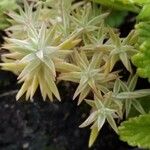
Sedum lineare
گل ناز خطی · Needle stonecrop · Shore Stonecrop
Description
Source: leafsnapSedum lineare, commonly known as needle stonecrop or creeping stonecrop, is a low-growing succulent belonging to the Crassulaceae family. Native to Asia, it thrives in various habitats such as rocky slopes, cliffs, and open woodlands. This plant features thin, needle-like leaves arranged in a spiral pattern along its stem. The leaves are green or bluish-green but can turn reddish-brown during drought or cold weather. The stem of Sedum lineare can grow up to 30 cm in length and produces small yellow flowers in the summer. Sedum lineare is easy to grow and requires minimal care. It prefers well-draining soil with moderate moisture levels and full sun exposure but can also tolerate partial shade. Although drought-tolerant, it should be watered occasionally during prolonged dry periods. This succulent is versatile and can be used as ground cover for rock gardens or borders, in container plantings for succulent arrangements, or as an accent plant in landscaping projects due to its unique texture and coloration. Overall, Sedum lineare is a versatile succulent with attractive foliage that enhances any garden setting while requiring minimal maintenance. It is an excellent choice for novice gardeners seeking easy-to-grow plants as well as experienced horticulturists looking to add unique specimens to their collection.
💡 The flowering and fruiting season of the carpet sedum coincides with the farmers' harvest season. Whenever a breeze blows, the rustling of the sedum fruits seems to signal to the farmers that it is time to harvest.
🌳 Although needle stonecrop might not immediately draw attention in the plant world, one of its lesser-known functions is in landscaping and sustainable architecture. Its sturdy build and spreading growth habit make it a strong choice for green roof projects—where vegetation covers roofs, helping to reduce the urban heat island effect and improve building insulation. The plant's thick, fleshy leaves point to a potential role in drought-tolerant gardening, aiding water conservation. Likewise, those same characteristics could indicate an ability to take up pollutants, but specific studies would be necessary to confirm such applications.
🎭 Sense for rhythm
Care Guide
💧 Water Every 7 days
Carpet sedum grows well in well-drained soils and is highly drought-tolerant, making it ideal for arid environments. It requires minimal watering, ideally only once every three weeks. This plant adapts well to both outdoor xeriscaping and container gardening, but it's important to water it carefully to replicate its native dry conditions.
When Should I Water My Carpet Sedum?
Timely watering is crucial for the growth and health of carpet sedum. This plant has a unique watering schedule distinct from most indoor plants, relying on several indicators to signal the need for water. The appearance of the leaves is a primary indicator; when they start to look wrinkled or desiccated and feel soft, it's a sign they're losing moisture and the plant needs watering. Additionally, the soil should be completely dry before watering again, a condition you can check by feeling the soil up to your second knuckle. Note that carpet sedum enters dormancy in winter, during which its water requirements decrease. Be cautious with watering intervals to avoid root rot from overwatering or dehydration from underwatering.
How Should I Water My Carpet Sedum?
Watering carpet sedum properly involves techniques such as bottom-watering or using a watering can for precise watering directly into the soil, avoiding the foliage. The plant is susceptible to overwatering, so it's important to ensure the soil is on the drier side before the next watering. If you're bottom-watering, fill a saucer with water and let the plant soak up what it needs. When using a watering can, opt for a gentle pour directly onto the soil. Always make sure not to water the leaves, crown, or stem directly to prevent rot and disease. Suitable tools like a moisture meter and a watering can with a long, slim spout can help in executing this task effectively.
How Much Water Does Carpet Sedum Really Need?
The amount of water carpet sedum needs varies with the plant size and growing conditions but generally adheres to the principle of watering until a small amount runs out of the pot's drainage holes. This is to ensure the root system is adequately moistened. Carpet sedum's native habitat, which has good drainage and light rainfall, conditions it to thrive on consistent but moderate watering. A vibrantly green color, thick leaves, and healthy new growth are signs of optimal watering. Over and underwatering can both lead to leaf shriveling and wilting, indicating the need for adjustment. In potted plants, ensure the water reaches the deeper roots by allowing a gentle flow for a longer period.
What Kind of Water is Best for Carpet Sedum?
Carpet sedum thrives best with the use of rainwater, which is naturally soft and devoid of harmful elements. Distilled or filtered water is also beneficial, while tap water should be used cautiously due to its potential chlorine content. Carpet sedum is sensitive to chlorine and fluoride, commonly found in tap water, which can impair growth. Using dechlorinated, filtered, or distilled water helps avoid the accumulation of harmful salts in the soil. During active growth stages in spring and summer, room temperature water is preferred, shifting to slightly cooler water in winter to mimic natural conditions.
How Do Carpet Sedum's Watering Needs Change with the Seasons?
Carpet sedum's watering needs vary significantly with the seasons. In spring, as the plant awakens from dormancy, gradually increase watering, making sure the soil is thoroughly saturated at each watering, yet allowing the topsoil to dry out before the next. Watering demands peak during summer due to higher temperatures, necessitating regular watering sessions that ensure deep moisture penetration. In autumn, prepare for reduced watering as temperatures drop and the plant enters dormancy. Winter sees a significant reduction in the plant’s watering needs, focusing on preventing the soil from completely drying out, while being cautious not to overwater.
☀️ Light Full sun
Needle stonecrop can thrive in full-day sun exposure, though it can also survive in locations where sunlight is not constant. Originating from sun-exposed habitats, it remains a healthy green under those conditions. Too much or too little light can lead to poor growth for this plant.
What are the sun requirements for carpet sedum?
Carpet sedum requires varied sunlight conditions to thrive. It ideally needs full sun, which is above 6 hours of sunlight daily, or can also grow in partial sun, receiving about 3-6 hours of sunlight. Observing how sunlight moves through your garden helps in choosing the right spots for planting, ensuring a perfect balance of light and shade to keep your plants happy.
Can carpet sedum grow in artificial lighting?
Yes, carpet sedum can grow under artificial lighting, which is especially helpful in winters or less sunny spaces where natural sunlight is insufficient. Ideally, LED lights should be used, providing the necessary wavelengths of light. The requirement for artificial lighting varies: full sun plants need 30-50W/sq ft, partial sun plants 20-30W/sq ft, and full shade plants 10-20W/sq ft. The light source should be placed 12-36 inches above the plant for 8-12 hours per day to mimic natural sunlight conditions.
What are the signs of improper lighting in carpet sedum?
Carpet sedum shows several signs when exposed to suboptimal lighting conditions. These include lighter-colored new leaves indicating a lack of chlorophyll, leggy or sparse growth due to inadequate light, slower or no new growth as the plant enters survival mode, faster leaf drop as a resource conservation tactic, chlorosis leading to yellowing leaves, sunscald from intense sunlight exposure, leaf curling to reduce surface area against sun, wilting due to increased water loss, and leaf scorching characterized by brown, dry patches from too much sunlight.
How can you address lighting issues for carpet sedum?
To address lighting issues for carpet sedum, ensure gradual adaptation to sunlight by moving plants to sunnier locations each week until they receive at least 6 hours of direct sunlight daily. For indoor plants, use south-facing windows or artificial light sources such as desk or ceiling lamps, keeping them on for at least 8 hours daily, or invest in plant grow lights. When planting outdoors, avoid drastic changes in sunlight to prevent sunburn. For ground plants, prune obstructions like trees and consider transplanting smaller plants during their dormant period to sunnier areas.
🌡️ Temperature 15–37.8°C
The needle stonecrop performs best in its native growing environment when temperatures are between 59 and 100 ℉ (15 to 38 ℃). It prefers conditions within that range but can tolerate occasional drops to 50 ℉ (10 ℃) and occasional rises to 104 ℉ (40 ℃). In colder seasons, it is advisable to keep the plant indoors or in a sheltered spot to protect it from frost.
What are the optimal growing conditions for Carpet sedum?
Carpet sedum thrives in its native growth environment with temperatures ranging from 59 to 100°F (15 to 38°C). It prefers these temperature conditions but can withstand occasional drops to as low as 50°F (10°C) and rises up to 104°F (40°C). To protect the plant from frost during cooler seasons, it's recommended to keep it indoors or in a sheltered area. Carpet sedum is a heat-loving plant and enters a dormant state in winter. It should be moved indoors when outdoor temperatures drop below 14°F (-10°C), placing it near a south-facing window for ample sunlight. If natural light is insufficient, supplemental lighting can be used. When temperatures fall below 59°F (15°C), the plant's growth slows, and watering should be reduced or stopped to prevent root rot. Outdoor plants require a halt in watering during low temperatures, and temporary insulation or wrapping with plastic film or fabric can be beneficial.
How does Carpet sedum respond to low and high temperatures, and what are the solutions?
Carpet sedum is sensitive to extreme temperatures. In low temperatures above 59°F (15°C), it thrives but should be kept above 14°F (-10°C) to avoid damage. Exposure to temperatures below -15°C may cause the plant to become weak, wilt, and be prone to root rot. If frost damage occurs, affected areas should be trimmed, and if there's root rot, the rotten roots need to be cut off for possible propagation through cuttings. The plant should be moved to a warm indoor environment and placed near a south-facing window for sufficient sunlight, using supplemental lighting if natural light isn't adequate. In high temperatures, ideally, it should be kept under 100°F (38°C). When the temperature exceeds 109°F (43°C), plants may stop growing and suffer from water loss, wilting, and sunburn. Sunburned and rotten parts should be removed. Protecting the plant from afternoon sunlight until recovery and halting watering in cases of root rot until new roots emerge is essential.
💨 Humidity dry (<40%)
This plant prefers dry conditions, so don't mist it. However, watering it less often can also thrive in higher humidity.
🪴 Soil 6-7
🌱 Fertilizer
Needle stonecrop only needs light doses of fertilizer once or twice a year during the growing season. Avoid fertilizing in winter and in summer when it is dormant. Use less fertilizer for repotted plants and wait a couple of months after repotting before fertilizing. Fertilizing promotes healthy growth and encourages blooms.
Why should I add fertilizer to my Carpet sedum?
Fertilizing Carpet sedum helps to add nutrients to the soil, supporting healthy growth. Despite its ability to store water and nutrients, applying plant food during the growing season is still beneficial. Fertilizing can also stimulate blooming in mature specimens during this time.
When should I fertilize my Carpet sedum?
Carpet sedum, like other plants, benefits from additional nutrients. However, it only requires a small amount of fertilizer during the growing season. It is recommended to fertilize this plant 1-2 times a year, specifically in the spring and autumn, when it is actively growing. Avoid fertilizing in the winter and summer, when the plant is dormant. If the Carpet sedum has been repotted, be cautious with the amount of fertilizer you use, as you should reduce it. It is also advisable to wait a few months after repotting before beginning to apply fertilizer.
When should I not put fertilizer on my Carpet sedum plant?
Carpet sedum, like other plants, goes through a period of dormancy where you should avoid fertilizing. This happens in both summer and winter when the plant stops growing. It's also recommended to refrain from fertilizing for the first few months after repotting in the spring.
Which fertilizer should I use for my Carpet sedum?
To properly fertilize Carpet sedum, it's recommended to use a liquid plant food specifically designed for succulents and cacti. Remember to dilute the fertilizer with water, cutting it to half-strength to prevent any buildup in the soil. Apply the fertilizer at the base of the plant, making sure to water thoroughly. This will help ensure that any excess moisture drains from the container or seeps into the ground.
How do I make my Carpet sedum plant grow better?
When fertilizing Carpet sedum, using liquid plant food is easier, although granules are also an option. Make sure to follow the instructions on the packaging, especially when diluting liquid fertilizers to half-strength. Regardless of whether you choose granules or liquid plant food, always apply it to the soil. Afterward, cover the granules with a thin layer of soil and water the plant.
🪴 Pot & Repot Every 2 years
When repotting Needle stonecrop, choose a pot slightly larger than the current one that has good drainage. Use a gritty, well-draining succulent or cactus potting mix. Gently remove the plant from its old container, brush off excess soil, and set it at the same depth. Wait several days before watering so any root injury can heal. Repot in spring or fall and place the plant in a brightly lit spot.
✂️ Pruning
To keep carpet sedum in shape, prune any excess or dense branches during spring and fall using a knife or scissors. After pruning, apply sulfur powder to the cuts to promote healing. If you want to propagate the plant, cut a healthy stem with 5-6 leaves, allow the wound to heal, and then plant it in slightly moist soil during spring or fall.
🌿 Propagating
🐛 Diseases & pets
☠️ Toxicity
All parts of the Carpet Sedum are usually regarded as non-toxic to animals and people. However, ingestion may cause minor discomfort and the sap may cause skin irritation.
Characteristics
- Plant Type
- Succulent, Herb
- Life Cycle
- Perennial
- Genus
- Sedum
- Family
- Crassulaceae
- Hardiness Zone
- 7-11
- Mature Height
- 10 cm to 20 cm
- Mature Spread
- 61 cm
- Leaf Color
- Green
- Leaf Type
- Evergreen, Semi-evergreen
- Flower Color
- Yellow
- Flower Size
- 4.06 cm to 7.62 cm
- Bloom Time
- Early summer, Mid summer
- Planting Time
- Spring, Summer, Autumn
- Harvest Time
- Mid summer
- Native Area
- Vietnam, Japan, China