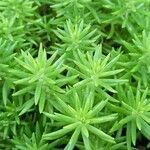
Sedum mexicanum
Mexican stonecrop · Lemon Sedum · Mexican sedum · Time flower
Description
Source: leafsnapSedum mexicanum, commonly known as Mexican stonecrop, is a succulent plant native to Mexico. It belongs to the Crassulaceae family and is widely appreciated as an ornamental plant due to its attractive foliage and flowers. The plant boasts small, fleshy leaves arranged in rosettes that vary in color from green to reddish-brown. These leaves are covered with fine hairs, giving them a velvety texture. During the summer months, Mexican stonecrop produces clusters of small, star-shaped flowers that can be pink or white. These flowers are known to attract pollinators such as bees and butterflies. One of the appealing aspects of this plant is its ease of care. Mexican stonecrop requires minimal watering and thrives in well-draining soil with ample sunlight exposure. It can be grown both indoors and outdoors, though it thrives best in warm climates. Beyond its ornamental value, Sedum mexicanum also possesses various medicinal properties, including anti-inflammatory, analgesic, antifungal, and antibacterial effects. These properties make it useful for treating various ailments, including wound healing. Overall, Sedum mexicanum is an attractive, low-maintenance succulent, making it an excellent addition to any garden or indoor space!
💡 Golden sedum is a beautiful succulent with spoon-shaped leaves and a lotus-like form. Each leaf has a small tip at its end. The plant appears golden or yellow-green, making it instantly charming and delightful at first sight.
Care Guide
💧 Water Every 7 days
Originating from arid regions, Mexican stonecrop is highly drought-tolerant and thrives with minimal moisture. It prefers well-draining soil and sustains itself by storing water in its fleshy leaves. For optimal health, Mexican stonecrop should be watered weekly, maintaining its lush foliage year-round as an evergreen plant.
☀️ Light Full sun
Native to arid regions, Mexican stonecrop does best in full sun; its natural habitat features intense sunlight and little shade. It will also tolerate partial sun, giving it some flexibility in where it grows.
🌡️ Temperature 15–37.8°C
Although Mexican stonecrop can tolerate some heat, it mainly does best and grows during the cooler seasons and goes dormant in summer. In hot summer weather, give it shade to avoid scorching from strong sunlight. Watering should be cut back or stopped during the hottest part of the year to avoid root rot. Mexican stonecrop grows vigorously in winter and spring. Provided the temperature does not fall too low, it will continue to grow steadily.
💨 Humidity dry (<40%)
This plant prefers dry conditions, so don't mist it. However, watering it less often can also thrive in higher humidity.
🪴 Soil 0-0
🌱 Fertilizer
For Mexican stonecrop, light applications of fertilizer 1–2 times a year during the growing season are enough. Do not fertilize in winter or summer when the plant is dormant. Cut back on fertilizer for repotted plants and wait a couple of months after repotting before feeding. Fertilizing helps maintain healthy growth and promotes blooms.
🪴 Pot & Repot Every 12 months
Mexican stonecrop needs pots with excellent drainage in order to thrive.
✂️ Pruning
To keep your Mexican stonecrop looking its best, it's important to prune the plant, especially removing any redundant or dense branches during spring and fall. For propagation, cut 5-6 leaves from a sturdy stem, apply sulfur powder to the cut areas to prevent infection, and then plant the leaves in slightly moist soil after they have healed.
🌿 Propagating
🐛 Diseases & pets
☠️ Toxicity
Characteristics
- Plant Type
- Herb
- Life Cycle
- Perennial
- Genus
- Sedum
- Family
- Crassulaceae
- Hardiness Zone
- 7-11
- Mature Height
- 30 cm
- Mature Spread
- 46 cm
- Leaf Color
- Lime Green, Yellow Green
- Leaf Type
- Evergreen
- Flower Color
- Yellow
- Flower Size
- 1.02 cm to 1.52 cm
- Bloom Time
- Summer, Early fall, Mid fall
- Planting Time
- Spring, Summer, Autumn
- Harvest Time
- Late summer, Fall, Early winter
- Native Area
- Honduras, Mexico, Guatemala, Costa Rica