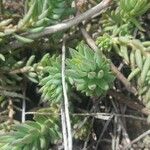
Sedum rupestre
Rock stonecrop · Reflexed stonecrop · Jenny's stonecrop · Large Yellow Stonecrop · Yellow Stonecrop
Description
Source: leafsnapSedum rupestre, commonly known as stonecrop, is a low-growing succulent plant belonging to the Crassulaceae family. Native to Europe and Asia, it has been introduced and naturalized in many parts of the world. This plant features fleshy, green leaves arranged in a rosette pattern that can reach up to 10 cm in length. The leaves are covered with tiny hairs, giving them a velvety texture. During the summer months, Sedum rupestre produces small, yellow, star-shaped flowers in clusters, each with five petals. These flowers attract bees, butterflies, and other pollinators, adding to the plant's appeal. Known for its drought tolerance, Sedum rupestre thrives in poor soil conditions, such as rocky or sandy soils. While it prefers full sun, it can also tolerate partial shade. Often used as ground cover or in rock gardens, Sedum rupestre's low-growing habit and ability to spread rapidly through offsets or stem cuttings make it a popular choice. Overall, Sedum rupestre is an attractive succulent with a unique foliage texture that requires minimal care. It is an excellent choice for gardeners seeking a low-maintenance plant with ornamental value.
Care Guide
💧 Water Every 7 days
During the hot summers, plan to water every 7-10 days. Water every 2-3 week in the fall and winter. Watering needs of container Sedum rupestre depends on a few factors. Based on rainfall, an outdoor container may not need any watering; whereas, an indoor container will need weekly watering. All of the soil should be dry before watering. If the soil is still moist, you risk giving this plant too much water which can make it start to rot. When you water this plant, water well and then allow the soil to dry out completely before you water it again.
☀️ Light Full sun
The golden sedum prefers strong sunlight but can tolerate moderate shade. Its natural habitat is places with abundant sun. It requires substantial light for healthy growth. Excessive exposure can scorch the leaves, while insufficient light may stunt growth or cause leggy growth.
🌡️ Temperature 5–35°C
Although Golden sedum can tolerate some heat, it mainly grows and does best in cooler seasons and becomes dormant in summer. In very hot weather, provide shade to prevent scorching from strong sunlight. Watering should be reduced or stopped during the hottest period to avoid root rot. Winter and spring are when Golden sedum grows vigorously, and as long as temperatures do not fall too low, it will continue to grow steadily.
💨 Humidity
🪴 Soil 6-7
🌱 Fertilizer
Golden sedum only needs small amounts of fertilizer once or twice a year during the growing season. Do not fertilize in winter or summer, when the plant is dormant. Cut back on feeding for repotted plants and wait a couple of months after repotting before applying fertilizer. Fertilizing helps sustain healthy growth and encourages flowering.
🪴 Pot & Repot
✂️ Pruning
🌿 Propagating
🐛 Diseases & pets
☠️ Toxicity
Sedum rupestre has no toxic effects reported.
Characteristics
- Plant Type
- Succulent
- Life Cycle
- Perennial
- Genus
- Sedum
- Family
- Crassulaceae
- Hardiness Zone
- 4-9
- Mature Height
- 5 cm to 15 cm
- Mature Spread
- 5 cm to 10 cm
- Leaf Color
- Green, Light Green
- Leaf Type
- Semi-evergreen
- Flower Color
- Yellow
- Flower Size
- 0.51 cm to 0.76 cm
- Bloom Time
- Late spring, Early summer, Mid summer
- Planting Time
- Spring, Autumn
- Harvest Time
- Mid summer, Late summer, Early fall
- Native Area
- Turkey, Sweden, Austria, Slovakia, Montenegro, Bulgaria, Greece, Croatia, Slovenia, Ukraine, Serbia, Russia, Norway, Germany, Italy, Spain, Switzerland, Denmark, Iceland, Finland, Iran, Albania, Azerbaijan, Romania, France