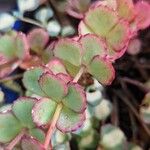
Sedum sieboldii
October Daphne
Description
Source: leafsnapSedum sieboldii, commonly known as October Daphne or Hylotelephium sieboldii, is a succulent plant native to Japan and Korea. This low-growing perennial forms rosettes of blue-green leaves edged with pink. The round, fleshy leaves are covered with a powdery coating, giving them a frosted appearance. In late summer to early fall, Sedum sieboldii produces clusters of small pink flowers on tall stems that rise above the foliage. These flowers attract bees and butterflies, adding life to your garden. Sedum sieboldii is easy to grow and thrives in full sun or partial shade with well-draining soil. Once established, it is drought-tolerant and can be propagated through stem cuttings or division. This plant is an excellent addition to rock gardens, borders, or containers, where its unique foliage can be appreciated up close. Its low-maintenance requirements make it ideal for beginner gardeners seeking an attractive and easy-to-care-for plant for their landscape design projects.
Care Guide
💧 Water Every 7 days
☀️ Light
🌡️ Temperature
This plant is hardy in much of the United States, ranging from zones 3 to 9. In the winter, they are quite durable and can withstand temperatures as low as -20 °F. Keep your plants away from severe temperatures when they are dormant. Furthermore, these plants need at least 40% humidity to flourish.
💨 Humidity
🪴 Soil
🌱 Fertilizer
🪴 Pot & Repot
✂️ Pruning
Deadhead the blooms as required during the growth season to encourage flowering. Leave dead stems on the plant at the conclusion of the growth season. When new growth appears in the spring, trim or break off the dead stems.
🌿 Propagating
🐛 Diseases & pets
☠️ Toxicity
All components of the plant are somewhat poisonous and may induce gastrointestinal upset. Nonetheless, extremely young, delicate leaves may be consumed without heating. When simply sautéed or steamed, somewhat older leaves may be consumed safely.
Characteristics
- Plant Type
- Perennial herb
- Genus
- Sedum
- Family
- Crassulaceae
- Hardiness Zone
- 3-9
- Bloom Time
- Summer, fall