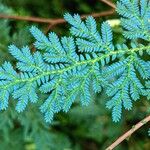
Selaginella willdenowii
Peacock-fern · Willdenow's Spike-Moss · Willdenow's spikemoss
Description
Source: leafsnapSelaginella willdenowii, commonly known as Willdenow's spikemoss, is a species of fern-like plant that belongs to the family Selaginellaceae. It is native to the tropical and subtropical regions of Africa and Madagascar. The plant has a creeping habit with small, scale-like leaves arranged in a spiral pattern along its stem. These leaves are green and have a glossy texture. Selaginella willdenowii thrives in moist soil with good drainage and prefers partial to full shade exposure. It can grow up to 30 cm in height, although it generally remains smaller when cultivated as an indoor plant. Due to its unique appearance and low maintenance needs, Selaginella willdenowii is popular for ornamental purposes. It can be grown indoors or outdoors and is often used in landscaping as ground cover or for border planting. In traditional medicine, Selaginella willdenowii has been used for its anti-inflammatory properties and has shown effectiveness against certain types of cancer cells in laboratory studies. Overall, Selaginella willdenowii is an intriguing fern-like species that offers both aesthetic appeal and potential medicinal benefits.
Care Guide
💧 Water Every 7 days
Willdenow's spikemoss comes from tropical rainforests and thrives in high humidity environments. To keep it healthy, it should be watered weekly and maintained in consistently moist conditions throughout the year. This makes it an ideal plant for indoor growth, where humidity levels can be easily controlled.
☀️ Light Partial sun
Willdenow's spikemoss is indigenous to habitats like forest understories and rocky areas, where it occurs in natural shade. It prefers partial sun but can adapt to full sun or full shade, reflecting its hardy, versatile nature.
What are the sunlight requirements for Willdenow's spikemoss?
Willdenow's spikemoss thrives in environments that offer partial sun, requiring about 3-6 hours of sunlight daily, but it can also grow well in full shade, where it receives less than 3 hours of sunlight. It's essential to monitor how sunlight moves through your garden throughout the day to pick the ideal spots that provide the right balance of light and shade, ensuring the plants' optimal growth and happiness.
How can artificial lighting be used for indoor plants?
Indoor Willdenow's spikemoss plants may require artificial lighting when natural sunlight is insufficient, especially during winter or in less sunny areas. For optimal growth, it's important to choose the right type of artificial light, such as LED lights that can offer specific wavelengths needed by your plants. The intensity required varies by plant type: full sun plants need 30-50W/sq ft, partial sun plants 20-30W/sq ft, and full shade plants 10-20W/sq ft. The light source should be placed 12-36 inches above the plant, mimicking natural sunlight conditions, and most plants benefit from 8-12 hours of light per day to simulate the natural length of daylight hours.
What are some common symptoms of light deficiency in Willdenow's spikemoss?
When grown indoors under insufficient light, Willdenow's spikemoss may exhibit several symptoms indicating a lack of light. These include smaller new leaves, leggy or sparse growth due to longer spaces between leaves or stems, faster leaf drop, slower or halted new growth, and lighter-colored or irregularly patterned new leaves suggesting a lack of chlorophyll and essential nutrients. Insufficient or excessive sunlight can also lead to chlorosis, where leaves turn yellow, sunscald causing damage to leaves or stems, leaf curling as a defense mechanism against overexposure, wilting from rapid water loss, and leaf scorching characterized by brown, dry edges on leaves.
How can I address and prevent light deficiency symptoms in Willdenow's spikemoss?
To prevent and address symptoms of light deficiency in Willdenow's spikemoss, gradually acclimate your plants to brighter conditions. For indoor plants, shift them to sunnier spots each week until they receive 3-6 hours of direct sunlight daily, or use artificial light sources like desk lamps or professional plant grow lights for at least 8 hours daily. Outdoors, gradually move your plants to brighter locations each week to avoid shock. If sunlight is blocked by trees or buildings, consider pruning or transplanting smaller plants to a sunnier spot. Note that parts of the plant damaged by insufficient sunlight may not recover, but new growth after adjusting light exposure should be healthy.
🌡️ Temperature 20–37.8°C
Willdenow's spikemoss comes from tropical areas, where the climate is generally warm and humid. Consequently, it is adapted to high temperatures and moisture. It is sensitive to abrupt temperature changes and prefers a steady thermal environment, so indoor temperature fluctuations should be avoided. It typically does not tolerate cold and needs relatively high temperatures to grow. If the ambient temperature falls too low, the plant may stop growing or even die.
💨 Humidity normal (40-60%)
This plant will thrive in moderate humidity, which is probably the level in your home. However, misting it a few times a week can be very beneficial. Make sure the room has good ventilation.
🪴 Soil 5-6
🌱 Fertilizer
Willdenow's spikemoss requires the most fertilizer during its active growth phase, which takes place mainly in spring, summer, and early fall. Fertilizing supplies essential nutrients that the soil might lack, supporting healthy root and stem growth and the attractive foliage that distinguishes this plant.
🪴 Pot & Repot
✂️ Pruning
Willdenow's spikemoss showcases vibrant bluish-green foliage. To keep it healthy and dense, prune the plant from early to late spring while it's actively growing. Trim away dead or overgrown stems to encourage fuller growth. Use light, selective pruning to shape the plant, which helps improve air circulation and reduces the risk of disease, promoting vigorous growth.
🌿 Propagating
🐛 Diseases & pets
☠️ Toxicity
This plant is not considered toxic.
Characteristics
- Plant Type
- Herb, Vine
- Life Cycle
- Perennial
- Genus
- Selaginella
- Family
- Selaginellaceae
- Hardiness Zone
- 10-11
- Mature Height
- 30 cm
- Mature Spread
- 49 cm
- Leaf Color
- Blue, Green
- Leaf Type
- Evergreen
- Planting Time
- Spring, Autumn
- Native Area
- Malaysia, Indonesia, Cambodia, Vietnam, Myanmar, Singapore, Laos, Thailand, China