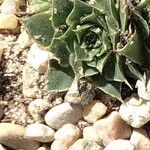
Sempervivum heuffelii
Hen and chickens
Description
Source: leafsnapSempervivum heuffelii, commonly known as Heuffel's houseleek, is a perennial succulent belonging to the Crassulaceae family. Native to the mountainous regions of Europe and Asia, it is widely cultivated as an ornamental plant due to its attractive rosette-shaped foliage. The leaves of Sempervivum heuffelii are fleshy, thick, and pointed, with a waxy coating that helps retain moisture. They are arranged in tight rosettes that can range in color from green to red or purple. The plant’s flowers are small and star-shaped, featuring pink or white petals. Sempervivum heuffelii prefers well-draining soil and full sun exposure but can also tolerate partial shade. While it is drought-tolerant, occasional watering is needed during prolonged dry spells. This plant possesses several medicinal properties, including anti-inflammatory, antiseptic, and analgesic effects, making it useful for treating various ailments like wounds and burns. Overall, Sempervivum heuffelii is an excellent addition to any garden due to its low maintenance requirements and attractive foliage, making it a popular choice among gardeners worldwide.
Care Guide
💧 Water Every 7 days
Job's beard, native to rocky and arid regions, thrives with minimal watering. Thanks to its drought tolerance and water-storing leaves, it ideally requires watering only once a week. This outdoor plant is perfect for rock gardens and adapts well to varying moisture levels, benefiting from a strong, robust root system.
☀️ Light Full sun
Native to dry areas, Job's beard does best in full sun; its native habitat has intense sunlight and very little shade. It will also tolerate partial sun, giving it some flexibility in how it grows.
🌡️ Temperature 5–35°C
Although Job's beard can tolerate some heat, it mainly does best and grows in the cooler months and becomes dormant in summer. In hot summer conditions, provide shade to avoid scorching from strong sunlight. Reduce or stop watering during the hottest part of the year to prevent root rot. Job's beard grows vigorously in winter and spring, and provided temperatures do not fall too low, it will continue to grow steadily.
💨 Humidity
🪴 Soil 0-0
🌱 Fertilizer
Job's beard needs only light applications of fertilizer once or twice a year during its growing season. Do not fertilize in winter or summer when it is dormant. Cut back on fertilizer for repotted plants and wait a couple of months after repotting before applying any. Fertilizing helps maintain healthy growth and promotes flowering.
🪴 Pot & Repot 2-3 years
Repot Job's Beard every 2 to 3 years during the spring to promote healthy rosette growth. Choose a shallow, wide container with excellent drainage. Once repotted, place the plant in bright, indirect light and return to a regular watering schedule after it has settled in. This will help support its recovery and overall health.
✂️ Pruning
Job's beard has a rosette shape and vibrant colors. To maintain its appearance and encourage thicker growth, prune it from early to late spring. Focus on removing dead leaves, particularly around the outer areas. Make sure to use clean tools to prevent infection, which will improve both the plant's aesthetics and its health.
🌿 Propagating
🐛 Diseases & pets
☠️ Toxicity
Characteristics
- Plant Type
- Herb
- Life Cycle
- Perennial
- Genus
- Sempervivum
- Family
- Crassulaceae
- Hardiness Zone
- 4-9
- Mature Height
- 20 cm
- Mature Spread
- 20 cm
- Leaf Color
- Green
- Leaf Type
- Evergreen
- Flower Color
- Pink, Yellow
- Flower Size
- 1.02 cm to 2.03 cm
- Bloom Time
- Early summer, Mid summer
- Planting Time
- Spring, Autumn
- Harvest Time
- Late summer, Early fall
- Native Area
- Romania, Montenegro, Bulgaria, Albania, Greece, Serbia