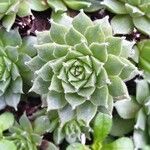
Sempervivum montanum
Mountain Houseleek · Mountain house-leek · Ušesnik (SLO)
Description
Source: leafsnapSempervivum montanum, commonly known as mountain houseleek, is a perennial succulent plant belonging to the Crassulaceae family. Native to the mountainous regions of Europe and Asia, it thrives in rocky areas, cliffs, and alpine meadows. The plant features a rosette of fleshy, green leaves with reddish tips. These leaves are covered with fine hairs that protect them from excessive sunlight and water loss. The rosettes can reach up to 10 cm in diameter. During the summer months, Sempervivum montanum produces small pink or white flowers on tall stems, attracting bees and other pollinators. This plant is easy to grow and requires minimal care. It prefers well-draining soil with moderate moisture but can tolerate drought conditions once established. It thrives in full sun or partial shade. Sempervivum montanum has several medicinal properties, including anti-inflammatory, antiseptic, and diuretic effects, making it useful for treating various ailments such as wound healing, skin infections, and urinary tract infections. Overall, Sempervivum montanum is an attractive addition to any garden or rockery due to its unique appearance, which makes it stand out from other plants.
🌳 Common houseleek has been used as a bioindicator to show the presence of heavy metals in the soil. Its uptake and accumulation of certain metals can indicate soil health. Additionally, because of its thick, fleshy leaves, it offers a water-efficient landscaping option and thus helps anti-pollution efforts by reducing urban heat islands.
🎭 Security, prosperity
Care Guide
💧 Water Every 7 days
Native to rocky environments, the mountain house-leek excels in dry conditions with little moisture, needing water only every three weeks. This cold-resistant alpine succulent prefers well-draining soil to prevent root rot, underscoring its high drought tolerance and the importance of managing moisture carefully.
What should I do if I give my Mountain house-leek too much or too little water?
Mountain house-leek and other succulents are resilient when it comes to surviving without water. However, if you forget to water your Mountain house-leek for a month or more, you'll notice signs of thirst and damage. Underwatered plants will appear lacklustre, wrinkled, and some may have dried up completely. The soil will also be completely dried out. To remedy the situation, submerge the pot in water for 5-10 minutes until the soil feels moist on the surface. On the other hand, overwatering can be fatal to your Mountain house-leek. Too much moisture leads to root rot, which prevents the roots from absorbing nutrients and water. The symptoms of overwatering include yellow, swollen, and translucent organs that may burst open. If not treated, the plant can turn brown or black and parts may fall off easily. Check the soil to confirm overwatering as the cause. To save an overwatered plant, remove it from its pot, clean the roots with room-temperature water, and remove any damaged roots. If root rot is severe, it may not be possible to save the plant. However, if some healthy roots remain, there is a chance it can be saved. After removing unhealthy roots, dip the remaining ones in a fungicide and repot in fresh, well-draining soil. In most cases, the plant will recover and start growing again in the next season.
How often do I need to water my Mountain house-leek?
Determining how often to water Mountain house-leek is not set in stone. To find out when to water, simply check the soil and only proceed if it is completely dry. You can either insert your finger or use a moisture meter to assess the moisture level below the surface. If you choose to plant it in a deep pot, a stick or chopstick can work for this. If the soil feels even slightly damp, wait a few days before checking again. While most people typically water Mountain house-leek every two weeks during summer and once a month in winter, the frequency can vary due to several factors. The following section provides some considerations to help determine the suitable watering schedule.
What do I need to think about when watering my Mountain house-leek?
To properly water your Mountain house-leek, you need to consider several environmental factors. The size of the container and the type of soil will determine how often and how much water you should use. It's important to use a container with good drainage to prevent overwatering. Smaller containers hold less moisture and require more frequent watering, while larger pots stay wet longer and need less frequent watering. Avoid using an oversized pot, as this can lead to overwatering. When repotting, only move to a slightly larger container. Shallow containers work better because Mountain house-leek has shallow root systems. In terms of seasons, Mountain house-leek needs less water in winter when its growth slows down. The cooler winter air reduces evaporation, so the soil stays wet for a longer time compared to the summer. The climate in your area also affects watering needs. If you live in a humid location with ample rain, you will need to water less frequently than in a dry, arid climate. Keep in mind that even within the same geographic location, watering requirements can vary based on the season and indoor heating or air conditioning. If you plant Mountain house-leek in the ground, it generally doesn't need additional watering, relying on natural precipitation and dew. However, during prolonged dry periods, occasional watering may be necessary. In areas where it can only be grown in a container, you can move the plant outside during the appropriate seasons and bring it indoors when temperatures drop. Outdoor potted Mountain house-leek typically requires more water due to increased sun exposure, even on a shaded porch.
How should I water Mountain house-leek?
To water Mountain house-leek effectively, start by thoroughly soaking it and then allowing it to dry out before watering again. This plant can tolerate drought, so it's best to let it become quite dry before watering. When watering, ensure that the soil throughout the entire pot is soaked by pouring water around the rim of the planter. The amount of water needed depends on the container size and soil absorption. After watering, let the drained water sit in the saucer for 20-30 minutes to absorb into dry soil pockets, then discard any excess to prevent waterlogging. Bottom-watering is also recommended for Mountain house-leek, where the pot is placed in a saucer of water and the soil absorbs moisture through the drainage holes. This method ensures thorough moistening of the soil, although it takes more time than top-watering. Mimicking the plant's natural habitat, bottom-water when the soil is completely dry. Deep soil bathing is preferable to frequent light watering for Mountain house-leek.
☀️ Light Full sun
The typical houseleek flourishes ideally in circumstances where it is subjected to plenty of daylight every day, similar to the environmental conditions of its original habitat. Throughout different developmental phases, constant sunlight promotes its robust growth. While it can tolerate some degree of sun filtering, inadequate light can impede its progress. On the other hand, too much exposure to sunlight can be harmful.
How much sunlight does the Mountain house-leek plant need to grow?
Mountain house-leek thrives in sunlight and should ideally receive at least 6 hours of sun daily, although more is preferable. The exact minimum hours required may differ based on factors like sunlight intensity and the environment. However, it is uncommon for the Mountain house-leek to receive an excessive amount of sunlight, and they can tolerate up to 14 hours of sun per day without any issues.
What kind of sunlight does Mountain house-leek require?
Mountain house-leek is a sun-loving plant that requires plenty of bright sunlight to thrive. It can do well in both direct light and bright indirect sun. While certain varieties may tolerate partial sun, it is typically best to provide them with more sunlight for optimal growth.
Should I make sure Mountain house-leek doesn't get too much sun?
Mountain house-leek typically grows in extremely hot and sunny areas and has evolved to thrive in such conditions. As a result, it doesn't require any protection from the sun. However, it's important to be cautious when transferring your Mountain house-leek to a highly sunny location if it isn't accustomed to it. Plants need time to adjust to new environments, so it's recommended to initially expose the plant to sunlight for a few hours each day, gradually increasing the duration. Once the Mountain house-leek adapts, it should be able to tolerate full sun without any additional safeguards.
What happens if Mountain house-leek doesn't get enough sunlight?
When Mountain house-leek doesn't get enough sunlight, it can't grow well. Signs of not enough sunlight include pale coloring, wilting leaves, and leaf drop. Mountain house-leek may also become etiolated or leggy, which means it will stretch towards the light source, making it look sparse and with weak stems.
What will happen if Mountain house-leek gets too much sunlight?
Mountain house-leek can change colors to protect itself from excessive sunlight, such as turning red, pink, or orange. To encourage this change, some people purposely expose these plants to mild sun stress during the summer. Don't worry, this is not harmful, and as the light levels decrease from autumn to spring, the plants will return to their normal coloring. However, if Mountain house-leek is suddenly exposed to direct sun, it can get sunburned. This will appear as white or brown spots on the leaves that have received the most sun. If this happens, it's best to move the plant to a shadier spot and water it if necessary. You can also remove the damaged leaves, as new ones will grow back over time.
🌡️ Temperature 0–35°C
The common houseleek, originally from the mountainous areas of Southern Europe, can withstand temperatures down to 0℉ (-18℃). Nevertheless, it thrives best in temperatures between 60 and 95℉ (15 to 35℃). In the hotter periods, it can be placed outside to enjoy direct sunlight. Conversely, during colder seasons, it needs to be housed indoors where temperatures do not drop under 45℉ (7℃).
What are the essential care instructions for Mountain house-leek?
Mountain house-leek, botanically known as Sempervivum montanum, is a plant that thrives in warm environments. It requires higher temperatures during the growing season to facilitate growth and metabolism, benefits from plenty of sunlight, appropriate moisture levels, and good ventilation. It's vital to maintain a balance, avoiding excessively low temperatures that can cause damage and overwatering which could lead to root issues. The plant enters a dormant state during the winter and prefers being moved indoors if outdoor temperatures drop below 5°C, ideally placed near a south-facing window to maximize sunlight exposure. Supplemental lighting may be used if natural light is insufficient. When temperatures are below 20°C, its growth slows, necessitating reduced watering to avoid root rot. Outdoor plants should not be watered during cold weather, and utilizing a temporary greenhouse or wrapping the plant for insulation can be beneficial in maintaining an appropriate climate.
What should I do if my Mountain house-leek is exposed to low temperatures?
Mountain house-leek is not tolerant of low temperatures and thrives best above 20°C. In winters, it's crucial to keep it above 5°C to prevent damage. Exposure to temperatures below 1°C may cause the plant to become weak, wilt, and potentially lead to root rot. In the event of mild frost damage, which might not show immediate symptoms, the plant may begin to wither after a week. To address this, trim off the frostbitten areas and inspect the roots for rot. Rotted roots should be removed, and the plant can be propagated through cuttings if necessary. Relocate the plant to a warm indoor environment near a south-facing window for ample sunlight. If light is insufficient, supplemental lighting is recommended.
How do I protect my Mountain house-leek from high temperatures?
During the warmer summer months, it's essential to keep Mountain house-leek below 41°C to prevent stunting growth, wilting, water loss, and susceptibility to sunburn. Should the temperature exceed 45°C, remove any sunburnt or rotten parts and shield the plant from the harsh afternoon sunlight until it shows signs of recovery and resumes growth. In cases where root rot has occurred, halt watering until new roots develop. This care prevents the plant from suffering further damage and aids in its recovery from high temperature exposure.
💨 Humidity
🪴 Soil 6-7
🌱 Fertilizer
A light application of fertilizer 1-2 times yearly during its growth period is ample for the Common houseleek. Refrain from fertilizing during the winter and summer seasons when it is in a dormant state. For plants that have been repotted, lessen the amount of fertilizer used and wait a few months post-repotting before applying any. Regular fertilization contributes to robust growth and promotes blossoming.
Why should I put fertilizer on my Mountain house-leek?
By fertilizing Mountain house-leek, nutrients are added to the growing medium. Even though it already stores water and nutrients, applying plant food during the growing season helps promote healthy growth. Additionally, fertilizing can stimulate mature specimens to produce blooms in the growing season.
When should I fertilize my Mountain house-leek?
Mountain house-leek only requires a small amount of fertilizer during the growing season. It is recommended to fertilize it 1-2 times a year, typically in the spring and autumn. Avoid fertilizing it during the winter and summer when it is dormant. If you have recently repotted your plant, use less fertilizer and wait a few months before beginning to fertilize it again.
When is it not a good time to add fertilizer to my Mountain house-leek plant?
Mountain house-leek, like most plants, goes through a dormancy period. During this time, which occurs in the summer and winter, the plant stops growing and it is recommended to stop applying fertilizer. Additionally, it is advisable to refrain from fertilizing for the initial few months after repotting in the spring.
What kind of fertilizer does my Mountain house-leek plant need?
To fertilize Mountain house-leek, it is recommended to use a liquid plant food designed for succulents and cacti. Dilute the fertilizer with water to half-strength to prevent accumulation in the soil. Apply the fertilizer to the base of the plant and water it generously, making sure any excess moisture drains away.
How do I make sure my Mountain house-leek plant gets enough fertilizer?
When fertilizing Mountain house-leek, liquid plant food is a simpler option, although using granules is also possible. Just follow the directions on the packaging and remember to dilute liquid fertilizers to half-strength. Regardless of the type of plant food you choose, always apply it to the soil. Afterward, cover the granules with a thin layer of soil and water the plant.
🪴 Pot & Repot Every 2 years
Choose a container slightly bigger than the current one, with excellent drainage, for repotting the Common houseleek. Utilize a gritty succulent or cactus mix that provides good drainage. Gently take out the plant from its previous pot, clear away extra soil, and replant it at the same level. To let any root injuries recover, delay watering it for a few days. Repot it during the spring or autumn, and place it in a well-lit location.
✂️ Pruning
To keep your mountain house-leek in good shape, you should prune it in the spring and autumn. During pruning, remove any unnecessary or crowded branches. For propagation, cut strong stems that have 5-6 leaves. Treat the cut areas with sulfur powder, and when you plant the cuttings, lightly moisten the soil using a watering can.
🌿 Propagating
🐛 Diseases & pets
☠️ Toxicity
Characteristics
- Plant Type
- Succulent, Herb
- Life Cycle
- Perennial
- Genus
- Sempervivum
- Family
- Crassulaceae
- Hardiness Zone
- 3-9
- Mature Height
- 15 cm to 49 cm
- Mature Spread
- 6 cm to 30 cm
- Leaf Color
- Green, Red, Blue, Purple, Yellow, Gray
- Leaf Type
- Evergreen
- Flower Color
- Purple, Pink, Red, Yellow
- Flower Size
- 5.08 cm to 6.35 cm
- Bloom Time
- Early summer, Mid summer
- Planting Time
- Spring, Autumn
- Harvest Time
- Mid summer