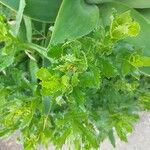
Senecio glastifolius
Woad-leaved Ragwort · Holly-leaf senecio · Woad-leaf ragwort · Holly-leaved Groundsel · Holly-leaved Senecio
Description
Source: leafsnapSenecio glastifolius, commonly known as Cape ivy or wild cineraria, is a perennial plant species in the Asteraceae family. Native to South Africa, it thrives in diverse habitats such as forests, grasslands, and rocky areas. The plant exhibits a sprawling growth habit with stems that can extend up to 2 meters in length. Its glossy green leaves are distinctively triangular with serrated edges. The flowers are small, yellow, and cluster at the ends of the stems. Senecio glastifolius is easy to cultivate and requires minimal care once established. It prefers well-draining soil and partial shade but can also tolerate full sun if provided with adequate moisture. Indigenous people have used the plant for medicinal purposes for centuries, particularly for its anti-inflammatory properties. However, some parts of Senecio glastifolius contain toxic compounds that may cause skin irritation or allergic reactions if ingested. Overall, Senecio glastifolius is an attractive ornamental species, ideal for use as ground cover or for trailing over walls or fences. It thrives best in gardens or landscapes with mild climatic conditions and moderate rainfall throughout the year.
Care Guide
💧 Water Every 7 days
☀️ Light Full sun
Pink ragwort is a sun-loving, perennial herbaceous plant that originates from open habitats and is often found thriving in meadows and grasslands. It prefers full sun but can also tolerate partial sun conditions.
What are the sunlight requirements for Pink ragwort (Senecio glastifolius)?
Pink ragwort (Senecio glastifolius) thrives in various sunlight conditions. It requires full sun, which means the plant should receive above 6 hours of sunlight daily, to flourish. Alternatively, it can grow in partial sun, receiving about 3-6 hours of sunlight. Observing how sunlight moves through your garden will help you determine the best spots for planting, ensuring that your Pink ragwort gets the perfect balance of light and shade it needs to be happy.
🌡️ Temperature 15–37.8°C
Pink ragwort can adapt to a wide range of temperatures, but its distribution may still be restricted by different combinations of moisture and heat. It grows best in warm summer climates with sufficient rainfall or watering. Extended periods of cloudy, rainy weather, as well as prolonged high temperatures, can increase the likelihood of Pink ragwort dying. In winter, adequate protection from cold can improve the plant's survival rate.
💨 Humidity
🪴 Soil 6-8
🌱 Fertilizer
The best time to fertilize a Pink ragwort is in early spring, when it is coming out of dormancy and beginning active growth. Fertilizing supplies essential nutrients for healthy development. Although Pink ragwort has fairly low fertilizer requirements, applying fertilizer annually can improve its survival and encourage stronger, longer-lasting blooms.
🪴 Pot & Repot
✂️ Pruning
The pink ragwort is a fast-growing flowering plant admired for its bright pink blooms. To encourage growth and flowering, prune the plant in early spring. This not only helps to shape the plant by removing damaged stems but also improves air circulation. Additionally, managing its height and bushiness enhances its ornamental appeal.
🌿 Propagating
🐛 Diseases & pets
☠️ Toxicity
Characteristics
- Plant Type
- Herb
- Life Cycle
- Perennial
- Genus
- Senecio
- Family
- Asteraceae
- Hardiness Zone
- 8-11
- Mature Height
- 0.61 m to 1.22 m
- Mature Spread
- 49 cm to 76 cm
- Leaf Color
- Green, Dark Green
- Leaf Type
- Deciduous
- Flower Size
- 3.05 cm to 5.08 cm
- Bloom Time
- Mid spring, Late spring, Early summer
- Planting Time
- Spring, Summer, Autumn
- Harvest Time
- Summer
- Native Area
- South Africa