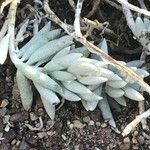
Senecio haworthii
Cocoon plant
Description
Source: leafsnapSenecio haworthii is a succulent plant belonging to the Asteraceae family and is native to South Africa. Commonly known as woolly senecio or cocoon plant due to its fuzzy appearance, it has a compact, rounded shape and can grow up to 30 cm in height. The plant's leaves are covered in white hairs, giving them a woolly texture, and they are arranged in rosettes at the base of the stem. During the summer months, Senecio haworthii produces small, yellow flowers that appear on long stalks rising above the foliage. The plant prefers well-draining soil and moderate watering during its growing season, although it can tolerate periods of drought. Senecio haworthii is an excellent choice for both indoor and outdoor gardening due to its low maintenance requirements and unique appearance. It can be easily propagated from stem cuttings or by dividing offsets from mature plants. Although Senecio haworthii has no known medicinal uses, indigenous people have traditionally utilized it for various purposes, such as making ropes from its fibrous stems or using it as an ornamental houseplant due to its attractive appearance. Overall, Senecio haworthii is an intriguing succulent with unique features that make it a standout addition to any garden setting.
🎭 Best of luck
Care Guide
💧 Water Every 7 days
The woolly senecio, native to arid regions, is highly drought-tolerant and needs watering only every 2 to 3 weeks. This plant thrives in well-draining soil, efficiently retaining water. As a result, overwatering is a common mistake for those who admire its unique foliage.
☀️ Light Full sun
The woolly senecio flourishes in its natural habitat where there is an ample supply of sunlight. It prefers situations where it consistently receives a significant amount of sunlight throughout the day. This brightness contributes to its robust growth. However, if the sunshine surpasses its ability to soak up, it could negatively impact its vitality.
What are the sunlight requirements for Woolly Senecio?
Woolly Senecio, or Senecio haworthii, thrives in full sun conditions, which means it requires more than 6 hours of sunlight daily to maintain its health and vigor. It can also adapt to partial sun, defined as about 3-6 hours of sunlight per day. Observing how sunlight moves through your garden is crucial for finding the perfect spots that offer a balance of light and shade, ensuring your plants' happiness. In its native environment, Woolly Senecio flourishes with abundant sunlight, promoting substantial growth. However, excessive sun exposure beyond its absorbing capacity may impede its growth.
How can artificial lighting be used for Woolly Senecio indoors?
When natural sunlight is insufficient, especially during winter or in areas with less sunlight, artificial lighting becomes essential for optimal growth of Woolly Senecio indoors. LED lights are recommended due to their ability to provide specific wavelengths needed by the plants. For full sun plants like Woolly Senecio, 30-50W/sq ft of artificial light is needed, while partial sun plants require 20-30W/sq ft. The ideal distance for artificial lights is 12-36 inches above the plant to mimic natural sun conditions, and the plants generally need 8-12 hours of light per day.
What are the symptoms of insufficient light in Woolly Senecio?
Woolly Senecio may show several symptoms when exposed to inadequate light levels, including smaller new leaves, leggy or sparse growth, faster leaf drop, slower or no new growth, and lighter-colored new leaves indicating a lack of chlorophyll. Additionally, excessive sunlight can cause chlorosis (leaves turning yellow), sunscald (damage from intense light), leaf curling (a defense mechanism to minimize water loss), wilting (loss of turgor pressure), and leaf scorching (brown, dry patches due to excessive light), adversely affecting the plant's health.
How can light-related issues be addressed for Woolly Senecio?
To address light-related issues in Woolly Senecio, a gradual increase in light exposure is recommended. For indoor plants, moving them to a sunnier spot progressively each week until they receive at least 6 hours of direct sunlight daily is beneficial. Utilizing a south-facing window or artificial light sources, such as desk, ceiling lamps, or professional grow lights for at least 8 hours daily, can help. Outdoors, it's important to find the best sunlight spot and adjust the plant's position gradually. Pruning obstructing trees or transplanting to sunnier locations can also aid the growth of the plant. However, parts of the plant damaged by insufficient light might not recover, but new growth will be healthy following these adjustments.
🌡️ Temperature 20–37.8°C
The Woolly senecio originates from regions where the temperature fluctuates within the bounds of 68 to 100.4 °F (20 to 38 ℃), which suggests its preferred temperature range. For optimal growth, it's essential to adjust the conditions suitably, depending on the time of year, to reflect this temperature range.
What is the native temperature range for Woolly Senecio?
Woolly senecio, known botanically as Senecio haworthii, thrives in a native environment where the temperature remains between 68 to 100.4 °F (20 to 38 °C). This range indicates the plant's temperature preference, underlining its love for heat. To ensure optimal growth, it's important to adjust the surrounding temperature according to the season to simulate this native range. During winter, as Woolly senecio enters a dormant state and growth slows, steps should be taken to protect the plant from colder temperatures by moving it indoors, especially when outdoor temperatures drop below 0°C. A south-facing window is ideal for providing the necessary sunlight, and if the natural light isn't sufficient, supplemental lighting can be considered. Additionally, when temperatures fall below 20°C, the growth of Woolly senecio slows, necessitating reduced watering to prevent root rot. Outdoor plants require watering to be completely halted in low temperatures. If possible, creating a temporary greenhouse or using materials like plastic film or fabric for insulation could offer more protection against the cold.
What are the symptoms and solutions for Woolly Senecio in low temperatures?
In low temperatures, Woolly senecio becomes vulnerable as it is not tolerant of the cold, thriving best above 20°C. During winter, keeping the temperature above 0°C is crucial to avoid frost damage which can lead to the plant becoming weak, wilting, and being prone to root rot. If temperatures fall below -5°C, there may not be immediate signs, but after a week, the plant could gradually wither. To manage mild frost damage, the frostbitten parts should be trimmed off, and the plant should be inspected for root rot. If found, the rotten roots need to be cut off, and the plant can undergo propagation through cuttings. Moving the plant immediately indoors to a warm environment and placing it near a south-facing window ensures ample sunlight. Supplemental lighting may be employed if natural light is insufficient.
How should Woolly Senecio be cared for in high temperatures?
During the summer, Woolly senecio's temperature should be kept below 38°C to avoid stress from excessive heat. Temperatures exceeding 43°C halt its growth and lead to water loss, wilting, and an increased risk of sunburn. In such cases, the sunburned and rotten parts of the plant need to be removed. It's also important to protect the plant from the harsh afternoon sunlight until it shows signs of recovery and begins to grow again. If the plant suffers from root rot due to overwatering or high moisture levels, water intake should be stopped until new roots develop, indicating recovery.
💨 Humidity dry (<40%)
This plant prefers dry conditions, so don't mist it. However, watering it less often can also thrive in higher humidity.
🪴 Soil 6-7
🌱 Fertilizer
For the Woolly senecio, administering mild amounts of fertilizer 1-2 instances annually during its growth period is adequate. Refrain from fertilizing in the dormant phases of winter and summer. Lower the fertilizer amount for plants that have been repotted and allow a few months to pass after repotting prior to fertilizing. Fertilization promotes robust growth and facilitates flower development.
🪴 Pot & Repot Every 2 years
While repotting a Woolly senecio, choose a pot that's slightly bigger than the current one and has excellent drainage. Ensure to use a gritty succulent or cactus mix that drains well. Gently take the plant out from its previous pot, clean off any surplus soil, and place it in the new pot at the same level it was previously. Allow few days before watering the plant to let any injuries to the roots recover. It's best to repot during the spring or fall and keep the plant in an area with plenty of light.
✂️ Pruning
Senecio plants need little care. They may, however, become floppy, particularly the tall types. Pruning should be done in the early spring. Trim the stem to where it is solid. Keep the stem cuttings to root and grow new house plants.
🌿 Propagating
🐛 Diseases & pets
☠️ Toxicity
Characteristics
- Plant Type
- Succulent
- Life Cycle
- Perennial
- Genus
- Senecio
- Family
- Compositae
- Hardiness Zone
- 9-11
- Mature Height
- 30 cm
- Mature Spread
- 30 cm
- Leaf Color
- Silver, Green, White
- Leaf Type
- Evergreen
- Flower Color
- Yellow
- Flower Size
- 2.03 cm to 3.05 cm
- Bloom Time
- Summer, Early fall
- Planting Time
- Spring
- Harvest Time
- Late summer, Fall