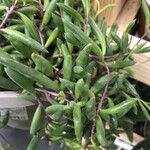
Senecio herreianus
String of bananas · String of Pearls · String of Raindrops · String of beans · Hridaya haaram (హృదయ హారం)
Description
Source: leafsnapSenecio herreianus, commonly known as String of Beads or String of Pearls, is a succulent plant native to South Africa. This trailing plant can grow up to 3 feet long and features small, round leaves that resemble beads or pearls. The green leaves often exhibit a slight bluish tint. During the summer months, the plant produces small white flowers. Senecio herreianus is an easy-to-care-for houseplant, thriving in bright but indirect light and well-draining soil. It should be watered sparingly and regularly during the growing season, with the soil allowed to dry out between waterings. The String of Beads plant can be propagated through stem cuttings, which should be allowed to callus over before being planted in soil or water. This unique succulent, with its trailing habit and interesting bead-like foliage, makes an excellent addition to any indoor garden or hanging basket display.
Care Guide
💧 Water Every 7 days
The string of watermelons is a drought-tolerant succulent that efficiently stores water, allowing it to thrive in arid conditions. It prefers dry environments and should be watered once a week. To ensure its optimal health, it needs well-draining soil, making it an ideal indoor plant with minimal water requirements.
☀️ Light Partial sun
Watermelon vines spring from habitats that have mottled sunlight, like the lower layers of forests or stony regions, which provide inherent shade. These vines favor semi-sunlit locations but have the ability to endure intense sunlight as well.
🌡️ Temperature 20–37.8°C
Watermelon vines flourish in hot climates and need warm weather during the cultivation period for growth and metabolic enhancement. They thrive under abundant sunlight, appropriate humidity, and adequate air circulation. Yet, they are vulnerable to harm from too cold temperatures and over-irrigation. It's crucial to maintain a balance and steer clear of extremely hot temperatures and too dry conditions too.
💨 Humidity
🪴 Soil 6-7
🌱 Fertilizer
For watermelon strands, minor applications of fertilizer 1-2 times per annum during the growth period are enough. Refrain from fertilizing during winter and summer as this is when it becomes dormant. Minimize the usage of fertilizer for freshly repotted plants, and delay fertilization for a few months post-repoting. The use of fertilizer promotes vigorous growth and invites flowering.
🪴 Pot & Repot Every 2 years
While replanting string of watermelons, choose a pot that's a bit bigger than the current one and has proper drainage. Utilize a gritty succulent or cactus mix that provides good drainage. Delicately take the plant out from its previous pot, clear away surplus soil, and plant it back at an equivalent depth. Let a few days pass before watering it to enable the recovery of any potential root harm. Do the repotting during spring or autumn and place it in an area that gets plenty of light.
✂️ Pruning
Trimming is occasionally necessary for String of Teardrops care to increase air circulation around the foliage, which lowers humidity buildup around the middle leaf layer of the String plant. Over-trimming can harm string plants, while under-trimming will result in a string plant growing too tall for its pot and toppling over in a matter of months.
🌿 Propagating
🐛 Diseases & pets
☠️ Toxicity
String of Tears, is a mildly toxic plant for humans and the majority of animals. Keep it away from dogs, cats, rabbits, and horses as well because it can be poisonous to them. Eating a portion of the plant in humans can result in mild gastrointestinal symptoms including nausea and vomiting.
Characteristics
- Plant Type
- Succulent
- Life Cycle
- Perennial
- Genus
- Senecio
- Family
- Compositae
- Hardiness Zone
- 9-11
- Mature Height
- 10 cm to 30 cm
- Mature Spread
- 30 cm to 61 cm
- Leaf Color
- Medium Sea Green, Dark Green
- Leaf Type
- Evergreen
- Flower Size
- 1.02 cm to 1.52 cm
- Bloom Time
- All year round
- Planting Time
- Spring, Summer
- Harvest Time
- All year round
- Native Area
- Namibia and Northwestern South Africa